
 Aforika
 Asia
Asia Yuropa
 Amerika Borwa
 Australia le Oceania
 Antarctica
 Lewatle la Pacific
 Lewatle la Atlantic
 Lewatle la India
 Lewatle la Arctic
 Lewatle la Mediterranean
 Lewatle le Lehibidu
 Lewatle la Caribbean
 Lewatle la Coral
 Lewatle la China Borwa
 Lewatle la Philippines
 Lewatle la Andaman
 Lewatle la Bokone
 Lewatle la Timor le la Arafura
 Kou ya Bengal
 Gulf ya California
Blue-lipped sea krait
 Go loma
The blue-lipped sea krait is a venomous sea snake. It lives in the Indian and Western Pacific Oceans, and it comes onto land to rest, shed its skin, mate and lay eggs. It is one of the most widespread sea kraits in the region.1
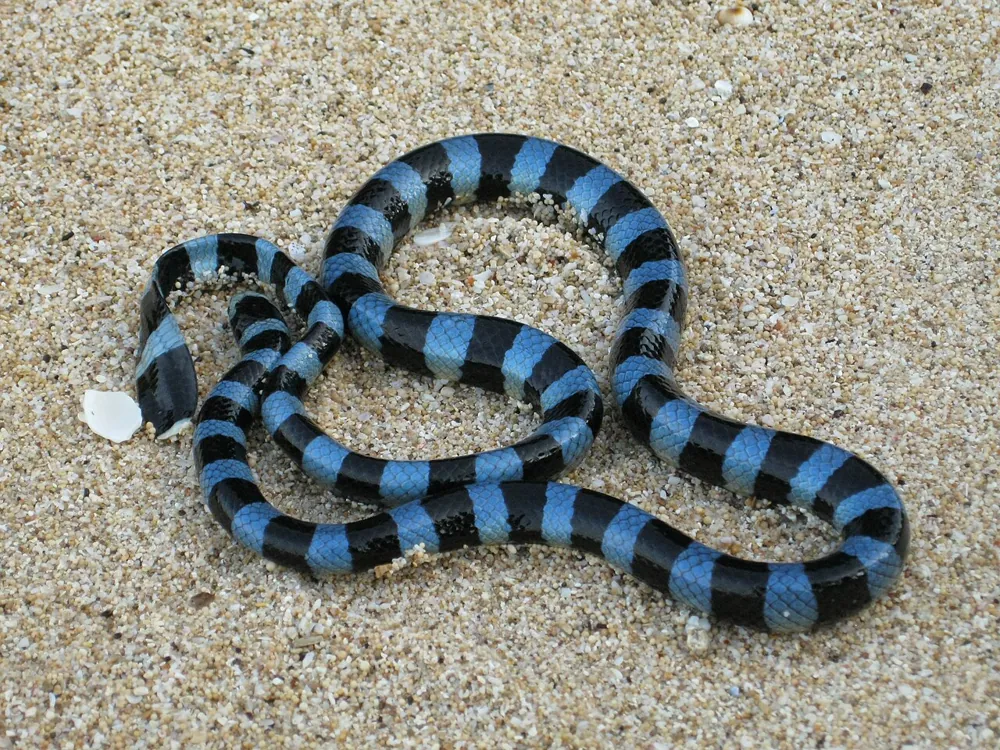
 Tsela ya go e lemoga
- The upper lip is dark brown.1
- There are 19 rows of scales at the middle of the body.1
- The large belly scales are one-third to more than one-half the width of the body.1
- Males grow to about 91 cm in total length, and females to about 107 cm.1
- The tail is about 11 cm long.1
Gantsi e tlhakanngwa le: It is often confused with other Laticauda sea kraits. The 19 rows of body scales and the dark brown upper lip can be used to tell it apart from them.1
Maatla a botlhole
Botlhole bo tswa ka meno a yone fa e loma.
E kotsi go le kae go batho?
Kotsi go batho: E kotsi thataE ka bolaya motho yo o sa alafiweng. Fa e loma
- Go gatelela le go sa tshikinyege (pressure immobilisation): bofa bandeiji e e gogegang e e tiileng mo godimo ga fa go lomilweng mme o tswelele o bofe setho sotlhe go ya kwa godimo, se tshegetse ka sepilinti (splint), mme o dire gore motho a nne a sa tshikinyege gotlhelele go fitlha thuso e goroga.
- Ntsha motho mo metsing mme o mo ise bookelong ka bonako.
Ka gale leletsa nomoro ya gago ya tshoganyetso pele (112, 000, 911). Se ke kaelo e e akaretsang ya thuso ya ntlha, ga se kgakololo ya bongaka. Motheo wa thuso ya ntlha
 Nna o babalesegile
- O se ka wa ama, wa tshwara kgotsa wa tshwenya phologolo ya naga, le fa e le e nnye, le fa e lebega e robetse kgotsa e sule.
- E fe sebaka. Fa o kopana le yone, ritibala, boela morago ka bonya mme o e tlogele e tsamaye ka tsela ya yone.
- Fa e nngwe e go loma: ritibala, o se ka wa tshikinyega, leletsa nomoro ya gago ya tshoganyetso (112, 000, 911) kgotsa o ye bookelong ka bonako. Gopola gore e ne e lebega jang, setshwantsho se a thusa.
Ga e go batle. E dirisa botlhole jwa yone go tshwara dijo kgotsa go itshireletsa, mme e rata go iphitlha go feta. Go le gontsi ka go nna o babalesegile
Kae mo lefatsheng?
E kgolo go le kae?
E telele go le kae?
 boleele jo bo lekanang le dikatse tsa ntlo di le 2 go tloga kwa nkong go ya mogatleng
 boleele jo bo lekanang le dipanana di le 6 di latelana
 e ka thuma boleele jwa bodiba jo bogolo jwa go thuma (50 m) ka metsotswana e le 45
Blue-lipped sea krait e kgolo go le kae fa e bapisiwa le WENA?
Ke dipalo fela mo sefetleng sa gago (browser). Ga go sepe se se bolokwang kgotsa se se romelwang gope.
E bonako go le kae?
Dintlha
This snake is known to warm up in the burrows of wedge-tailed shearwater seabirds.1
A single animal was found in Devonport, New Zealand, in 2011 and again in January 2025, far outside its usual range. It died shortly after being taken to Kelly Tarlton's Sea Life Aquarium.1
Moving between water and land exposes it to rapid temperature changes, so it often seeks shade from direct sunlight.1
Ya baitseanape ba botlhole
- Leina la saense
- Laticauda laticaudata
- Setlhopha
- Dinoga tsa lewatle
- Lelapa
- Elapidae2
- Lekoko
- Squamata
- Dikontinente
- Lewatle la Pacific, Lewatle la Philippines, Lewatle la Coral, Lewatle la China Borwa, Lewatle la Timor le la Arafura, Kou ya Bengal, Mawatle
- Masea
- Lays eggs on land.1
- Kotsi go batho
- 4 / 5: E kotsi thata3
Kwa dintlha di tswang teng
- Blue-lipped sea krait (Wikipedia (CC BY-SA 4.0))
- Laticauda laticaudata (iNaturalist): maina le thulaganyo ya mefuta.
- Venom Wiki: seelo sa kotsi, bogolo jo bo tlwaelegileng le kakanyo ya lebelo ke tsa rona. Bona kafa re di balang ka teng: Kafa re lekanyang kotsi ka teng.
Ntlha nngwe le nngwe mo tsebeng e e na le nomoro e e supang motswedi wa yone. Fa re dirile phoso, maitshwarelo, re barati ba diphologolo, e seng kgatiso ya saense. Re bolelele kwa [email protected] mme re tla e baakanya.
 Phepheng e tshwerwe ke tlala! Venom Wiki ke porojeke ya motho a le mongwe: ke mahala, ga e na dipapatso le ditraka. Mpho e nnye e thusa go e tshegetsa mo inthaneteng.Fepa phepheng
Tse dingwe tsa setlhopha se se tshwanang: Dinoga tsa lewatle
 Beaked sea snake
 Belcher's sea snake
 Black-banded sea krait
 Dubois' sea snake
 Olive sea snake
 Yellow-lipped sea krait
E tshela gape kwa: Lewatle la Pacific
 Australian box jellyfishDijelifishi le dibopiwa tsa lewatle tse di tlhabangE a bolayaO se ka wa ama
 Geography coneDikgopa tsa khouno le diokotopaseE a bolaya
 Greater blue-ringed octopusDikgopa tsa khouno le diokotopaseE a bolaya
 Japanese pufferfishDiphologolo tse dingwe tse di botlhole go di ama kgotsa go di jaE a bolaya
 Southern blue-ringed octopusDikgopa tsa khouno le diokotopaseE a bolaya
 Hawksbill sea turtleDiphologolo tse dingwe tse di botlhole go di ama kgotsa go di jaE ka bolaya