
 Aforika
 Asia
Asia Yuropa
 Amerika Borwa
 Australia le Oceania
 Antarctica
 Lewatle la Pacific
 Lewatle la Atlantic
 Lewatle la India
 Lewatle la Arctic
 Lewatle la Mediterranean
 Lewatle le Lehibidu
 Lewatle la Caribbean
 Lewatle la Coral
 Lewatle la China Borwa
 Lewatle la Philippines
 Lewatle la Andaman
 Lewatle la Bokone
 Lewatle la Timor le la Arafura
 Kou ya Bengal
 Gulf ya California
Brazilian wandering spider
 Go loma
The Brazilian wandering spider is a large, hairy spider whose bite is medically significant. It lives in parts of South America, including Brazil, Uruguay, Paraguay and Argentina, and it is often found near homes. Its bite can cause severe pain and dangerous effects on the heart and breathing.1



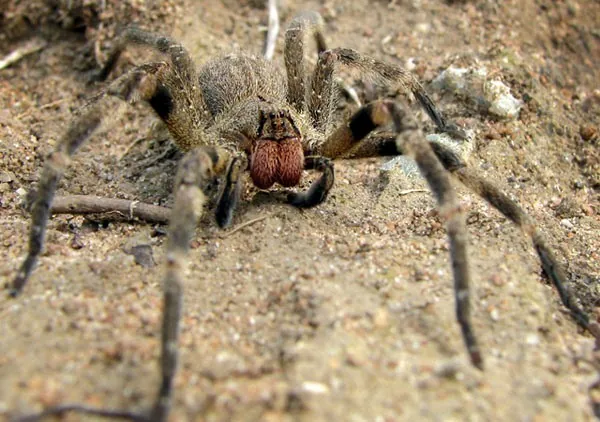
 Tsela ya go e lemoga
Maatla a botlhole
Botlhole bo tswa ka meno a yone fa e loma.
Botlhole jo e bo tsenyang bo dira eng?
The venom contains neurotoxic peptides, which attack the nerves. These act as calcium channel blockers that disrupt how nerve cells send signals. The venom also causes intense pain and inflammation. At deadly concentrations it causes loss of muscle control, breathing problems, paralysis and eventual asphyxiation. Other symptoms reported include priapism, a rapid heartbeat, irregular heartbeat, cardiogenic shock, fluid in the lungs and convulsions.1
E kotsi go le kae go batho?
Kotsi go batho: E kotsi thataE ka bolaya motho yo o sa alafiweng.Its bite can be life-threatening, and several deaths are documented. Between 1925 and 1945, 415 bites by this species were recorded, and 400 of those people needed antivenom. The spider can give a dry bite with no venom, or a bite with only a small dose.1
 Dikgang tse di molemo: dingaka di na le molemo (antivenom) kgotsa kalafi ya se.1
E dira eng fa e tshogile?
When threatened, it raises its first two pairs of legs as a warning.1
 Fa e loma
- In the documented cases, victims were treated in hospital with anaesthetics, tetanus prophylaxis, antivenom and fluid replacement. Recovery could take about 36 hours after a bite.1
- Tlhatswa fa go lomilweng mme o tsenye pakana ya aese mo go gone go fokotsa botlhoko. Batla thuso ya bongaka fa botlhoko bo le bogolo, bo anama kgotsa motho a ikutlwa a sa siama.
Ka gale leletsa nomoro ya gago ya tshoganyetso pele (112, 000, 911). Se ke kaelo e e akaretsang ya thuso ya ntlha, ga se kgakololo ya bongaka. Motheo wa thuso ya ntlha
 Nna o babalesegile
- O se ka wa ama, wa tshwara kgotsa wa tshwenya phologolo ya naga, le fa e le e nnye, le fa e lebega e robetse kgotsa e sule.
- E fe sebaka. Fa o kopana le yone, ritibala, boela morago ka bonya mme o e tlogele e tsamaye ka tsela ya yone.
- Fa e nngwe e go loma: ritibala, o se ka wa tshikinyega, leletsa nomoro ya gago ya tshoganyetso (112, 000, 911) kgotsa o ye bookelong ka bonako. Gopola gore e ne e lebega jang, setshwantsho se a thusa.
Ga e go batle. E dirisa botlhole jwa yone go tshwara dijo kgotsa go itshireletsa, mme e rata go iphitlha go feta. Go le gontsi ka go nna o babalesegile
Kae mo lefatsheng?
E kgolo go le kae?
E telele go le kae?
 khutshwane go feta monwana wa gago o monnye
 e ka taboga dimetara di le 100 ka metsotswana e le 170 (motho yo o bonako go gaisa o tlhoka 9,6)
Brazilian wandering spider e kgolo go le kae fa e bapisiwa le WENA?
Ke dipalo fela mo sefetleng sa gago (browser). Ga go sepe se se bolokwang kgotsa se se romelwang gope.
E bonako go le kae?


Dintlha
A venom component called Tx2-6 is being studied for use in treatments for erectile dysfunction.1
Humans may be about ten times more sensitive to the venom than mice.1
Females may attack males after mating.1
Males perform a dance to attract females, and males may fight each other during courtship.1
Females can store sperm in a separate chamber until they are ready to fertilise their eggs.1
The average venom yield is 1.25 mg, and 0.4 mg in winter.1
Kwa dintlha di tswang teng
- Phoneutria nigriventer (Wikipedia (CC BY-SA 4.0))
- Phoneutria nigriventer (iNaturalist): maina le thulaganyo ya mefuta.
- Venom Wiki: seelo sa kotsi, bogolo jo bo tlwaelegileng le kakanyo ya lebelo ke tsa rona. Bona kafa re di balang ka teng: Kafa re lekanyang kotsi ka teng.
Ntlha nngwe le nngwe mo tsebeng e e na le nomoro e e supang motswedi wa yone. Fa re dirile phoso, maitshwarelo, re barati ba diphologolo, e seng kgatiso ya saense. Re bolelele kwa [email protected] mme re tla e baakanya.
 Phepheng e tshwerwe ke tlala! Venom Wiki ke porojeke ya motho a le mongwe: ke mahala, ga e na dipapatso le ditraka. Mpho e nnye e thusa go e tshegetsa mo inthaneteng.Fepa phepheng
Tse dingwe tsa setlhopha se se tshwanang: Digokgo
 Amazon wandering spider
 Chilean recluse
 Golden silk orb-weaver
 Keyserling's wandering spider
 Argentine black widow
 Bahia wandering spider
E tshela gape kwa: Amerika Borwa
 Golden poison frogDigwagwa tsa botlhole, digwagwa tse dingwe le dinewtE a bolayaO se ka wa ama
 TerciopeloDivaepara tsa mesima (pit vipers)E a bolaya
 Eyelash viperDivaepara tsa mesima (pit vipers)E ka bolaya
 Golden lanceheadDivaepara tsa mesima (pit vipers)E ka bolaya
 South American bushmasterDivaepara tsa mesima (pit vipers)E ka bolaya
 Cane toadDigwagwa tsa botlhole, digwagwa tse dingwe le dinewtE tlhoka ngakaO se ka wa ama