
 Aforika
 Asia
Asia Yuropa
 Amerika Borwa
 Australia le Oceania
 Antarctica
 Lewatle la Pacific
 Lewatle la Atlantic
 Lewatle la India
 Lewatle la Arctic
 Lewatle la Mediterranean
 Lewatle le Lehibidu
 Lewatle la Caribbean
 Lewatle la Coral
 Lewatle la China Borwa
 Lewatle la Philippines
 Lewatle la Andaman
 Lewatle la Bokone
 Lewatle la Timor le la Arafura
 Kou ya Bengal
 Gulf ya California
Golden poison frog
 Botlhole mo letlalong la yoneE ja: DikhukhwaneE botlhole go e ama kgotsa go e ja, ga e tsenye botlhole
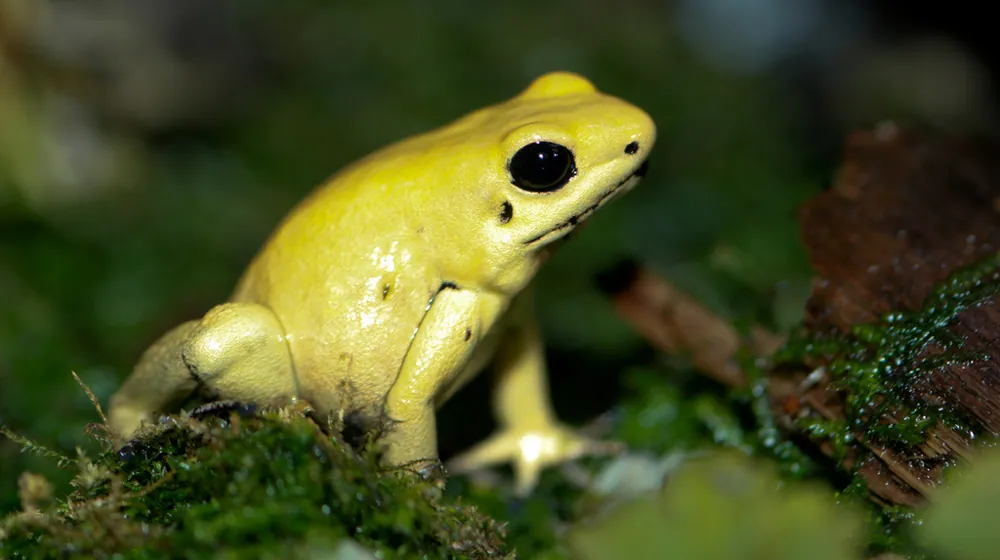
The golden poison frog is a small, bright frog from the rainforests of Colombia. It is considered the most poisonous animal species on Earth, even though it is small. Its bright colours warn predators to stay away.1


 Tsela ya go e lemoga
- Adults are brightly coloured, in yellow, mint green, orange or golden yellow forms.1
- Juveniles are mostly black with two golden-yellow stripes along their backs.1
- Juveniles become fully coloured at about 18 weeks of age.1
- It is the largest species in the poison dart frog family.1
- Females are typically larger than males.1
Maatla a botlhole
Letlalo la yone le botlhole. Go kotsi go e ama, go e latswa kgotsa go e ja.
Botlhole jwa yone (jwa go e ama kgotsa go e ja) bo dira eng?
The frog's skin glands produce batrachotoxin, a very strong alkaloid poison. It affects the sodium channels of nerve cells, leaving muscles stuck in a contracted state. This can lead to paralysis, heart fibrillation, heart failure and death.1
E kotsi go le kae go batho?
Kotsi go batho: E a bolayaNngwe ya diphologolo tse di kotsi go gaisa mo lefatsheng.An average wild frog is estimated to carry about one milligram of poison, enough to kill 10 to 20 humans. A predator usually has to try to eat the frog to be poisoned, but contact with the skin is also dangerous. Captive-bred frogs are not toxic.1
E dira eng fa e tshogile?
Its bright colours warn predators of its toxicity, a pattern called aposematic coloration.1
 Fa mongwe a e amile kgotsa a e jele
- Fa mongwe a amile e nngwe: tlhatswa diatla sentle mme o se ka wa ama matlho kgotsa molomo. Fa ngwana kgotsa phologolo ya gae e latswitse kgotsa e jele e nngwe: leletsa senthara ya botlhole kgotsa nomoro ya tshoganyetso.
Ka gale leletsa nomoro ya gago ya tshoganyetso pele (112, 000, 911). Se ke kaelo e e akaretsang ya thuso ya ntlha, ga se kgakololo ya bongaka. Motheo wa thuso ya ntlha
 Nna o babalesegile
- O se ka wa ama, wa tshwara kgotsa wa tshwenya phologolo ya naga, le fa e le e nnye, le fa e lebega e robetse kgotsa e sule.
- E fe sebaka. Fa o kopana le yone, ritibala, boela morago ka bonya mme o e tlogele e tsamaye ka tsela ya yone.
- Fa o e amile kgotsa o e jele: o se ka wa gotlha matlho kgotsa molomo wa gago, tlhatswa diatla mme o batle thuso ya bongaka.
Ga e go batle. Botlhole jwa yone bo teng fela gore sepe se se ka se e je. Go le gontsi ka go nna o babalesegile
Kae mo lefatsheng?
E kgolo go le kae?
E telele go le kae?
E kima go le kae?

 boleele jo bo lekanang le diboloko tsa go aga tsa ditshamekisi di le 2 mo moleng
 e ka taboga dimetara di le 100 ka metsotswana e le 90 (motho yo o bonako go gaisa o tlhoka 9,6)
Golden poison frog e kgolo go le kae fa e bapisiwa le WENA?
Ke dipalo fela mo sefetleng sa gago (browser). Ga go sepe se se bolokwang kgotsa se se romelwang gope.
E bonako go le kae?


Dintlha
Local indigenous peoples, such as the Emberá and Cofán, use the frog's poison on the tips of hunting darts and arrows. The poison stays deadly for two years or longer.1
The frog gets its toxicity from its diet. Frogs fed commercial feeder insects in captivity lose their toxicity over time.1
Scientists think a small beetle from the family Melyridae may be a key prey item that supplies the poison.1
The Leimadophis epinephelus snake has shown resistance to several frog toxins and has been seen eating juvenile frogs without harm.1
The frog's colour varies. The yellow form gives it its common name, but the species also has mint green, orange and orange blackfoot forms.1
Mosenyi wa ditlhamane
Tlhamane: All golden poison frogs are always poisonous.
Nnete: The frog only becomes toxic when it eats the right prey in the wild. Captive-bred frogs raised without their natural food are non-toxic.1
Ya baitseanape ba botlhole
- Leina la saense
- Phyllobates terribilis
- Setlhopha
- Digwagwa tsa botlhole, digwagwa tse dingwe le dinewt
- Lelapa
- Dendrobatidae2
- Lekoko
- Anura
- Dikontinente
- Amerika Borwa
- Masea
- The eggs are laid on the ground, hidden under leaf litter. Tadpoles stick to the mucus on the parent's back, and the parent carries them to water pools in the canopy.1
- Seemo sa yone kwa nageng
- Endangered1
- Kotsi go batho
- 5 / 5: E a bolaya3
Kwa dintlha di tswang teng
- Golden poison frog (Wikipedia (CC BY-SA 4.0))
- Phyllobates terribilis (iNaturalist): maina le thulaganyo ya mefuta.
- Venom Wiki: seelo sa kotsi, bogolo jo bo tlwaelegileng le kakanyo ya lebelo ke tsa rona. Bona kafa re di balang ka teng: Kafa re lekanyang kotsi ka teng.
Ntlha nngwe le nngwe mo tsebeng e e na le nomoro e e supang motswedi wa yone. Fa re dirile phoso, maitshwarelo, re barati ba diphologolo, e seng kgatiso ya saense. Re bolelele kwa [email protected] mme re tla e baakanya.
 Phepheng e tshwerwe ke tlala! Venom Wiki ke porojeke ya motho a le mongwe: ke mahala, ga e na dipapatso le ditraka. Mpho e nnye e thusa go e tshegetsa mo inthaneteng.Fepa phepheng
Tse dingwe tsa setlhopha se se tshwanang: Digwagwa tsa botlhole, digwagwa tse dingwe le dinewt
 Cane toadDigwagwa tsa botlhole, digwagwa tse dingwe le dinewtE tlhoka ngakaO se ka wa ama
 Dyeing poison dart frogDigwagwa tsa botlhole, digwagwa tse dingwe le dinewtE utlwisa botlhoko felaO se ka wa ama
 Black-legged poison frogDigwagwa tsa botlhole, digwagwa tse dingwe le dinewtE ka bolayaO se ka wa ama
 Bruno's casque-headed frogDigwagwa tsa botlhole, digwagwa tse dingwe le dinewtE tlhoka ngakaO se ka wa ama
 Harlequin poison frogDigwagwa tsa botlhole, digwagwa tse dingwe le dinewtE tlhoka ngakaO se ka wa ama
 Giant leaf frogDigwagwa tsa botlhole, digwagwa tse dingwe le dinewtE utlwisa botlhoko felaO se ka wa ama
E tshela gape kwa: Amerika Borwa
 TerciopeloDivaepara tsa mesima (pit vipers)E a bolaya
 Brazilian wandering spiderDigokgoE ka bolaya
 Eyelash viperDivaepara tsa mesima (pit vipers)E ka bolaya
 Golden lanceheadDivaepara tsa mesima (pit vipers)E ka bolaya
 South American bushmasterDivaepara tsa mesima (pit vipers)E ka bolaya
 Peruvian giant centipedeDisentipitiE tlhoka ngaka