
 Aforika
 Asia
Asia Yuropa
 Amerika Borwa
 Australia le Oceania
 Antarctica
 Lewatle la Pacific
 Lewatle la Atlantic
 Lewatle la India
 Lewatle la Arctic
 Lewatle la Mediterranean
 Lewatle le Lehibidu
 Lewatle la Caribbean
 Lewatle la Coral
 Lewatle la China Borwa
 Lewatle la Philippines
 Lewatle la Andaman
 Lewatle la Bokone
 Lewatle la Timor le la Arafura
 Kou ya Bengal
 Gulf ya California
Common cuttlefish
 Go loma
The common cuttlefish is a sea creature related to squid and octopuses. It is one of the largest and best-known cuttlefish species. It lives on sand and mud seabeds in the Mediterranean, North Sea and Baltic Sea.1



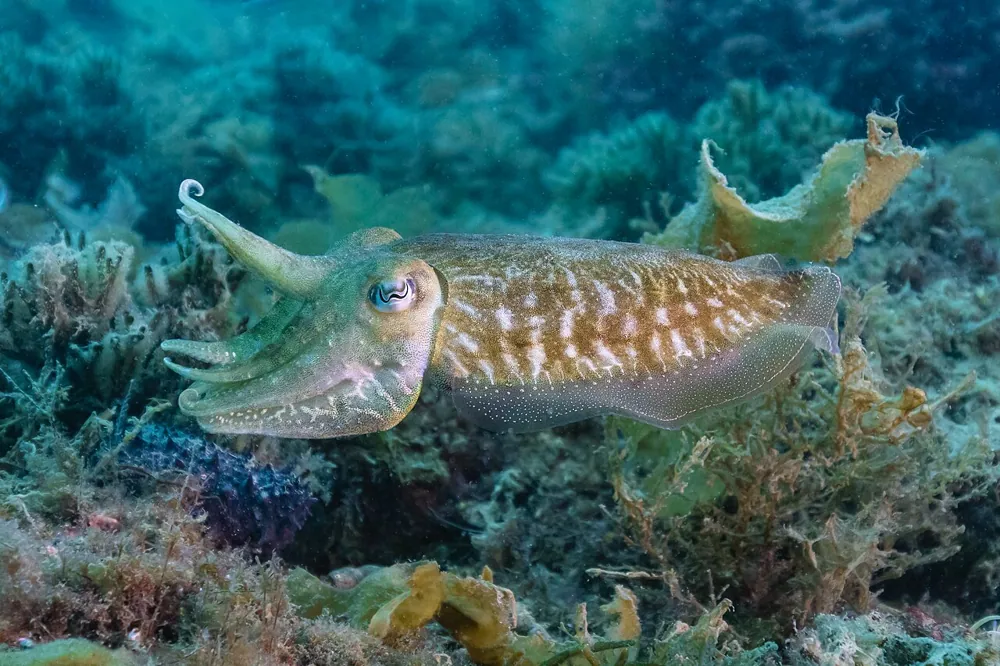
 Tsela ya go e lemoga
- Two highly developed eyes and eight arms around the mouth, plus two longer feeding tentacles1
- An internal shell, the cuttlebone, on the back of the body1
- Males in breeding season show a bold black and white zebra pattern on the mantle1
- Females in breeding season show a uniform grey colour1
- Can change colour and skin texture to blend into its surroundings1
Maatla a botlhole
Botlhole bo tswa ka meno a yone fa e loma.
E kotsi go le kae go batho?
Kotsi go batho: Kotsi e nnyeJaaka go tlhabiwa ke notshe kgotsa go le kwa tlase. Ga e na kotsi go batho.E dira eng fa e tshogile?
It hides by camouflage, sitting still while a predator passes. If found, it jets away using its siphon and often releases ink.1
 Fa e loma
- Go gatelela le go sa tshikinyege (pressure immobilisation): bofa bandeiji e e gogegang e e tiileng mo godimo ga fa go lomilweng mme o tswelele o bofe setho sotlhe go ya kwa godimo, se tshegetse ka sepilinti (splint), mme o dire gore motho a nne a sa tshikinyege gotlhelele go fitlha thuso e goroga.
- Okotopase e e nang le dikgole tse di tala kgotsa kgopa ya khouno e ka emisa motho go hema a sa ntse a tsogile: bitsa thuso mme o ipaakanyetse go mo hemela ka molomo (rescue breaths) go fitlha bathusi ba ambulense ba tsaya tiro.
Ka gale leletsa nomoro ya gago ya tshoganyetso pele (112, 000, 911). Se ke kaelo e e akaretsang ya thuso ya ntlha, ga se kgakololo ya bongaka. Motheo wa thuso ya ntlha
 Nna o babalesegile
- O se ka wa ama, wa tshwara kgotsa wa tshwenya phologolo ya naga, le fa e le e nnye, le fa e lebega e robetse kgotsa e sule.
- E fe sebaka. Fa o kopana le yone, ritibala, boela morago ka bonya mme o e tlogele e tsamaye ka tsela ya yone.
- Fa e nngwe e go loma: ritibala, o se ka wa tshikinyega, leletsa nomoro ya gago ya tshoganyetso (112, 000, 911) kgotsa o ye bookelong ka bonako. Gopola gore e ne e lebega jang, setshwantsho se a thusa.
Ga e go batle. E dirisa botlhole jwa yone go tshwara dijo kgotsa go itshireletsa, mme e rata go iphitlha go feta. Go le gontsi ka go nna o babalesegile
Kae mo lefatsheng?
E kgolo go le kae?
E telele go le kae?
E kima go le kae?
 boleele jo bo lekanang le dipanana di le 2,5 di latelana
 boleele jo bo lekanang le diboloko tsa go aga tsa ditshamekisi di le 15 mo moleng
 e ka nna bokima jo bo lekanang le jwa katse ya ntlo
 e ka thuma boleele jwa bodiba jo bogolo jwa go thuma (50 m) ka metsotswana e le 12
Common cuttlefish e kgolo go le kae fa e bapisiwa le WENA?
Ke dipalo fela mo sefetleng sa gago (browser). Ga go sepe se se bolokwang kgotsa se se romelwang gope.
E bonako go le kae?

,_Parque_natural_de_la_Arr%C3%A1bida,_Portugal,_2020-07-21,_DD_62.jpg)
Dintlha
Cuttlefish can change colour and skin texture within seconds, and this camouflage ability is present before they hatch, as young can change their pattern from inside the egg.1
Young cuttlefish learn prey preferences before hatching. Embryos that see crabs later hunt crabs more often than shrimp.1
The colour sepia, a deep brown, is named after this cuttlefish and is extracted from its ink sac.1
Cuttlebones are sold as a source of calcium for pet parrots, and they help keep the bird's beak trimmed.1
Cuttlefish ink is used as a food ingredient that stains dishes deep black.1
Large numbers of cuttlefish die after spawning, and they usually live only up to 2 years.1
Ya baitseanape ba botlhole
- Leina la saense
- Sepia officinalis
- Setlhopha
- Dikgopa tsa khouno le diokotopase
- Lelapa
- Sepiidae2
- Lekoko
- Sepiida
- Dikontinente
- Lewatle la Atlantic, Lewatle la Mediterranean, Lewatle la Bokone, Mawatle
- Masea
- The female attaches between 150 and 4000 eggs to seaweed, shells or other surfaces. The eggs hatch after 30 to 90 days, depending on temperature, into miniature adults.1
- Dingwaga tsa botshelo
- e ka nna dingwaga di le 21
- Seemo sa yone kwa nageng
- Least Concern1
- Kotsi go batho
- 1 / 5: Kotsi e nnye3
Kwa dintlha di tswang teng
- Common cuttlefish (Wikipedia (CC BY-SA 4.0))
- Sepia officinalis (iNaturalist): maina le thulaganyo ya mefuta.
- Venom Wiki: seelo sa kotsi, bogolo jo bo tlwaelegileng le kakanyo ya lebelo ke tsa rona. Bona kafa re di balang ka teng: Kafa re lekanyang kotsi ka teng.
Ntlha nngwe le nngwe mo tsebeng e e na le nomoro e e supang motswedi wa yone. Fa re dirile phoso, maitshwarelo, re barati ba diphologolo, e seng kgatiso ya saense. Re bolelele kwa [email protected] mme re tla e baakanya.
 Phepheng e tshwerwe ke tlala! Venom Wiki ke porojeke ya motho a le mongwe: ke mahala, ga e na dipapatso le ditraka. Mpho e nnye e thusa go e tshegetsa mo inthaneteng.Fepa phepheng
Tse dingwe tsa setlhopha se se tshwanang: Dikgopa tsa khouno le diokotopase
 Geography coneDikgopa tsa khouno le diokotopaseE a bolaya
 Greater blue-ringed octopusDikgopa tsa khouno le diokotopaseE a bolaya
 Southern blue-ringed octopusDikgopa tsa khouno le diokotopaseE a bolaya
 Blue sea dragonDikgopa tsa khouno le diokotopaseE utlwisa botlhoko fela
 Common octopusDikgopa tsa khouno le diokotopaseGa e na kotsi
 Giant Pacific octopusDikgopa tsa khouno le diokotopaseGa e na kotsi
E tshela gape kwa: Lewatle la Atlantic
 Hawksbill sea turtleDiphologolo tse dingwe tse di botlhole go di ama kgotsa go di jaE ka bolaya
 Portuguese man o' warDijelifishi le dibopiwa tsa lewatle tse di tlhabangE tlhoka ngakaO se ka wa ama
 Greenland sharkDiphologolo tse dingwe tse di botlhole go di ama kgotsa go di jaE utlwisa botlhoko fela
 Lion's mane jellyfishDijelifishi le dibopiwa tsa lewatle tse di tlhabangE utlwisa botlhoko felaO se ka wa ama
 Moon jellyfishDijelifishi le dibopiwa tsa lewatle tse di tlhabangGa e na kotsi
 Common stingrayDitlhapi tse di tsenyang botlholeE tlhoka ngaka