
 Aforika
 Asia
Asia Yuropa
 Amerika Borwa
 Australia le Oceania
 Antarctica
 Lewatle la Pacific
 Lewatle la Atlantic
 Lewatle la India
 Lewatle la Arctic
 Lewatle la Mediterranean
 Lewatle le Lehibidu
 Lewatle la Caribbean
 Lewatle la Coral
 Lewatle la China Borwa
 Lewatle la Philippines
 Lewatle la Andaman
 Lewatle la Bokone
 Lewatle la Timor le la Arafura
 Kou ya Bengal
 Gulf ya California
Common stingray
 Go tlhaba
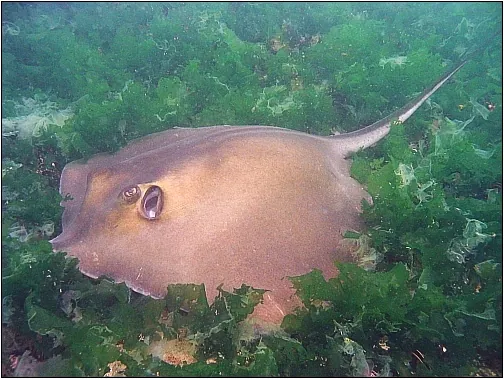
The common stingray is a flat, diamond-shaped ray that lives on sandy or muddy seabeds in shallow coastal waters. It is found in the northeastern Atlantic, the Mediterranean and the Black Sea. It has a venomous spine on its tail, which can give a very painful sting.1
 Tsela ya go e lemoga
- Diamond-shaped pectoral fin disc that is slightly wider than it is long1
- Plain colour: solid grey, brown, reddish or olive-green above, and whitish below with dark fin edges1
- Mostly smooth skin; the largest individuals have a row of bony knobs along the middle of the back1
- Slender, whip-like tail with a serrated venomous spine about a third of the way along it1
Gantsi e tlhakanngwa le: The blue stingray of southern Africa was once thought to be a variant of this species, but it is a separate species. The common stingray lacks the blue markings of the blue stingray. Tortonese's stingray of the Mediterranean is similar, and the difference between the two is poorly understood.1
Maatla a botlhole
Botlhole bo tswa ka lemao le le tlhabang.
Botlhole jo e bo tsenyang bo dira eng?
The venom comes from a gland at the base of a serrated tail spine. A sting causes an excruciatingly painful wound. It is rarely life-threatening.1
E kotsi go le kae go batho?
Kotsi go batho: E masisiGo tlhabiwa ke yone go tlhoka ngaka. Go swa go seoka thata.The common stingray is not aggressive, but it can inflict a very painful wound with its tail spine. The wound is rarely life-threatening.1
 Fa e tlhaba
- Tsenya ntho mo metsing a a mogote, a a bollo jo motho a ka bo itshokang a sa fiswe (a leke ka seatla sa gago pele), metsotso e le 30 go ya go 90. Batla thuso ya bongaka, bogolo jang go ditlhapi tsa lefika le distingrei.
Ka gale leletsa nomoro ya gago ya tshoganyetso pele (112, 000, 911). Se ke kaelo e e akaretsang ya thuso ya ntlha, ga se kgakololo ya bongaka. Motheo wa thuso ya ntlha
 Nna o babalesegile
- O se ka wa ama, wa tshwara kgotsa wa tshwenya phologolo ya naga, le fa e le e nnye, le fa e lebega e robetse kgotsa e sule.
- E fe sebaka. Fa o kopana le yone, ritibala, boela morago ka bonya mme o e tlogele e tsamaye ka tsela ya yone.
- Fa e nngwe e go tlhaba: ritibala, o se ka wa tshikinyega, leletsa nomoro ya gago ya tshoganyetso (112, 000, 911) kgotsa o ye bookelong ka bonako. Gopola gore e ne e lebega jang, setshwantsho se a thusa.
Ga e go batle. E dirisa botlhole jwa yone go tshwara dijo kgotsa go itshireletsa, mme e rata go iphitlha go feta. Go le gontsi ka go nna o babalesegile
Kae mo lefatsheng?
E kgolo go le kae?
E telele go le kae?
 boleele jo bo lekanang le dintša di le 2,5 go tloga kwa nkong go ya mogatleng
 boleele jo bo lekanang le dipanana di le 14 di latelana
 e ka thuma boleele jwa bodiba jo bogolo jwa go thuma (50 m) ka metsotswana e le 9,5
Common stingray e kgolo go le kae fa e bapisiwa le WENA?
Ke dipalo fela mo sefetleng sa gago (browser). Ga go sepe se se bolokwang kgotsa se se romelwang gope.
E bonako go le kae?


Dintlha
The tail spine is replaced regularly, and a second or even third spine may be growing in behind the first.1
The largest recorded specimen was found in 2016 in İzmir Province, Turkey, with fins measuring 2.21 m across.1
Welsh fishermen once used its liver oil to treat burns and other injuries, and its liver is a delicacy in French cuisine.1
The oldest known wild individual was ten years old, but the species has lived up to 21 years in captivity.1
Mosenyi wa ditlhamane
Tlhamane: The stingray's spine could kill trees, pierce armour like an arrow, corrode iron and even dissolve stone, as some ancient writers claimed.
Nnete: The common stingray's wound is painful but rarely life-threatening. These ancient claims about its spine were legends.1
Ya baitseanape ba botlhole
- Leina la saense
- Dasyatis pastinaca
- Setlhopha
- Ditlhapi tse di tsenyang botlhole
- Lelapa
- Dasyatidae2
- Lekoko
- Myliobatiformes
- Dikontinente
- Lewatle la Atlantic, Lewatle la Mediterranean, Lewatle la Bokone, Mawatle
- Masea
- It is aplacental viviparous, meaning it gives birth to live young. Females bear 4–9 young twice a year in shallow inshore water, after a gestation period of four months.1
- Dingwaga tsa botshelo
- e ka nna dingwaga di le 211
- Seemo sa yone kwa nageng
- Vulnerable1
- Kotsi go batho
- 3 / 5: E masisi3
Kwa dintlha di tswang teng
- Common stingray (Wikipedia (CC BY-SA 4.0))
- Dasyatis pastinaca (iNaturalist): maina le thulaganyo ya mefuta.
- Venom Wiki: seelo sa kotsi, bogolo jo bo tlwaelegileng le kakanyo ya lebelo ke tsa rona. Bona kafa re di balang ka teng: Kafa re lekanyang kotsi ka teng.
Ntlha nngwe le nngwe mo tsebeng e e na le nomoro e e supang motswedi wa yone. Fa re dirile phoso, maitshwarelo, re barati ba diphologolo, e seng kgatiso ya saense. Re bolelele kwa [email protected] mme re tla e baakanya.
 Phepheng e tshwerwe ke tlala! Venom Wiki ke porojeke ya motho a le mongwe: ke mahala, ga e na dipapatso le ditraka. Mpho e nnye e thusa go e tshegetsa mo inthaneteng.Fepa phepheng
Tse dingwe tsa setlhopha se se tshwanang: Ditlhapi tse di tsenyang botlhole
 Reef stonefishDitlhapi tse di tsenyang botlholeE ka bolayaO se ka wa ama
 Red lionfishDitlhapi tse di tsenyang botlholeE tlhoka ngakaO se ka wa ama
 Estuarine stonefishDitlhapi tse di tsenyang botlholeE ka bolayaO se ka wa ama
 Short-tail stingrayDitlhapi tse di tsenyang botlholeE ka bolaya
 Striped eel catfishDitlhapi tse di tsenyang botlholeE ka bolayaO se ka wa ama
 Bluespotted ribbontail rayDitlhapi tse di tsenyang botlholeE tlhoka ngaka
E tshela gape kwa: Lewatle la Atlantic
 Hawksbill sea turtleDiphologolo tse dingwe tse di botlhole go di ama kgotsa go di jaE ka bolaya
 Portuguese man o' warDijelifishi le dibopiwa tsa lewatle tse di tlhabangE tlhoka ngakaO se ka wa ama
 Blue sea dragonDikgopa tsa khouno le diokotopaseE utlwisa botlhoko fela
 Greenland sharkDiphologolo tse dingwe tse di botlhole go di ama kgotsa go di jaE utlwisa botlhoko fela
 Lion's mane jellyfishDijelifishi le dibopiwa tsa lewatle tse di tlhabangE utlwisa botlhoko felaO se ka wa ama
 Common octopusDikgopa tsa khouno le diokotopaseGa e na kotsi