
 Aforika
 Asia
Asia Yuropa
 Amerika Borwa
 Australia le Oceania
 Antarctica
 Lewatle la Pacific
 Lewatle la Atlantic
 Lewatle la India
 Lewatle la Arctic
 Lewatle la Mediterranean
 Lewatle le Lehibidu
 Lewatle la Caribbean
 Lewatle la Coral
 Lewatle la China Borwa
 Lewatle la Philippines
 Lewatle la Andaman
 Lewatle la Bokone
 Lewatle la Timor le la Arafura
 Kou ya Bengal
 Gulf ya California
Cuban solenodon
 Go loma
The Cuban solenodon is a small, furry, shrew-like mammal that lives only in the mountain forests of eastern Cuba. It is one of the few mammals that can inject venom, which it uses to catch its prey. It is endangered and was once thought to be extinct.1



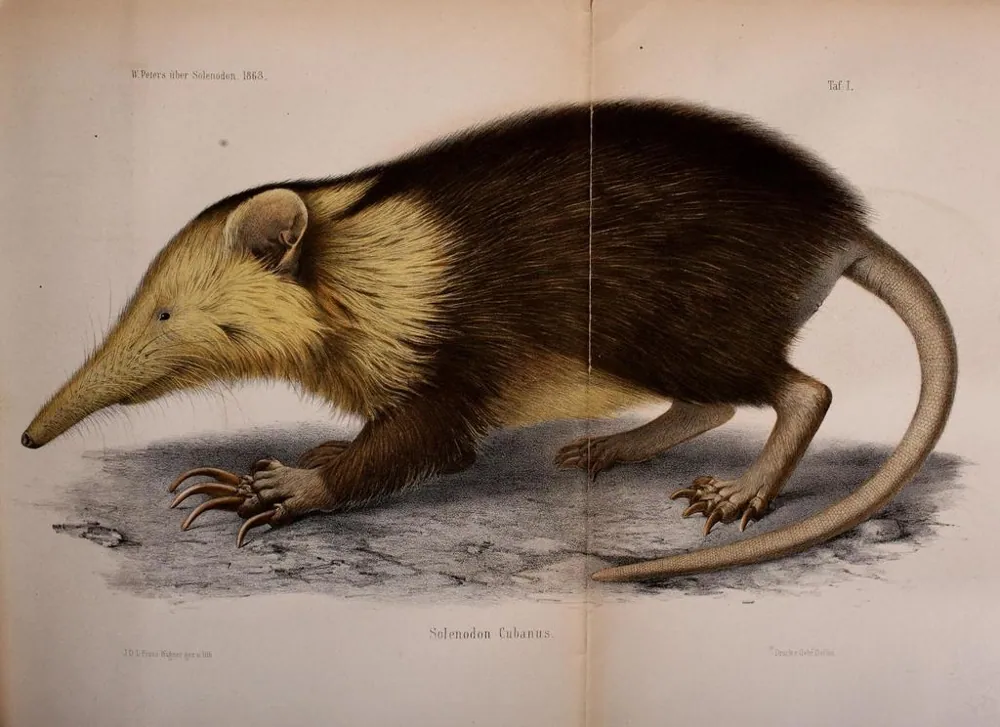
 Tsela ya go e lemoga
- Dark brown to black hair1
- Small eyes and an extremely elongated snout1
- Looks like a large brown rat, with a long, naked, scaly tail1
- Measures 41–56 cm from nose to tail tip1
Gantsi e tlhakanngwa le: It is sometimes compared to a shrew, but it most closely resembles the tenrecs of Madagascar.1
Maatla a botlhole
Botlhole bo tswa ka meno a yone fa e loma.
Botlhole jo e bo tsenyang bo dira eng?
Its venom comes from modified salivary glands in the lower jaw, so it is a venomous bite. The venom is strong enough to kill lizards, other small reptiles, frogs, small birds and rodents. Solenodons do not appear to be immune to the venom of their own kind, and cage mates have been reported dying after fights.1
E kotsi go le kae go batho?
Kotsi go batho: E botlhokoE ka utlwisa botlhoko tota, mme go seoka thata gore e nne masisi. Fa e loma
- Tlhatswa ntho sentle mme o batle thuso ya bongaka.
Ka gale leletsa nomoro ya gago ya tshoganyetso pele (112, 000, 911). Se ke kaelo e e akaretsang ya thuso ya ntlha, ga se kgakololo ya bongaka. Motheo wa thuso ya ntlha
 Nna o babalesegile
- O se ka wa ama, wa tshwara kgotsa wa tshwenya phologolo ya naga, le fa e le e nnye, le fa e lebega e robetse kgotsa e sule.
- E fe sebaka. Fa o kopana le yone, ritibala, boela morago ka bonya mme o e tlogele e tsamaye ka tsela ya yone.
- Fa e nngwe e go loma: ritibala, o se ka wa tshikinyega, leletsa nomoro ya gago ya tshoganyetso (112, 000, 911) kgotsa o ye bookelong ka bonako. Gopola gore e ne e lebega jang, setshwantsho se a thusa.
Ga e go batle. E dirisa botlhole jwa yone go tshwara dijo kgotsa go itshireletsa, mme e rata go iphitlha go feta. Go le gontsi ka go nna o babalesegile
Kae mo lefatsheng?
E kgolo go le kae?
E telele go le kae?
E kima go le kae?
 boleele jo bo lekanang le dipanana di le 3 di latelana
 boleele jo bo lekanang le diboloko tsa go aga tsa ditshamekisi di le 18 mo moleng
 e ka taboga dimetara di le 100 ka metsotswana e le 45 (motho yo o bonako go gaisa o tlhoka 9,6)
Cuban solenodon e kgolo go le kae fa e bapisiwa le WENA?
Ke dipalo fela mo sefetleng sa gago (browser). Ga go sepe se se bolokwang kgotsa se se romelwang gope.
E bonako go le kae?


Dintlha
The solenodons are one of the few groups of mammals that are venomous.1
It was declared extinct in 1970, but was found again in 1974.1
The Cuban solenodon found in 2003 was named Alejandrito. It was healthy, and it was released back into the wild after two days of scientific study.1
Males mate with several females, but they do not help raise the young. Males and females only meet to mate.1
Mosenyi wa ditlhamane
Tlhamane: The Cuban solenodon is extinct.
Nnete: It is not extinct. It was once thought to be extinct because it is so rare and hard to see, but it survives today and is listed as endangered.1
Ya baitseanape ba botlhole
Kwa dintlha di tswang teng
- Cuban solenodon (Wikipedia (CC BY-SA 4.0))
- Atopogale cubana (iNaturalist): maina le thulaganyo ya mefuta.
- Venom Wiki: seelo sa kotsi, bogolo jo bo tlwaelegileng le kakanyo ya lebelo ke tsa rona. Bona kafa re di balang ka teng: Kafa re lekanyang kotsi ka teng.
Ntlha nngwe le nngwe mo tsebeng e e na le nomoro e e supang motswedi wa yone. Fa re dirile phoso, maitshwarelo, re barati ba diphologolo, e seng kgatiso ya saense. Re bolelele kwa [email protected] mme re tla e baakanya.
 Phepheng e tshwerwe ke tlala! Venom Wiki ke porojeke ya motho a le mongwe: ke mahala, ga e na dipapatso le ditraka. Mpho e nnye e thusa go e tshegetsa mo inthaneteng.Fepa phepheng
Tse dingwe tsa setlhopha se se tshwanang: Diphologolo tse di anyisang tse di tsenyang botlhole
 Common vampire batDiphologolo tse di anyisang tse di tsenyang botlholeE utlwisa botlhoko fela
 Hispaniolan solenodonDiphologolo tse di anyisang tse di tsenyang botlholeE utlwisa botlhoko fela
 Northern short-tailed shrewDiphologolo tse di anyisang tse di tsenyang botlholeGa e na kotsi
 Hairy-legged vampire batDiphologolo tse di anyisang tse di tsenyang botlholeGa e na kotsi
 White-winged vampire batDiphologolo tse di anyisang tse di tsenyang botlholeGa e na kotsi
 PlatypusDiphologolo tse di anyisang tse di tsenyang botlholeE utlwisa botlhoko fela
E tshela gape kwa: Amerika Bokone
 TerciopeloDivaepara tsa mesima (pit vipers)E a bolaya
 Eastern coral snakeDinoga tsa khoraleE ka bolaya
 Eastern diamondback rattlesnakeDinoga tsa ratheleE ka bolaya
 Eyelash viperDivaepara tsa mesima (pit vipers)E ka bolaya
 Timber rattlesnakeDinoga tsa ratheleE ka bolaya
 Western diamondback rattlesnakeDinoga tsa ratheleE ka bolaya