
 Aforika
 Asia
Asia Yuropa
 Amerika Borwa
 Australia le Oceania
 Antarctica
 Lewatle la Pacific
 Lewatle la Atlantic
 Lewatle la India
 Lewatle la Arctic
 Lewatle la Mediterranean
 Lewatle le Lehibidu
 Lewatle la Caribbean
 Lewatle la Coral
 Lewatle la China Borwa
 Lewatle la Philippines
 Lewatle la Andaman
 Lewatle la Bokone
 Lewatle la Timor le la Arafura
 Kou ya Bengal
 Gulf ya California
Northern short-tailed shrew
 Go loma
The northern short-tailed shrew is a small, very active mammal that lives in eastern and central North America. It is one of the few venomous mammals, and it uses venom in its saliva to paralyse the animals it hunts. It is also a voracious eater that can eat up to three times its own weight in food each day.1



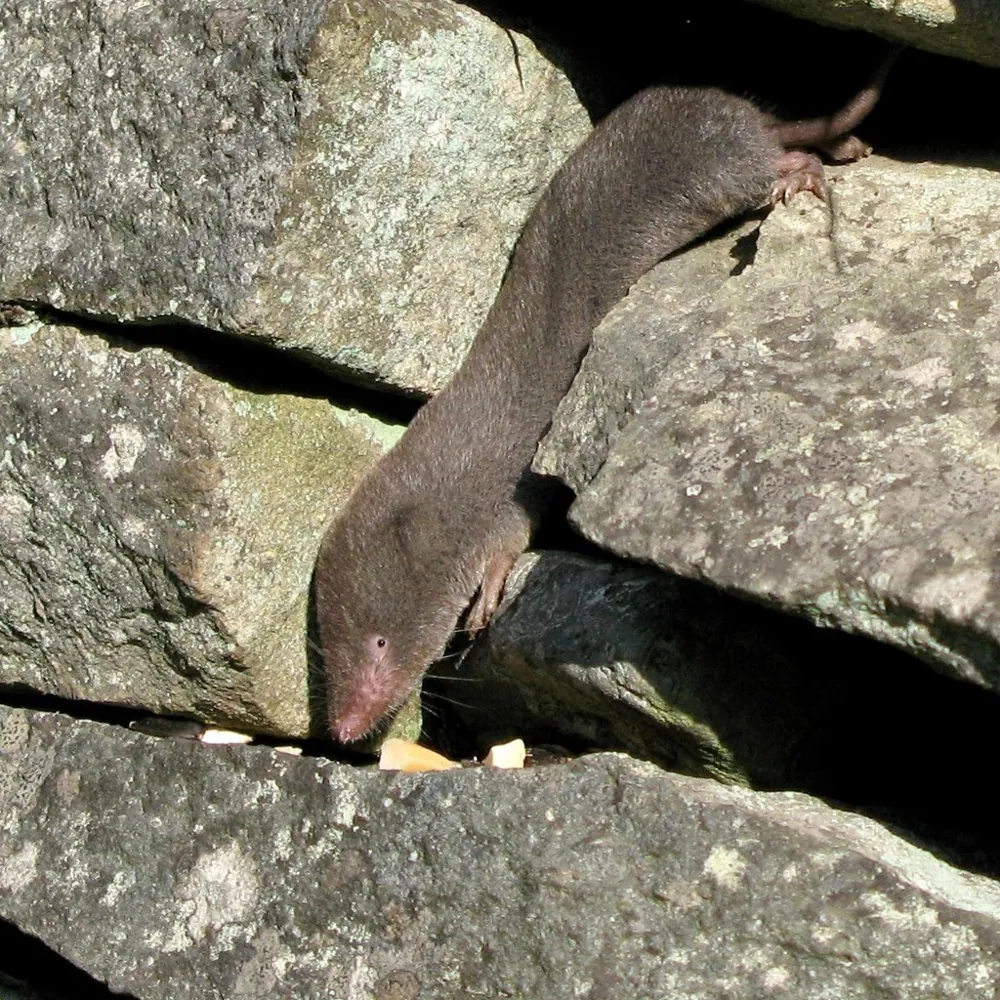
 Tsela ya go e lemoga
Maatla a botlhole
Botlhole bo tswa ka meno a yone fa e loma.
Botlhole jo e bo tsenyang bo dira eng?
Its saliva contains a kallikrein-like protease, a toxin that paralyses and subdues prey. The toxin is strong enough to kill small animals, including some somewhat larger than the shrew itself. In people, it causes painful bites when they handle the shrew.1
E kotsi go le kae go batho?
Kotsi go batho: Kotsi e nnyeJaaka go tlhabiwa ke notshe kgotsa go le kwa tlase. Ga e na kotsi go batho.Its bites are painful to people who try to handle it.1
E dira eng fa e tshogile?
Its scent glands produce a musky odour that deters mammalian carnivores.1
 Fa e loma
- Tlhatswa ntho sentle mme o batle thuso ya bongaka.
Ka gale leletsa nomoro ya gago ya tshoganyetso pele (112, 000, 911). Se ke kaelo e e akaretsang ya thuso ya ntlha, ga se kgakololo ya bongaka. Motheo wa thuso ya ntlha
 Nna o babalesegile
- O se ka wa ama, wa tshwara kgotsa wa tshwenya phologolo ya naga, le fa e le e nnye, le fa e lebega e robetse kgotsa e sule.
- E fe sebaka. Fa o kopana le yone, ritibala, boela morago ka bonya mme o e tlogele e tsamaye ka tsela ya yone.
- Fa e nngwe e go loma: ritibala, o se ka wa tshikinyega, leletsa nomoro ya gago ya tshoganyetso (112, 000, 911) kgotsa o ye bookelong ka bonako. Gopola gore e ne e lebega jang, setshwantsho se a thusa.
Ga e go batle. E dirisa botlhole jwa yone go tshwara dijo kgotsa go itshireletsa, mme e rata go iphitlha go feta. Go le gontsi ka go nna o babalesegile
Kae mo lefatsheng?
E kgolo go le kae?
E telele go le kae?
E kima go le kae?

 boleele jo bo lekanang le diboloko tsa go aga tsa ditshamekisi di le 4 mo moleng
 e ka taboga dimetara di le 100 ka metsotswana e le 90 (motho yo o bonako go gaisa o tlhoka 9,6)
Northern short-tailed shrew e kgolo go le kae fa e bapisiwa le WENA?
Ke dipalo fela mo sefetleng sa gago (browser). Ga go sepe se se bolokwang kgotsa se se romelwang gope.
E bonako go le kae?


Dintlha
It is one of the few venomous mammals, and its saliva is used to subdue prey.1
It can eat up to three times its own weight in food each day.1
It is thought to have a poor sense of smell and very limited vision, so it uses echolocation and a fine sense of touch instead.1
Its winter food intake is 43% higher than in summer, because it must work harder to keep its body warm.1
Its nests can be up to 20 cm across and lined with leaves or vole fur, and its waste is kept in a separate latrine area.1
Ya baitseanape ba botlhole
- Leina la saense
- Blarina brevicauda
- Setlhopha
- Diphologolo tse di anyisang tse di tsenyang botlhole
- Lelapa
- Soricidae2
- Lekoko
- Eulipotyphla
- Dikontinente
- Amerika Bokone
- Masea
- Females usually have two litters a season, each with six to eight young. The young are born hairless and blind, weighing less than a gram.1
- Seemo sa yone kwa nageng
- Least Concern1
- Kotsi go batho
- 1 / 5: Kotsi e nnye3
Kwa dintlha di tswang teng
- Northern short-tailed shrew (Wikipedia (CC BY-SA 4.0))
- Blarina brevicauda (iNaturalist): maina le thulaganyo ya mefuta.
- Venom Wiki: seelo sa kotsi, bogolo jo bo tlwaelegileng le kakanyo ya lebelo ke tsa rona. Bona kafa re di balang ka teng: Kafa re lekanyang kotsi ka teng.
Ntlha nngwe le nngwe mo tsebeng e e na le nomoro e e supang motswedi wa yone. Fa re dirile phoso, maitshwarelo, re barati ba diphologolo, e seng kgatiso ya saense. Re bolelele kwa [email protected] mme re tla e baakanya.
 Phepheng e tshwerwe ke tlala! Venom Wiki ke porojeke ya motho a le mongwe: ke mahala, ga e na dipapatso le ditraka. Mpho e nnye e thusa go e tshegetsa mo inthaneteng.Fepa phepheng
Tse dingwe tsa setlhopha se se tshwanang: Diphologolo tse di anyisang tse di tsenyang botlhole
 Common vampire batDiphologolo tse di anyisang tse di tsenyang botlholeE utlwisa botlhoko fela
 Cuban solenodonDiphologolo tse di anyisang tse di tsenyang botlholeE utlwisa botlhoko fela
 Hispaniolan solenodonDiphologolo tse di anyisang tse di tsenyang botlholeE utlwisa botlhoko fela
 Hairy-legged vampire batDiphologolo tse di anyisang tse di tsenyang botlholeGa e na kotsi
 White-winged vampire batDiphologolo tse di anyisang tse di tsenyang botlholeGa e na kotsi
 PlatypusDiphologolo tse di anyisang tse di tsenyang botlholeE utlwisa botlhoko fela
E tshela gape kwa: Amerika Bokone
 TerciopeloDivaepara tsa mesima (pit vipers)E a bolaya
 Eastern coral snakeDinoga tsa khoraleE ka bolaya
 Eastern diamondback rattlesnakeDinoga tsa ratheleE ka bolaya
 Eyelash viperDivaepara tsa mesima (pit vipers)E ka bolaya
 Timber rattlesnakeDinoga tsa ratheleE ka bolaya
 Western diamondback rattlesnakeDinoga tsa ratheleE ka bolaya