
 Aforika
 Asia
Asia Yuropa
 Amerika Borwa
 Australia le Oceania
 Antarctica
 Lewatle la Pacific
 Lewatle la Atlantic
 Lewatle la India
 Lewatle la Arctic
 Lewatle la Mediterranean
 Lewatle le Lehibidu
 Lewatle la Caribbean
 Lewatle la Coral
 Lewatle la China Borwa
 Lewatle la Philippines
 Lewatle la Andaman
 Lewatle la Bokone
 Lewatle la Timor le la Arafura
 Kou ya Bengal
 Gulf ya California
Filament-finned stinger
 Mitlwa ya botlhole
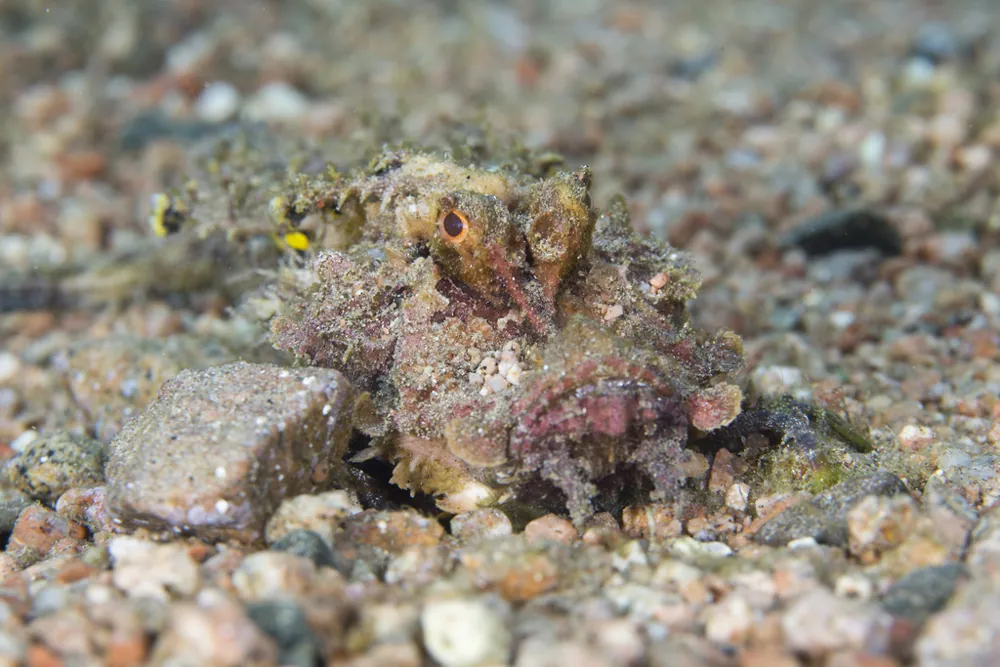
The filament-finned stinger is a well-camouflaged fish with venomous spines on its skin. It lives on sandy and silty seabeds in warm coastal waters, from the Red Sea and East Africa to the Maldives. It is easy to step on or touch by accident, so it is worth knowing what it looks like.1

 Tsela ya go e lemoga
- Body colour is dull yellow, grey, brown or rust, with light blotches that match the seabed1
- Skin has no scales along most of the body, but is covered in venomous spines and wart-like glands, giving a knobby look1
- Flattened, concave head, with the eyes, mouth and nostrils projecting upwards and outwards1
- Caudal (tail) fin has dark bands at its base and near its tip1
- Two pectoral fin rays are detached and angled downwards, and are used like legs1
Gantsi e tlhakanngwa le: It is often confused with Inimicus sinensis, which is nearly identical. The key difference is on the underside of the pectoral fins: the black bands of this species are faint, while those of I. sinensis have yellow spots.1
Maatla a botlhole
Mitlwa e e bogale e rwala botlhole. Go e gata kgotsa go e tshwara go a utlwisa botlhoko.
E kotsi go le kae go batho?
Kotsi go batho: E masisiFa mitlwa ya yone e go tlhaba, ya kwa ngakeng. Go swa go seoka thata.E dira eng fa e tshogile?
When disturbed by a diver or a possible predator, it fans out its brightly coloured pectoral and tail fins as a warning, and it is very reluctant to leave its hiding place once dug in.1
 Fa mitlwa ya yone e go tlhaba
- Tsenya ntho mo metsing a a mogote, a a bollo jo motho a ka bo itshokang a sa fiswe (a leke ka seatla sa gago pele), metsotso e le 30 go ya go 90. Batla thuso ya bongaka, bogolo jang go ditlhapi tsa lefika le distingrei.
Ka gale leletsa nomoro ya gago ya tshoganyetso pele (112, 000, 911). Se ke kaelo e e akaretsang ya thuso ya ntlha, ga se kgakololo ya bongaka. Motheo wa thuso ya ntlha
 Nna o babalesegile
- O se ka wa ama, wa tshwara kgotsa wa tshwenya phologolo ya naga, le fa e le e nnye, le fa e lebega e robetse kgotsa e sule.
- E fe sebaka. Fa o kopana le yone, ritibala, boela morago ka bonya mme o e tlogele e tsamaye ka tsela ya yone.
- Fa mitlwa ya yone e go tlhaba: ritibala, o se ka wa tshikinyega, leletsa nomoro ya gago ya tshoganyetso (112, 000, 911) kgotsa o ye bookelong ka bonako. Gopola gore e ne e lebega jang, setshwantsho se a thusa.
Ga e go batle. E dirisa botlhole jwa yone go tshwara dijo kgotsa go itshireletsa, mme e rata go iphitlha go feta. Go le gontsi ka go nna o babalesegile
Kae mo lefatsheng?
E kgolo go le kae?
E telele go le kae?
E kima go le kae?

 boleele jo bo lekanang le diboloko tsa go aga tsa ditshamekisi di le 8 mo moleng
 e ka thuma boleele jwa bodiba jo bogolo jwa go thuma (50 m) ka metsotswana e le 36
Filament-finned stinger e kgolo go le kae fa e bapisiwa le WENA?
Ke dipalo fela mo sefetleng sa gago (browser). Ga go sepe se se bolokwang kgotsa se se romelwang gope.
E bonako go le kae?
Dintlha
It walks slowly along the seabed, using the two lower pectoral fin rays on each side as legs.1
Its pectoral fins can be brightly coloured, which it shows as a warning when threatened.1
It has no known natural predators.1
During the day it covers itself with sand and debris, which hides it further.1
It is nocturnal, so it hunts mainly at night.1
Kwa dintlha di tswang teng
- Inimicus filamentosus (Wikipedia (CC BY-SA 4.0))
- Inimicus filamentosus (iNaturalist): maina le thulaganyo ya mefuta.
- Venom Wiki: seelo sa kotsi, bogolo jo bo tlwaelegileng le kakanyo ya lebelo ke tsa rona. Bona kafa re di balang ka teng: Kafa re lekanyang kotsi ka teng.
Ntlha nngwe le nngwe mo tsebeng e e na le nomoro e e supang motswedi wa yone. Fa re dirile phoso, maitshwarelo, re barati ba diphologolo, e seng kgatiso ya saense. Re bolelele kwa [email protected] mme re tla e baakanya.
 Phepheng e tshwerwe ke tlala! Venom Wiki ke porojeke ya motho a le mongwe: ke mahala, ga e na dipapatso le ditraka. Mpho e nnye e thusa go e tshegetsa mo inthaneteng.Fepa phepheng
Tse dingwe tsa setlhopha se se tshwanang: Ditlhapi tse di tsenyang botlhole
 Reef stonefishDitlhapi tse di tsenyang botlholeE ka bolayaO se ka wa ama
 Red lionfishDitlhapi tse di tsenyang botlholeE tlhoka ngakaO se ka wa ama
 Estuarine stonefishDitlhapi tse di tsenyang botlholeE ka bolayaO se ka wa ama
 Short-tail stingrayDitlhapi tse di tsenyang botlholeE ka bolaya
 Striped eel catfishDitlhapi tse di tsenyang botlholeE ka bolayaO se ka wa ama
 Bluespotted ribbontail rayDitlhapi tse di tsenyang botlholeE tlhoka ngaka
E tshela gape kwa: Lewatle la India
 Australian box jellyfishDijelifishi le dibopiwa tsa lewatle tse di tlhabangE a bolayaO se ka wa ama
 Geography coneDikgopa tsa khouno le diokotopaseE a bolaya
 Greater blue-ringed octopusDikgopa tsa khouno le diokotopaseE a bolaya
 Southern blue-ringed octopusDikgopa tsa khouno le diokotopaseE a bolaya
 Hawksbill sea turtleDiphologolo tse dingwe tse di botlhole go di ama kgotsa go di jaE ka bolaya
 Irukandji jellyfishDijelifishi le dibopiwa tsa lewatle tse di tlhabangE ka bolayaO se ka wa ama