
 Aforika
 Asia
Asia Yuropa
 Amerika Borwa
 Australia le Oceania
 Antarctica
 Lewatle la Pacific
 Lewatle la Atlantic
 Lewatle la India
 Lewatle la Arctic
 Lewatle la Mediterranean
 Lewatle le Lehibidu
 Lewatle la Caribbean
 Lewatle la Coral
 Lewatle la China Borwa
 Lewatle la Philippines
 Lewatle la Andaman
 Lewatle la Bokone
 Lewatle la Timor le la Arafura
 Kou ya Bengal
 Gulf ya California
Javan slow loris
 Go loma
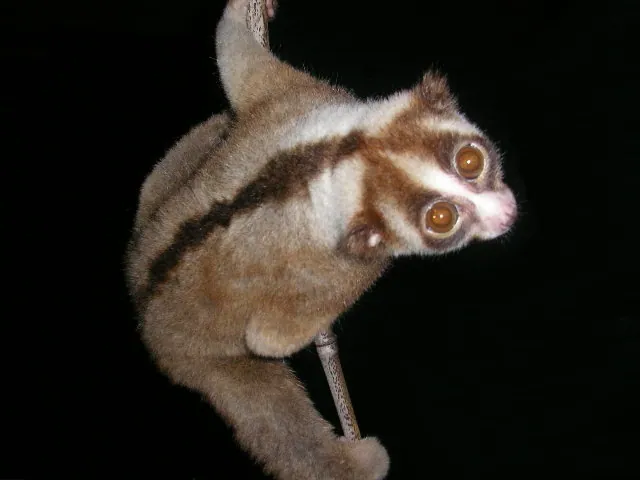
The Javan slow loris is a small, slow-moving primate that lives only on the western and central parts of the island of Java in Indonesia. It moves through the trees at night, creeping along vines and branches rather than leaping. It is critically endangered, mainly because it is captured for the pet trade.1



 Tsela ya go e lemoga
- A distinct white diamond pattern on the forehead, made by a stripe that runs over the head and forks towards the eyes and ears1
- Yellowish-grey body with cream-coloured head, neck and shoulders1
- Weighs between 565 and 687 g, with a head-body length of about 29 cm1
- Moves slowly through vines and lianas rather than jumping between trees, and is active at night1
Gantsi e tlhakanngwa le: It closely resembles the Bengal slow loris, which is similar in appearance, and the Sunda slow loris, which it was long considered a subspecies of. Rescue centres have sometimes misidentified it. It is larger than both the Sunda and Bornean slow lorises.1
Maatla a botlhole
Botlhole bo tswa ka meno a yone fa e loma.
E kotsi go le kae go batho?
Kotsi go batho: E botlhokoE ka utlwisa botlhoko tota, mme go seoka thata gore e nne masisi. Fa e loma
- Tlhatswa ntho sentle mme o batle thuso ya bongaka.
Ka gale leletsa nomoro ya gago ya tshoganyetso pele (112, 000, 911). Se ke kaelo e e akaretsang ya thuso ya ntlha, ga se kgakololo ya bongaka. Motheo wa thuso ya ntlha
 Nna o babalesegile
- O se ka wa ama, wa tshwara kgotsa wa tshwenya phologolo ya naga, le fa e le e nnye, le fa e lebega e robetse kgotsa e sule.
- E fe sebaka. Fa o kopana le yone, ritibala, boela morago ka bonya mme o e tlogele e tsamaye ka tsela ya yone.
- Fa e nngwe e go loma: ritibala, o se ka wa tshikinyega, leletsa nomoro ya gago ya tshoganyetso (112, 000, 911) kgotsa o ye bookelong ka bonako. Gopola gore e ne e lebega jang, setshwantsho se a thusa.
Ga e go batle. E dirisa botlhole jwa yone go tshwara dijo kgotsa go itshireletsa, mme e rata go iphitlha go feta. Go le gontsi ka go nna o babalesegile
Kae mo lefatsheng?
E kgolo go le kae?
E telele go le kae?
E kima go le kae?

 boleele jo bo lekanang le diboloko tsa go aga tsa ditshamekisi di le 9 mo moleng
 e ka taboga dimetara di le 100 ka metsotswana e le 180 (motho yo o bonako go gaisa o tlhoka 9,6)
Javan slow loris e kgolo go le kae fa e bapisiwa le WENA?
Ke dipalo fela mo sefetleng sa gago (browser). Ga go sepe se se bolokwang kgotsa se se romelwang gope.
E bonako go le kae?


Dintlha
Local farmers have helped maintain mid-air walkways that conservationists built so the lorises can cross between treetops in cleared farmland. These walkways also serve as irrigation pipes.1
Unlike most primates, it sleeps curled up on exposed branches rather than in nest holes.1
It is the largest of the slow lorises found in Indonesia.1
It can move on the ground to cross open spaces in disturbed habitat.1
Mosenyi wa ditlhamane
Tlhamane: It has magical and curative properties.
Nnete: This is a myth. Even so, it is still sometimes used in traditional medicine in Indonesia, which adds to the pressure on the species.1
Kwa dintlha di tswang teng
- Javan slow loris (Wikipedia (CC BY-SA 4.0))
- Nycticebus javanicus (iNaturalist): maina le thulaganyo ya mefuta.
- Venom Wiki: seelo sa kotsi, bogolo jo bo tlwaelegileng le kakanyo ya lebelo ke tsa rona. Bona kafa re di balang ka teng: Kafa re lekanyang kotsi ka teng.
Ntlha nngwe le nngwe mo tsebeng e e na le nomoro e e supang motswedi wa yone. Fa re dirile phoso, maitshwarelo, re barati ba diphologolo, e seng kgatiso ya saense. Re bolelele kwa [email protected] mme re tla e baakanya.
 Phepheng e tshwerwe ke tlala! Venom Wiki ke porojeke ya motho a le mongwe: ke mahala, ga e na dipapatso le ditraka. Mpho e nnye e thusa go e tshegetsa mo inthaneteng.Fepa phepheng
Tse dingwe tsa setlhopha se se tshwanang: Diphologolo tse di anyisang tse di tsenyang botlhole
 Bengal slow lorisDiphologolo tse di anyisang tse di tsenyang botlholeE utlwisa botlhoko fela
 Pygmy slow lorisDiphologolo tse di anyisang tse di tsenyang botlholeE utlwisa botlhoko fela
 Sunda slow lorisDiphologolo tse di anyisang tse di tsenyang botlholeE utlwisa botlhoko fela
 Kayan River slow lorisDiphologolo tse di anyisang tse di tsenyang botlholeE utlwisa botlhoko fela
 Philippine slow lorisDiphologolo tse di anyisang tse di tsenyang botlholeE utlwisa botlhoko fela
 Eurasian water shrewDiphologolo tse di anyisang tse di tsenyang botlholeGa e na kotsi
 Deathstalker
 Indian cobra
 Indian saw-scaled viper
 King cobra
 Puff adder
 Phika ya ga Russell