
 Aforika
 Asia
Asia Yuropa
 Amerika Borwa
 Australia le Oceania
 Antarctica
 Lewatle la Pacific
 Lewatle la Atlantic
 Lewatle la India
 Lewatle la Arctic
 Lewatle la Mediterranean
 Lewatle le Lehibidu
 Lewatle la Caribbean
 Lewatle la Coral
 Lewatle la China Borwa
 Lewatle la Philippines
 Lewatle la Andaman
 Lewatle la Bokone
 Lewatle la Timor le la Arafura
 Kou ya Bengal
 Gulf ya California
Kayan River slow loris
 Go loma
The Kayan River slow loris is a small, nocturnal primate that lives in the highlands of northern and central Borneo. It is the only primate known to have a toxic bite, which it uses to defend itself. It is classed as Vulnerable because its forest home is being lost.1



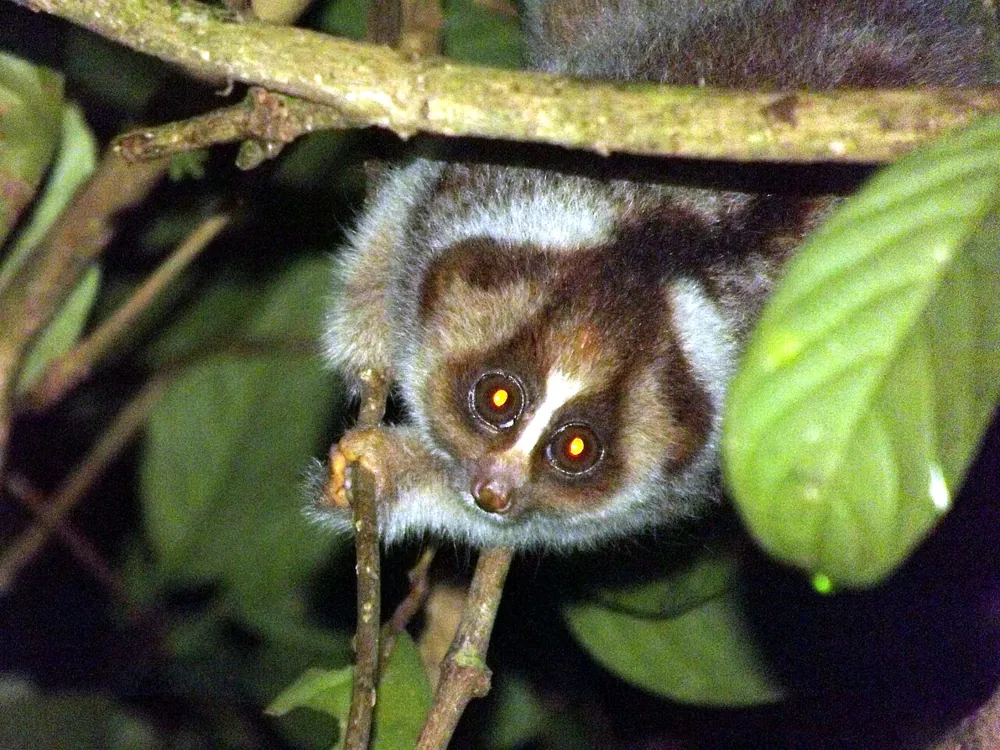
 Tsela ya go e lemoga
- High contrast between its black and white facial markings1
- The stripe between its eyes is sometimes bulb-shaped rather than rectangular1
- The ears are always covered in hair1
- Its fur is generally longer and fluffier than that of the Bornean slow loris1
Gantsi e tlhakanngwa le: It is often confused with the Bornean slow loris (N. menagensis). The Kayan River slow loris has more contrast in its facial markings, hairy ears instead of naked ears, and longer, fluffier fur.1
Maatla a botlhole
Botlhole bo tswa ka meno a yone fa e loma.
Botlhole jo e bo tsenyang bo dira eng?
It has a toxic bite, which is unusual among primates. A pungent, clear, oily toxin is made in a gland on the inside of its elbow. The animal licks this gland, and the secretion mixes with its saliva to become active. The toxin is also rubbed onto its fur as protection for infants.1
E kotsi go le kae go batho?
Kotsi go batho: E botlhokoE ka utlwisa botlhoko tota, mme go seoka thata gore e nne masisi.E dira eng fa e tshogile?
When threatened, it wipes the toxin from its elbow gland onto its toothcomb, and it may bite the attacker. Slow lorises can be slow to let go of a bite, which helps deliver more toxin.1
 Fa e loma
- Tlhatswa ntho sentle mme o batle thuso ya bongaka.
Ka gale leletsa nomoro ya gago ya tshoganyetso pele (112, 000, 911). Se ke kaelo e e akaretsang ya thuso ya ntlha, ga se kgakololo ya bongaka. Motheo wa thuso ya ntlha
 Nna o babalesegile
- O se ka wa ama, wa tshwara kgotsa wa tshwenya phologolo ya naga, le fa e le e nnye, le fa e lebega e robetse kgotsa e sule.
- E fe sebaka. Fa o kopana le yone, ritibala, boela morago ka bonya mme o e tlogele e tsamaye ka tsela ya yone.
- Fa e nngwe e go loma: ritibala, o se ka wa tshikinyega, leletsa nomoro ya gago ya tshoganyetso (112, 000, 911) kgotsa o ye bookelong ka bonako. Gopola gore e ne e lebega jang, setshwantsho se a thusa.
Ga e go batle. E dirisa botlhole jwa yone go tshwara dijo kgotsa go itshireletsa, mme e rata go iphitlha go feta. Go le gontsi ka go nna o babalesegile
Kae mo lefatsheng?
E kgolo go le kae?
E telele go le kae?
E kima go le kae?

 boleele jo bo lekanang le diboloko tsa go aga tsa ditshamekisi di le 9 mo moleng
 e ka taboga dimetara di le 100 ka metsotswana e le 180 (motho yo o bonako go gaisa o tlhoka 9,6)
Kayan River slow loris e kgolo go le kae fa e bapisiwa le WENA?
Ke dipalo fela mo sefetleng sa gago (browser). Ga go sepe se se bolokwang kgotsa se se romelwang gope.
E bonako go le kae?


Dintlha
It is one of the few primates known to have a toxic bite, and this is a unique feature among primates.1
Its face mask may help it recognise other lorises of its own kind, and it may also make its eyes look bigger than they really are, which can deter predators.1
It has a toothcomb, a set of specialised lower front teeth that it uses for grooming.1
Its population is estimated to have fallen by more than 30% over about 21 to 24 years.1
Mosenyi wa ditlhamane
Tlhamane: The Kayan River slow loris was always known as a separate species.
Nnete: Until 2013 its museum specimens were identified as the Bornean slow loris. A study of facial markings then showed it was a distinct species.1
Kwa dintlha di tswang teng
- Nycticebus kayan (Wikipedia (CC BY-SA 4.0))
- Nycticebus kayan (iNaturalist): maina le thulaganyo ya mefuta.
- Venom Wiki: seelo sa kotsi, bogolo jo bo tlwaelegileng le kakanyo ya lebelo ke tsa rona. Bona kafa re di balang ka teng: Kafa re lekanyang kotsi ka teng.
Ntlha nngwe le nngwe mo tsebeng e e na le nomoro e e supang motswedi wa yone. Fa re dirile phoso, maitshwarelo, re barati ba diphologolo, e seng kgatiso ya saense. Re bolelele kwa [email protected] mme re tla e baakanya.
 Phepheng e tshwerwe ke tlala! Venom Wiki ke porojeke ya motho a le mongwe: ke mahala, ga e na dipapatso le ditraka. Mpho e nnye e thusa go e tshegetsa mo inthaneteng.Fepa phepheng
Tse dingwe tsa setlhopha se se tshwanang: Diphologolo tse di anyisang tse di tsenyang botlhole
 Bengal slow lorisDiphologolo tse di anyisang tse di tsenyang botlholeE utlwisa botlhoko fela
 Javan slow lorisDiphologolo tse di anyisang tse di tsenyang botlholeE utlwisa botlhoko fela
 Pygmy slow lorisDiphologolo tse di anyisang tse di tsenyang botlholeE utlwisa botlhoko fela
 Sunda slow lorisDiphologolo tse di anyisang tse di tsenyang botlholeE utlwisa botlhoko fela
 Philippine slow lorisDiphologolo tse di anyisang tse di tsenyang botlholeE utlwisa botlhoko fela
 Eurasian water shrewDiphologolo tse di anyisang tse di tsenyang botlholeGa e na kotsi
 Deathstalker
 Indian cobra
 Indian saw-scaled viper
 King cobra
 Puff adder
 Phika ya ga Russell