
 Aforika
 Asia
Asia Yuropa
 Amerika Borwa
 Australia le Oceania
 Antarctica
 Lewatle la Pacific
 Lewatle la Atlantic
 Lewatle la India
 Lewatle la Arctic
 Lewatle la Mediterranean
 Lewatle le Lehibidu
 Lewatle la Caribbean
 Lewatle la Coral
 Lewatle la China Borwa
 Lewatle la Philippines
 Lewatle la Andaman
 Lewatle la Bokone
 Lewatle la Timor le la Arafura
 Kou ya Bengal
 Gulf ya California
Kuhl's maskray
 Go tlhaba
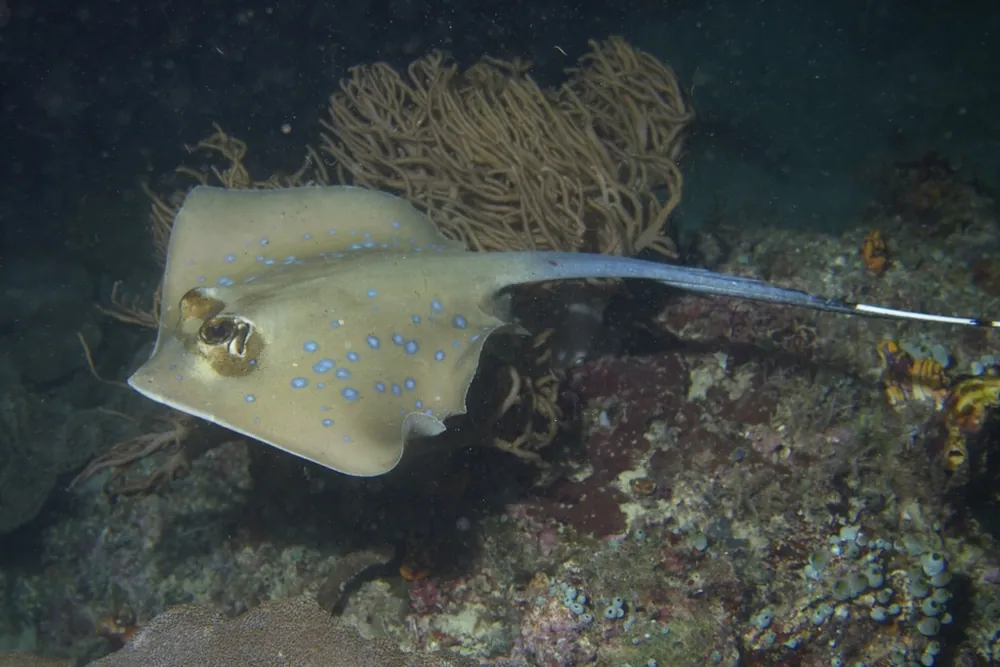
Kuhl's maskray is a flat, diamond-shaped stingray with green skin and blue spots. It lives on sandy and muddy seabeds in warm coastal waters from Indonesia to Japan and around most of Australia. Its tail has venomous spines, so it is important to know what it looks like and to keep a safe distance.1



 Tsela ya go e lemoga
- Flat, diamond-shaped (rhomboid) body that is dark green with blue spots1
- Light white underside1
- Very short snout with an angular disc1
- Bright yellow eyes1
- Long tail, about twice the length of the body, with two venomous spines at its base, one large and one medium in size1
Gantsi e tlhakanngwa le: It is often confused with the blue-spotted ribbontail ray, which is common in aquaria. The ribbontail has a rounded body, brighter green colouring and more vivid spots. Kuhl's maskray is larger.1
Maatla a botlhole
Botlhole bo tswa ka lemao le le tlhabang.
Botlhole jo e bo tsenyang bo dira eng?
The venom contains serotonin, 5' nucleotidase and phosphodiesterase. These are active compounds that act on the body's tissues.1
E kotsi go le kae go batho?
Kotsi go batho: E masisiGo tlhabiwa ke yone go tlhoka ngaka. Go swa go seoka thata.It is very venomous. Its barb can be about 30 cm long.1
E dira eng fa e tshogile?
Its bright colouring warns predators of its venomous spines. It buries itself in sand to hide from predators.1
 Fa e tlhaba
- Tsenya ntho mo metsing a a mogote, a a bollo jo motho a ka bo itshokang a sa fiswe (a leke ka seatla sa gago pele), metsotso e le 30 go ya go 90. Batla thuso ya bongaka, bogolo jang go ditlhapi tsa lefika le distingrei.
Ka gale leletsa nomoro ya gago ya tshoganyetso pele (112, 000, 911). Se ke kaelo e e akaretsang ya thuso ya ntlha, ga se kgakololo ya bongaka. Motheo wa thuso ya ntlha
 Nna o babalesegile
- O se ka wa ama, wa tshwara kgotsa wa tshwenya phologolo ya naga, le fa e le e nnye, le fa e lebega e robetse kgotsa e sule.
- E fe sebaka. Fa o kopana le yone, ritibala, boela morago ka bonya mme o e tlogele e tsamaye ka tsela ya yone.
- Fa e nngwe e go tlhaba: ritibala, o se ka wa tshikinyega, leletsa nomoro ya gago ya tshoganyetso (112, 000, 911) kgotsa o ye bookelong ka bonako. Gopola gore e ne e lebega jang, setshwantsho se a thusa.
Ga e go batle. E dirisa botlhole jwa yone go tshwara dijo kgotsa go itshireletsa, mme e rata go iphitlha go feta. Go le gontsi ka go nna o babalesegile
Kae mo lefatsheng?
E kgolo go le kae?
E telele go le kae?
 boleele jo bo lekanang le dipanana di le 4 di latelana
 e ka thuma boleele jwa bodiba jo bogolo jwa go thuma (50 m) ka metsotswana e le 12
Kuhl's maskray e kgolo go le kae fa e bapisiwa le WENA?
Ke dipalo fela mo sefetleng sa gago (browser). Ga go sepe se se bolokwang kgotsa se se romelwang gope.
E bonako go le kae?

Dintlha
Large sharks such as hammerhead sharks prey on it. A hammerhead pins it down with its head while the ray is in shock and much weaker.1
Its tail is about twice as long as its body and carries two venomous spines.1
Unlike most stingrays, which bury themselves to hunt, Kuhl's maskray buries itself in sand only to hide from predators.1
Its skin is used to make drums, such as the Arab and Turkish darbuka goblet drum and the riq tambourine.1
Two short peptides found in its hydrolysed proteins have shown protective effects against the oxidation of lipids, DNA and proteins. They may be useful as functional food ingredients or nutraceuticals.1
Ya baitseanape ba botlhole
- Leina la saense
- Neotrygon kuhlii
- Setlhopha
- Ditlhapi tse di tsenyang botlhole
- Lelapa
- Dasyatidae2
- Lekoko
- Myliobatiformes
- Dikontinente
- Lewatle la India, Lewatle la Pacific, Lewatle la Coral, Lewatle la Andaman, Lewatle la China Borwa, Lewatle la Philippines, Lewatle la Timor le la Arafura, Kou ya Bengal, Mawatle
- Masea
- It gives birth to live young. The embryos develop inside eggs held in the mother's body and are fed by uterine fluid. A litter can have up to seven pups, each 15 to 33 cm long at birth.1
- Dingwaga tsa botshelo
- e ka nna dingwaga di le 131
- Kotsi go batho
- 3 / 5: E masisi3
Kwa dintlha di tswang teng
- Kuhl's maskray (Wikipedia (CC BY-SA 4.0))
- Neotrygon kuhlii (iNaturalist): maina le thulaganyo ya mefuta.
- Venom Wiki: seelo sa kotsi, bogolo jo bo tlwaelegileng le kakanyo ya lebelo ke tsa rona. Bona kafa re di balang ka teng: Kafa re lekanyang kotsi ka teng.
Ntlha nngwe le nngwe mo tsebeng e e na le nomoro e e supang motswedi wa yone. Fa re dirile phoso, maitshwarelo, re barati ba diphologolo, e seng kgatiso ya saense. Re bolelele kwa [email protected] mme re tla e baakanya.
 Phepheng e tshwerwe ke tlala! Venom Wiki ke porojeke ya motho a le mongwe: ke mahala, ga e na dipapatso le ditraka. Mpho e nnye e thusa go e tshegetsa mo inthaneteng.Fepa phepheng
Tse dingwe tsa setlhopha se se tshwanang: Ditlhapi tse di tsenyang botlhole
 Reef stonefishDitlhapi tse di tsenyang botlholeE ka bolayaO se ka wa ama
 Red lionfishDitlhapi tse di tsenyang botlholeE tlhoka ngakaO se ka wa ama
 Estuarine stonefishDitlhapi tse di tsenyang botlholeE ka bolayaO se ka wa ama
 Short-tail stingrayDitlhapi tse di tsenyang botlholeE ka bolaya
 Striped eel catfishDitlhapi tse di tsenyang botlholeE ka bolayaO se ka wa ama
 Bluespotted ribbontail rayDitlhapi tse di tsenyang botlholeE tlhoka ngaka
E tshela gape kwa: Lewatle la India
 Australian box jellyfishDijelifishi le dibopiwa tsa lewatle tse di tlhabangE a bolayaO se ka wa ama
 Geography coneDikgopa tsa khouno le diokotopaseE a bolaya
 Greater blue-ringed octopusDikgopa tsa khouno le diokotopaseE a bolaya
 Southern blue-ringed octopusDikgopa tsa khouno le diokotopaseE a bolaya
 Hawksbill sea turtleDiphologolo tse dingwe tse di botlhole go di ama kgotsa go di jaE ka bolaya
 Irukandji jellyfishDijelifishi le dibopiwa tsa lewatle tse di tlhabangE ka bolayaO se ka wa ama