
 Aforika
 Asia
Asia Yuropa
 Amerika Borwa
 Australia le Oceania
 Antarctica
 Lewatle la Pacific
 Lewatle la Atlantic
 Lewatle la India
 Lewatle la Arctic
 Lewatle la Mediterranean
 Lewatle le Lehibidu
 Lewatle la Caribbean
 Lewatle la Coral
 Lewatle la China Borwa
 Lewatle la Philippines
 Lewatle la Andaman
 Lewatle la Bokone
 Lewatle la Timor le la Arafura
 Kou ya Bengal
 Gulf ya California
Lollyfish
 Botlhole mo letlalong la yoneE ja: Bonnye jwa sengwe le sengweE botlhole go e ama kgotsa go e ja, ga e tsenye botlhole
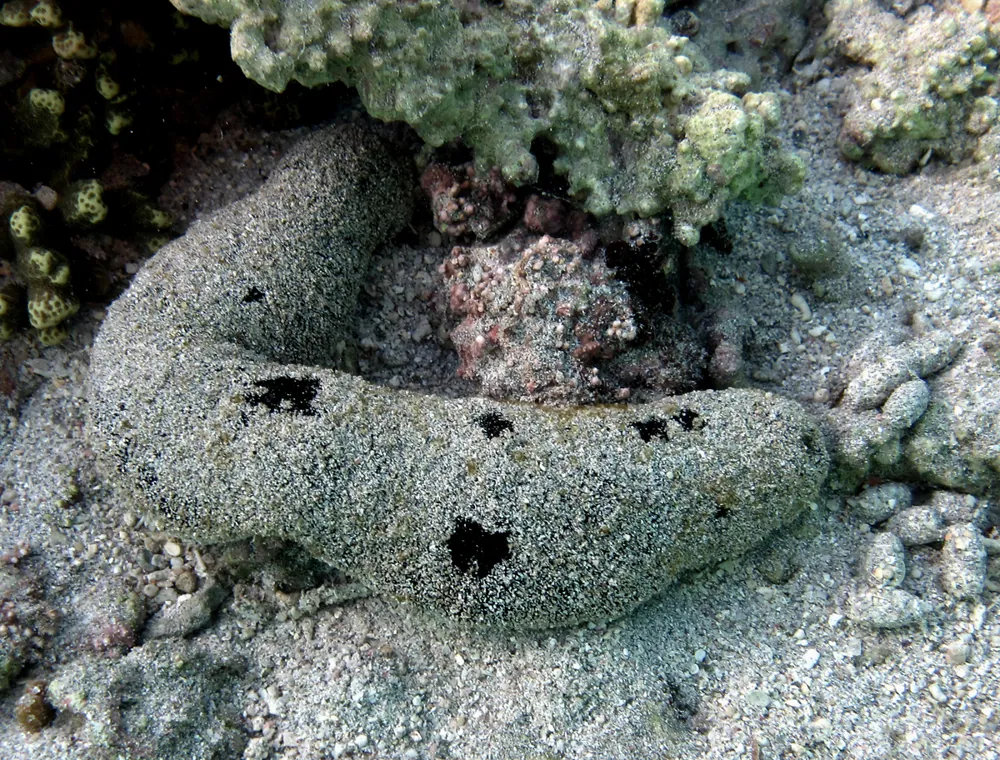
The lollyfish is a black sea cucumber, a soft-bodied animal that lives on the seabed. It is found in shallow tropical waters across the Indo-Pacific, from the Red Sea and East Africa to Australia. It matters to people because its skin releases a toxic red fluid when it is damaged.1
 Tsela ya go e lemoga
Maatla a botlhole
Letlalo la yone le botlhole. Go kotsi go e ama, go e latswa kgotsa go e ja.
Botlhole jwa yone (jwa go e ama kgotsa go e ja) bo dira eng?
It is not venomous. When its skin is rubbed or damaged, it releases a toxic red fluid.1
E kotsi go le kae go batho?
Kotsi go batho: Kotsi e nnyeJaaka go tlhabiwa ke notshe kgotsa go le kwa tlase. Ga e na kotsi go batho.E dira eng fa e tshogile?
When attacked, it pushes its internal organs out through its anus, and it releases a toxic red fluid when its skin is rubbed or damaged.1
 Fa mongwe a e amile kgotsa a e jele
- Tsenya ntho mo metsing a a mogote, a a bollo jo motho a ka bo itshokang a sa fiswe, mme o batle thuso ya bongaka go ntsha mitlwa. O se ka wa e epa ka bowena.
Ka gale leletsa nomoro ya gago ya tshoganyetso pele (112, 000, 911). Se ke kaelo e e akaretsang ya thuso ya ntlha, ga se kgakololo ya bongaka. Motheo wa thuso ya ntlha
 Nna o babalesegile
- O se ka wa ama, wa tshwara kgotsa wa tshwenya phologolo ya naga, le fa e le e nnye, le fa e lebega e robetse kgotsa e sule.
- E fe sebaka. Fa o kopana le yone, ritibala, boela morago ka bonya mme o e tlogele e tsamaye ka tsela ya yone.
- Fa o e amile kgotsa o e jele: o se ka wa gotlha matlho kgotsa molomo wa gago, tlhatswa diatla mme o batle thuso ya bongaka.
Ga e go batle. Botlhole jwa yone bo teng fela gore sepe se se ka se e je. Go le gontsi ka go nna o babalesegile
Kae mo lefatsheng?
E kgolo go le kae?
E telele go le kae?
 boleele jo bo lekanang le dipanana di le 3 di latelana
 bonya go feta kgopa ya tshingwana
Lollyfish e kgolo go le kae fa e bapisiwa le WENA?
Ke dipalo fela mo sefetleng sa gago (browser). Ga go sepe se se bolokwang kgotsa se se romelwang gope.
E bonako go le kae?


Dintlha
When attacked, it pushes its internal organs out through its anus rather than firing sticky Cuvierian tubules as some sea cucumbers do.1
On Guam, its toxic red fluid is used to drive octopuses out of their hiding holes.1
It can split in two by transverse fission, and a sand coating does not stick to the new surfaces.1
Pools warmed by the sun can reach 39 °C, and individuals there still appeared healthy and fed.1
A thick coating of sand may help keep it cool by shading it from the sun.1
Ya baitseanape ba botlhole
- Leina la saense
- Holothuria atra
- Setlhopha
- Di-urchin, dinaledi tsa lewatle le diboko
- Lelapa
- Holothuriidae2
- Lekoko
- Holothuriida
- Dikontinente
- Lewatle la Pacific, Lewatle la India, Lewatle le Lehibidu, Lewatle la Coral, Lewatle la Philippines, Lewatle la China Borwa, Lewatle la Timor le la Arafura, Kou ya Bengal, Mawatle
- Masea
- It is not possible to tell males from females by looking at them. It spawns mostly in summer and autumn, or all year in equatorial waters. It can also reproduce by splitting in two, which mostly happens to smaller animals.1
- Kotsi go batho
- 1 / 5: Kotsi e nnye3
Kwa dintlha di tswang teng
- Holothuria atra (Wikipedia (CC BY-SA 4.0))
- Holothuria atra (iNaturalist): maina le thulaganyo ya mefuta.
- Venom Wiki: seelo sa kotsi, bogolo jo bo tlwaelegileng le kakanyo ya lebelo ke tsa rona. Bona kafa re di balang ka teng: Kafa re lekanyang kotsi ka teng.
Ntlha nngwe le nngwe mo tsebeng e e na le nomoro e e supang motswedi wa yone. Fa re dirile phoso, maitshwarelo, re barati ba diphologolo, e seng kgatiso ya saense. Re bolelele kwa [email protected] mme re tla e baakanya.
 Phepheng e tshwerwe ke tlala! Venom Wiki ke porojeke ya motho a le mongwe: ke mahala, ga e na dipapatso le ditraka. Mpho e nnye e thusa go e tshegetsa mo inthaneteng.Fepa phepheng
Tse dingwe tsa setlhopha se se tshwanang: Di-urchin, dinaledi tsa lewatle le diboko
 Crown-of-thorns starfishDi-urchin, dinaledi tsa lewatle le dibokoE tlhoka ngakaO se ka wa ama
 Flower urchinDi-urchin, dinaledi tsa lewatle le dibokoE ka bolaya
 Fire urchinDi-urchin, dinaledi tsa lewatle le dibokoE tlhoka ngakaO se ka wa ama
 Bearded firewormDi-urchin, dinaledi tsa lewatle le dibokoE utlwisa botlhoko felaO se ka wa ama
 Black long-spined urchinDi-urchin, dinaledi tsa lewatle le dibokoE utlwisa botlhoko felaO se ka wa ama
 BloodwormDi-urchin, dinaledi tsa lewatle le dibokoE utlwisa botlhoko fela
E tshela gape kwa: Lewatle la Pacific
 Australian box jellyfishDijelifishi le dibopiwa tsa lewatle tse di tlhabangE a bolayaO se ka wa ama
 Geography coneDikgopa tsa khouno le diokotopaseE a bolaya
 Greater blue-ringed octopusDikgopa tsa khouno le diokotopaseE a bolaya
 Japanese pufferfishDiphologolo tse dingwe tse di botlhole go di ama kgotsa go di jaE a bolaya
 Southern blue-ringed octopusDikgopa tsa khouno le diokotopaseE a bolaya
 Hawksbill sea turtleDiphologolo tse dingwe tse di botlhole go di ama kgotsa go di jaE ka bolaya