
 Aforika
 Asia
Asia Yuropa
 Amerika Borwa
 Australia le Oceania
 Antarctica
 Lewatle la Pacific
 Lewatle la Atlantic
 Lewatle la India
 Lewatle la Arctic
 Lewatle la Mediterranean
 Lewatle le Lehibidu
 Lewatle la Caribbean
 Lewatle la Coral
 Lewatle la China Borwa
 Lewatle la Philippines
 Lewatle la Andaman
 Lewatle la Bokone
 Lewatle la Timor le la Arafura
 Kou ya Bengal
 Gulf ya California
Neuwied's lancehead
 Go loma
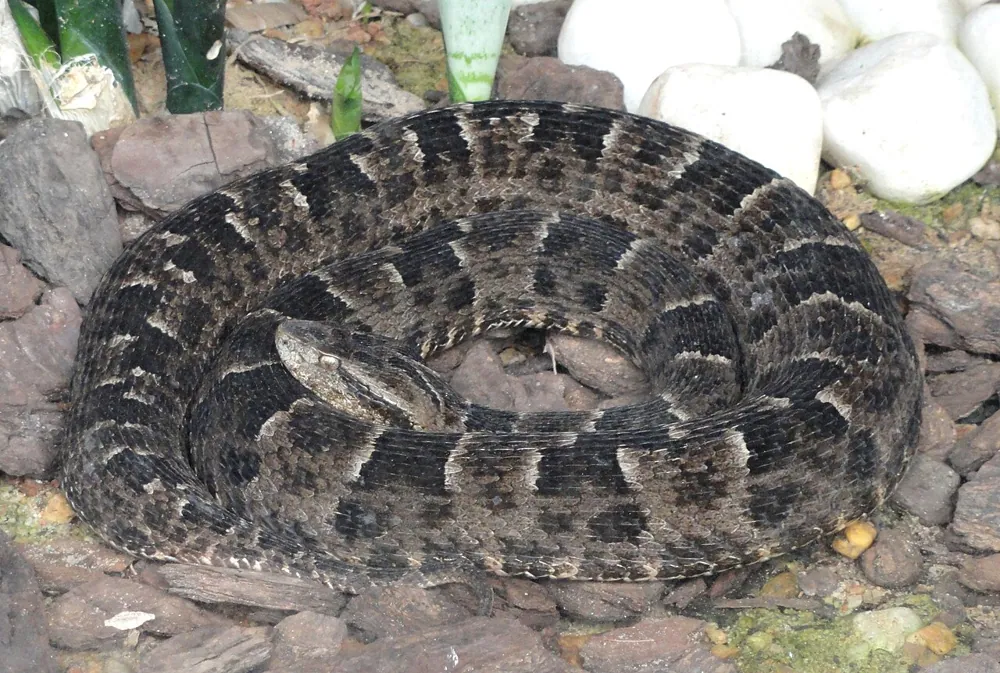
Neuwied's lancehead is a highly venomous pit viper found in South America. It is a relatively small snake, but it is a major cause of snakebites in Argentina. It lives east of the Andes, mostly in Brazil, Bolivia, Paraguay, Argentina and Uruguay.1
 Tsela ya go e lemoga
- Adults average 60–70 cm in total length, including the tail, but can grow to about 100 cm.1
- The ground colour is brown or dark brown.1
- A row of 16–27 dark brown or black blotches runs along the body, each edged in white.1
- The belly is white or yellow with grey speckling.1
- Young snakes have a white tail tip.1
Maatla a botlhole
Botlhole bo tswa ka meno a yone fa e loma.
Botlhole jo e bo tsenyang bo dira eng?
This snake is highly venomous. Its venom causes pain, swelling, bruising and necrosis (death of body tissue), and it can also lead to abscesses. The venom disturbs blood clotting: the venom has thrombin-like proteases, which slow the clotting of fibrinogen, a protein needed to form clots. Bites can also cause high blood pressure and collapse.1
E kotsi go le kae go batho?
Kotsi go batho: E kotsi thataE ka bolaya motho yo o sa alafiweng.This species is one of the main causes of snakebite in Argentina. Between 1960 and 1975, about 500 cases were reported there each year, and 80% of them were attributed to one subspecies, B. n. diporus. In a study of 18 bite cases admitted to a hospital in São Paulo from 1975 to 1992, all patients had pain, 83% had swelling, 50% had bruising, 17% had necrosis and 12% developed coagulopathy (a clotting disorder).1
 Dikgang tse di molemo: dingaka di na le molemo (antivenom) kgotsa kalafi ya se.1
 Fa e loma
- Three antivenins made by the Instituto Butantan in Brazil can be used to treat bites from this species. Treatment with heparin might help the clotting problems caused by the venom.1
- Dira gore motho a nne a sa tshikinyege a ritibetse, tshegetsa setho se se lomilweng mo boemong jwa pelo, tlosa direng le dilo tse di tiileng, mme o mo ise bookelong ka bonako.
Ka gale leletsa nomoro ya gago ya tshoganyetso pele (112, 000, 911). Se ke kaelo e e akaretsang ya thuso ya ntlha, ga se kgakololo ya bongaka. Motheo wa thuso ya ntlha
 Nna o babalesegile
- O se ka wa ama, wa tshwara kgotsa wa tshwenya phologolo ya naga, le fa e le e nnye, le fa e lebega e robetse kgotsa e sule.
- E fe sebaka. Fa o kopana le yone, ritibala, boela morago ka bonya mme o e tlogele e tsamaye ka tsela ya yone.
- Fa e nngwe e go loma: ritibala, o se ka wa tshikinyega, leletsa nomoro ya gago ya tshoganyetso (112, 000, 911) kgotsa o ye bookelong ka bonako. Gopola gore e ne e lebega jang, setshwantsho se a thusa.
Ga e go batle. E dirisa botlhole jwa yone go tshwara dijo kgotsa go itshireletsa, mme e rata go iphitlha go feta. Go le gontsi ka go nna o babalesegile
Kae mo lefatsheng?
E kgolo go le kae?
E telele go le kae?
 boleele jo bo lekanang le dikatse tsa ntlo di le 2 go tloga kwa nkong go ya mogatleng
 boleele jo bo lekanang le dipanana di le 6 di latelana
 e ka taboga dimetara di le 100 ka metsotswana e le 100 (motho yo o bonako go gaisa o tlhoka 9,6)
Neuwied's lancehead e kgolo go le kae fa e bapisiwa le WENA?
Ke dipalo fela mo sefetleng sa gago (browser). Ga go sepe se se bolokwang kgotsa se se romelwang gope.
E bonako go le kae?


Dintlha
Kwa dintlha di tswang teng
- Bothrops neuwiedi (Wikipedia (CC BY-SA 4.0))
- Bothrops neuwiedi (iNaturalist): maina le thulaganyo ya mefuta.
- Venom Wiki: seelo sa kotsi, bogolo jo bo tlwaelegileng le kakanyo ya lebelo ke tsa rona. Bona kafa re di balang ka teng: Kafa re lekanyang kotsi ka teng.
Ntlha nngwe le nngwe mo tsebeng e e na le nomoro e e supang motswedi wa yone. Fa re dirile phoso, maitshwarelo, re barati ba diphologolo, e seng kgatiso ya saense. Re bolelele kwa [email protected] mme re tla e baakanya.
 Phepheng e tshwerwe ke tlala! Venom Wiki ke porojeke ya motho a le mongwe: ke mahala, ga e na dipapatso le ditraka. Mpho e nnye e thusa go e tshegetsa mo inthaneteng.Fepa phepheng
Tse dingwe tsa setlhopha se se tshwanang: Divaepara tsa mesima (pit vipers)
 TerciopeloDivaepara tsa mesima (pit vipers)E a bolaya
 Eyelash viperDivaepara tsa mesima (pit vipers)E ka bolaya
 Golden lanceheadDivaepara tsa mesima (pit vipers)E ka bolaya
 South American bushmasterDivaepara tsa mesima (pit vipers)E ka bolaya
 Common lanceheadDivaepara tsa mesima (pit vipers)E a bolaya
 JararacaDivaepara tsa mesima (pit vipers)E ka bolaya
E tshela gape kwa: Amerika Borwa
 Golden poison frogDigwagwa tsa botlhole, digwagwa tse dingwe le dinewtE a bolayaO se ka wa ama
 Brazilian wandering spiderDigokgoE ka bolaya
 Cane toadDigwagwa tsa botlhole, digwagwa tse dingwe le dinewtE tlhoka ngakaO se ka wa ama
 Peruvian giant centipedeDisentipitiE tlhoka ngaka
 Bullet antDitshoswaneE utlwisa botlhoko fela
 Common vampire batDiphologolo tse di anyisang tse di tsenyang botlholeE utlwisa botlhoko fela