
 Aforika
 Asia
Asia Yuropa
 Amerika Borwa
 Australia le Oceania
 Antarctica
 Lewatle la Pacific
 Lewatle la Atlantic
 Lewatle la India
 Lewatle la Arctic
 Lewatle la Mediterranean
 Lewatle le Lehibidu
 Lewatle la Caribbean
 Lewatle la Coral
 Lewatle la China Borwa
 Lewatle la Philippines
 Lewatle la Andaman
 Lewatle la Bokone
 Lewatle la Timor le la Arafura
 Kou ya Bengal
 Gulf ya California
Patagonia green racer
 Go loma
The Patagonia green racer is a medium-sized snake with a venomous bite, though its fangs sit at the back of its mouth. It lives in open country across much of South America, from northern Argentina to northeastern Brazil. It is special because it hunts other snakes, including its own kind.1

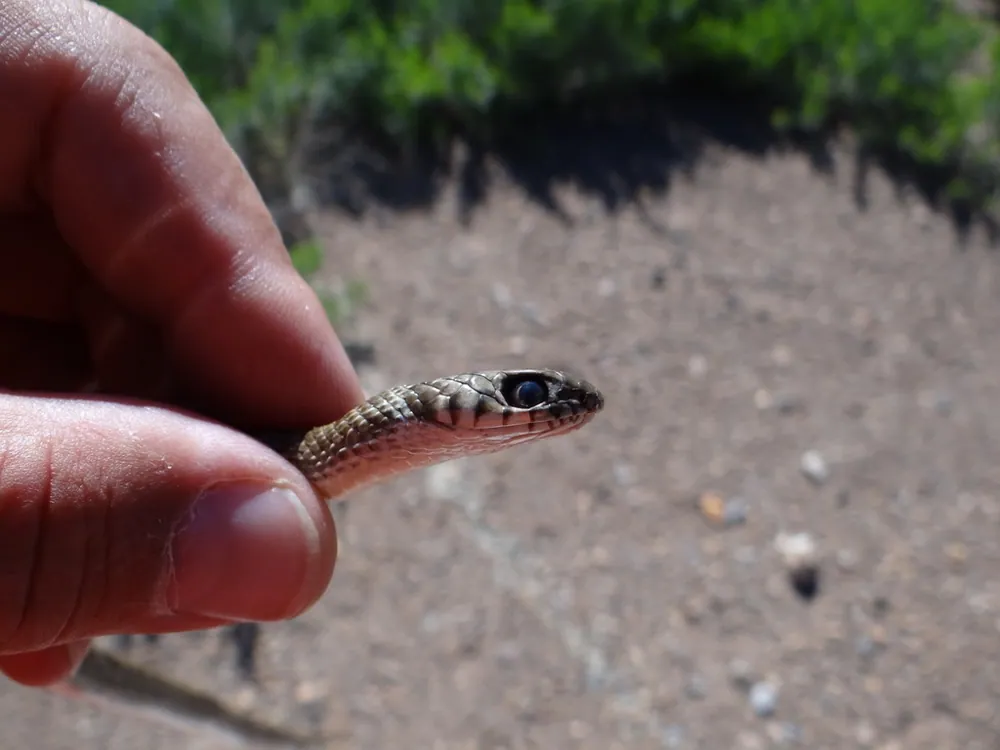
 Tsela ya go e lemoga
Maatla a botlhole
Botlhole bo tswa ka meno a yone fa e loma.
Botlhole jo e bo tsenyang bo dira eng?
It produces toxic saliva from a gland called the Duvernoy's gland. The toxin is about 90% protein, mainly metalloproteinases (enzymes that break down tissue). Its effects are similar to those of Bothrops snakes, causing swelling, bleeding and tissue death. Its venom also contains neurotoxic (nerve-attacking) and myotoxic (muscle-damaging) components, which can cause neuromuscular block (signals from nerves to muscles are interrupted) and myonecrosis (muscle death).1
E kotsi go le kae go batho?
Kotsi go batho: E botlhokoE ka utlwisa botlhoko tota, mme go seoka thata gore e nne masisi.The species has difficulty injecting venom because of its rear fangs.1
 Fa e loma
- Tlhatswa fa go lomilweng, dira gore motho a ritibale mme o batle thuso ya bongaka. Mefuta mengwe (jaaka boomslang) e ka bolaya diura morago.
Ka gale leletsa nomoro ya gago ya tshoganyetso pele (112, 000, 911). Se ke kaelo e e akaretsang ya thuso ya ntlha, ga se kgakololo ya bongaka. Motheo wa thuso ya ntlha
 Nna o babalesegile
- O se ka wa ama, wa tshwara kgotsa wa tshwenya phologolo ya naga, le fa e le e nnye, le fa e lebega e robetse kgotsa e sule.
- E fe sebaka. Fa o kopana le yone, ritibala, boela morago ka bonya mme o e tlogele e tsamaye ka tsela ya yone.
- Fa e nngwe e go loma: ritibala, o se ka wa tshikinyega, leletsa nomoro ya gago ya tshoganyetso (112, 000, 911) kgotsa o ye bookelong ka bonako. Gopola gore e ne e lebega jang, setshwantsho se a thusa.
Ga e go batle. E dirisa botlhole jwa yone go tshwara dijo kgotsa go itshireletsa, mme e rata go iphitlha go feta. Go le gontsi ka go nna o babalesegile
Kae mo lefatsheng?
E kgolo go le kae?
E telele go le kae?
 boleele jo bo lekanang le dikatse tsa ntlo di le 3 go tloga kwa nkong go ya mogatleng
 boleele jo bo lekanang le dipanana di le 8 di latelana
 e ka taboga dimetara di le 100 ka metsotswana e le 64 (motho yo o bonako go gaisa o tlhoka 9,6)
Patagonia green racer e kgolo go le kae fa e bapisiwa le WENA?
Ke dipalo fela mo sefetleng sa gago (browser). Ga go sepe se se bolokwang kgotsa se se romelwang gope.
E bonako go le kae?


Dintlha
It is one of the few snakes that hunts other snakes, including members of its own species.1
Its diet changes with age: juveniles eat cold-blooded prey, while adults eat warm-blooded prey.1
Despite its name, most of this snake's range lies outside Patagonia.1
Females are longer in body and heavier, while males have longer tails.1
Its birds of prey predators include the barn owl (Tyto furcata) and the seriema (Cariama cristata).1
Mosenyi wa ditlhamane
Tlhamane: Its name means it lives in Patagonia.
Nnete: Most of its range is outside Patagonia. It is found across Argentina, Bolivia, Brazil, Paraguay and Uruguay.1
Ya baitseanape ba botlhole
Kwa dintlha di tswang teng
- Philodryas patagoniensis (Wikipedia (CC BY-SA 4.0))
- Philodryas patagoniensis (iNaturalist): maina le thulaganyo ya mefuta.
- Venom Wiki: seelo sa kotsi, bogolo jo bo tlwaelegileng le kakanyo ya lebelo ke tsa rona. Bona kafa re di balang ka teng: Kafa re lekanyang kotsi ka teng.
Ntlha nngwe le nngwe mo tsebeng e e na le nomoro e e supang motswedi wa yone. Fa re dirile phoso, maitshwarelo, re barati ba diphologolo, e seng kgatiso ya saense. Re bolelele kwa [email protected] mme re tla e baakanya.
 Phepheng e tshwerwe ke tlala! Venom Wiki ke porojeke ya motho a le mongwe: ke mahala, ga e na dipapatso le ditraka. Mpho e nnye e thusa go e tshegetsa mo inthaneteng.Fepa phepheng
Tse dingwe tsa setlhopha se se tshwanang: Dinoga tse di nang le meno a botlhole kwa morago
 Baron's green racerDinoga tse di nang le meno a botlhole kwa moragoE utlwisa botlhoko fela
 False water cobraDinoga tse di nang le meno a botlhole kwa moragoE utlwisa botlhoko fela
 Brown vine snakeDinoga tse di nang le meno a botlhole kwa moragoGa e na kotsi
 Green vine snakeDinoga tse di nang le meno a botlhole kwa moragoGa e na kotsi
 Lichtenstein's green racerDinoga tse di nang le meno a botlhole kwa moragoE tlhoka ngaka
 Peruvian slender snakeDinoga tse di nang le meno a botlhole kwa moragoE tlhoka ngaka
E tshela gape kwa: Amerika Borwa
 Golden poison frogDigwagwa tsa botlhole, digwagwa tse dingwe le dinewtE a bolayaO se ka wa ama
 TerciopeloDivaepara tsa mesima (pit vipers)E a bolaya
 Brazilian wandering spiderDigokgoE ka bolaya
 Eyelash viperDivaepara tsa mesima (pit vipers)E ka bolaya
 Golden lanceheadDivaepara tsa mesima (pit vipers)E ka bolaya
 South American bushmasterDivaepara tsa mesima (pit vipers)E ka bolaya