
 Aforika
 Asia
Asia Yuropa
 Amerika Borwa
 Australia le Oceania
 Antarctica
 Lewatle la Pacific
 Lewatle la Atlantic
 Lewatle la India
 Lewatle la Arctic
 Lewatle la Mediterranean
 Lewatle le Lehibidu
 Lewatle la Caribbean
 Lewatle la Coral
 Lewatle la China Borwa
 Lewatle la Philippines
 Lewatle la Andaman
 Lewatle la Bokone
 Lewatle la Timor le la Arafura
 Kou ya Bengal
 Gulf ya California
Red imported fire ant
 Go tlhaba
The red imported fire ant is an ant that comes from South America. It has spread to Australia, New Zealand, parts of Asia, the Caribbean, Europe and the United States, where it is seen as a serious pest. Its sting burns, and in some people it causes a dangerous allergic reaction.1



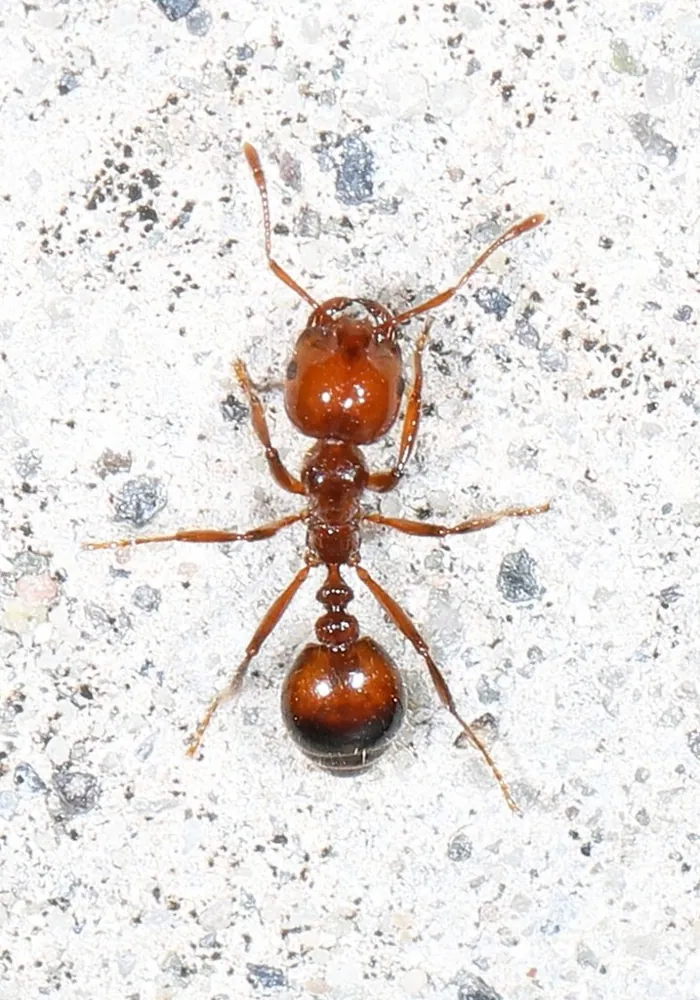
 Tsela ya go e lemoga
Maatla a botlhole
Botlhole bo tswa ka lemao le le tlhabang.
Botlhole jo e bo tsenyang bo dira eng?
About 95% of its venom is made of water-insoluble piperidine alkaloids called solenopsins, and the rest is a mixture of toxic proteins that can be especially strong in sensitive people. Most stings cause intense burning and swelling, followed by sterile pustules (small fluid-filled bumps) that can last several days. In some people, a severe allergic reaction called anaphylaxis can occur, with dizziness, chest pain, nausea, severe sweating, low blood pressure, shortness of breath and slurred speech.1
E kotsi go le kae go batho?
Kotsi go batho: E botlhokoE ka utlwisa botlhoko tota, mme go seoka thata gore e nne masisi.More than 14 million people are stung by these ants each year in the United States, and many are expected to develop allergies to the venom. Between 0.6% and 6.0% of people may suffer anaphylaxis, which can be fatal if left untreated. More than 80 deaths have been recorded from attacks by this ant.1
 Dikgang tse di molemo: dingaka di na le molemo (antivenom) kgotsa kalafi ya se.1
E dira eng fa e tshogile?
It uses its venom and chemical signals (pheromones) to defend itself and its nest.1
 Fa e tlhaba
- People who only have pain and pustules need no medical attention. People who develop anaphylaxis need emergency treatment with adrenaline. Whole body extract immunotherapy is used to treat people who are allergic and is regarded as highly effective.1
- Tlhatswa le go tsidifatsa mafelo a a tlhabilweng.
- Fa motho a hema ka bothata, sefatlhego kgotsa mometso o ruruga, kgotsa a ikutlwa a tla idibala, ke tshoganyetso ya aletshi: leletsa nomoro ya gago ya tshoganyetso.
Ka gale leletsa nomoro ya gago ya tshoganyetso pele (112, 000, 911). Se ke kaelo e e akaretsang ya thuso ya ntlha, ga se kgakololo ya bongaka. Motheo wa thuso ya ntlha
 Nna o babalesegile
- O se ka wa ama, wa tshwara kgotsa wa tshwenya phologolo ya naga, le fa e le e nnye, le fa e lebega e robetse kgotsa e sule.
- E fe sebaka. Fa o kopana le yone, ritibala, boela morago ka bonya mme o e tlogele e tsamaye ka tsela ya yone.
- Fa e nngwe e go tlhaba: ritibala, o se ka wa tshikinyega, leletsa nomoro ya gago ya tshoganyetso (112, 000, 911) kgotsa o ye bookelong ka bonako. Gopola gore e ne e lebega jang, setshwantsho se a thusa.
Ga e go batle. E dirisa botlhole jwa yone go tshwara dijo kgotsa go itshireletsa, mme e rata go iphitlha go feta. Go le gontsi ka go nna o babalesegile
Kae mo lefatsheng?
E kgolo go le kae?
E telele go le kae?
 e nnye mo e ka nnang mo lenaleng la gago
Red imported fire ant e kgolo go le kae fa e bapisiwa le WENA?
Ke dipalo fela mo sefetleng sa gago (browser). Ga go sepe se se bolokwang kgotsa se se romelwang gope.
E bonako go le kae?


Dintlha
When water levels rise, these ants build rafts to float on.1
A single mature colony can contain between 500,000 and 2,000,000 individuals.1
Over 1,800 scientific papers have been published using its name, and it is one of the most studied insects on the planet, rivalling the western honey bee.1
Workers dispose of scraps and dead ants on refuse piles outside the nest, a behaviour called necrophoric behaviour.1
Workers can live for several months, while queens can live for years.1
Mosenyi wa ditlhamane
Tlhamane: The name "fire ant" comes from fire or burning nests.
Nnete: The name comes from the burning sensation caused by its sting.1
Ya baitseanape ba botlhole
- Leina la saense
- Solenopsis invicta
- Setlhopha
- Ditshoswane
- Lelapa
- Formicidae2
- Lekoko
- Hymenoptera
- Dikontinente
- Amerika Borwa
- Masea
- Winged males and queens mate during a nuptial flight in the warm seasons. A colony can be started by a single queen or by a group of queens, which later compete for dominance once the first workers emerge.1
- Kotsi go batho
- 2 / 5: E botlhoko3
Kwa dintlha di tswang teng
- Red imported fire ant (Wikipedia (CC BY-SA 4.0))
- Solenopsis invicta (iNaturalist): maina le thulaganyo ya mefuta.
- Venom Wiki: seelo sa kotsi, bogolo jo bo tlwaelegileng le kakanyo ya lebelo ke tsa rona. Bona kafa re di balang ka teng: Kafa re lekanyang kotsi ka teng.
Ntlha nngwe le nngwe mo tsebeng e e na le nomoro e e supang motswedi wa yone. Fa re dirile phoso, maitshwarelo, re barati ba diphologolo, e seng kgatiso ya saense. Re bolelele kwa [email protected] mme re tla e baakanya.
 Phepheng e tshwerwe ke tlala! Venom Wiki ke porojeke ya motho a le mongwe: ke mahala, ga e na dipapatso le ditraka. Mpho e nnye e thusa go e tshegetsa mo inthaneteng.Fepa phepheng
Tse dingwe tsa setlhopha se se tshwanang: Ditshoswane
 Bullet ant
 Army ant
 Giant Amazonian ant
 Trap-jaw ant
 Black imported fire ant
 Dinosaur ant of Brazil
E tshela gape kwa: Amerika Borwa
 Golden poison frogDigwagwa tsa botlhole, digwagwa tse dingwe le dinewtE a bolayaO se ka wa ama
 TerciopeloDivaepara tsa mesima (pit vipers)E a bolaya
 Brazilian wandering spiderDigokgoE ka bolaya
 Eyelash viperDivaepara tsa mesima (pit vipers)E ka bolaya
 Golden lanceheadDivaepara tsa mesima (pit vipers)E ka bolaya
 South American bushmasterDivaepara tsa mesima (pit vipers)E ka bolaya