
 Aforika
 Asia
Asia Yuropa
 Amerika Borwa
 Australia le Oceania
 Antarctica
 Lewatle la Pacific
 Lewatle la Atlantic
 Lewatle la India
 Lewatle la Arctic
 Lewatle la Mediterranean
 Lewatle le Lehibidu
 Lewatle la Caribbean
 Lewatle la Coral
 Lewatle la China Borwa
 Lewatle la Philippines
 Lewatle la Andaman
 Lewatle la Bokone
 Lewatle la Timor le la Arafura
 Kou ya Bengal
 Gulf ya California
Red Sea fire urchin
 Mitlwa ya botlhole
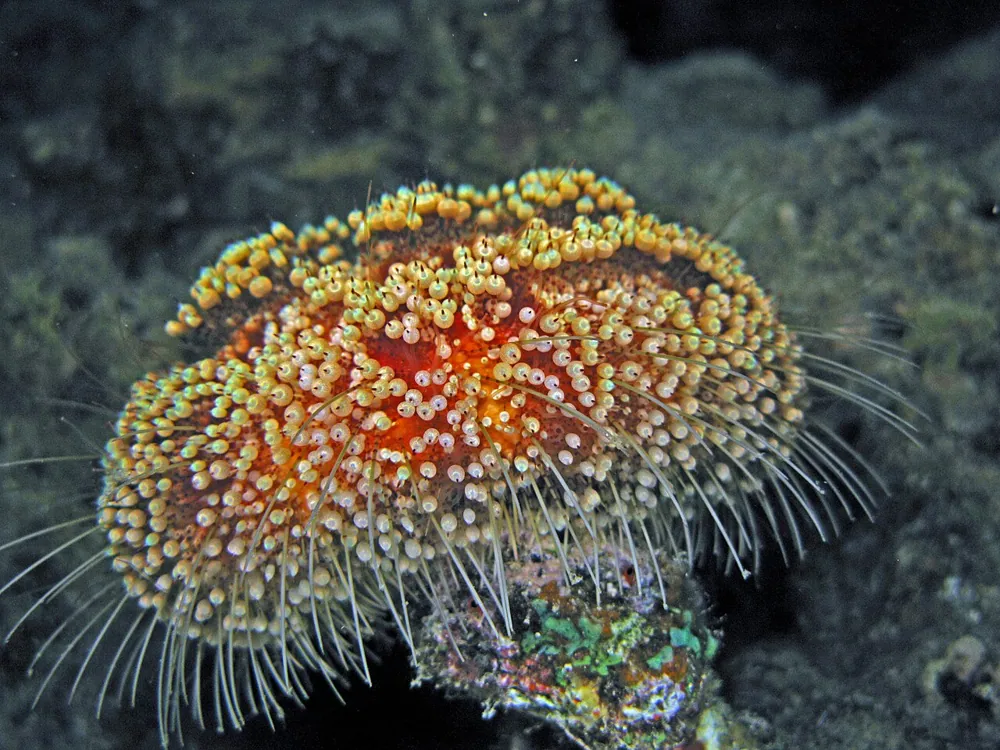
The Red Sea fire urchin is a spiny sea creature that lives on the seabed. It is a fairly common sea urchin across much of the Indo-Pacific. Its spines can cause extreme pain, so it is important to know it when you are in the water.1


 Tsela ya go e lemoga
- Its spines regularly cover the whole aboral (back) side of its body.1
- Its body plates are articulated, which makes the test (shell) quite flexible.1
- It is most active at night.1
Gantsi e tlhakanngwa le: It was once considered a colour variant of Asthenosoma varium. In the Red Sea fire urchin, the spines cover the whole back side evenly. In A. varium, the spines are grouped in rectangular patches separated by bare areas.1
Maatla a botlhole
Mitlwa e e bogale e rwala botlhole. Go e gata kgotsa go e tshwara go a utlwisa botlhoko.
Botlhole jo e bo tsenyang bo dira eng?
Its spines inflict extreme pain on anyone who is pricked by them. The pain is the main effect described for this urchin.1
E kotsi go le kae go batho?
Kotsi go batho: E masisiFa mitlwa ya yone e go tlhaba, ya kwa ngakeng. Go swa go seoka thata.Its spines cause extreme pain, which is the main danger to people who touch it or come into contact with its spines.1
 Fa mitlwa ya yone e go tlhaba
- Tsenya ntho mo metsing a a mogote, a a bollo jo motho a ka bo itshokang a sa fiswe, mme o batle thuso ya bongaka go ntsha mitlwa. O se ka wa e epa ka bowena.
Ka gale leletsa nomoro ya gago ya tshoganyetso pele (112, 000, 911). Se ke kaelo e e akaretsang ya thuso ya ntlha, ga se kgakololo ya bongaka. Motheo wa thuso ya ntlha
 Nna o babalesegile
- O se ka wa ama, wa tshwara kgotsa wa tshwenya phologolo ya naga, le fa e le e nnye, le fa e lebega e robetse kgotsa e sule.
- E fe sebaka. Fa o kopana le yone, ritibala, boela morago ka bonya mme o e tlogele e tsamaye ka tsela ya yone.
- Fa mitlwa ya yone e go tlhaba: ritibala, o se ka wa tshikinyega, leletsa nomoro ya gago ya tshoganyetso (112, 000, 911) kgotsa o ye bookelong ka bonako. Gopola gore e ne e lebega jang, setshwantsho se a thusa.
Ga e go batle. E dirisa botlhole jwa yone go tshwara dijo kgotsa go itshireletsa, mme e rata go iphitlha go feta. Go le gontsi ka go nna o babalesegile
Kae mo lefatsheng?
E kgolo go le kae?
E telele go le kae?
 boleele jo bo lekanang le diboloko tsa go aga tsa ditshamekisi di le 8 mo moleng
 bonya go feta kgopa ya tshingwana
Red Sea fire urchin e kgolo go le kae fa e bapisiwa le WENA?
Ke dipalo fela mo sefetleng sa gago (browser). Ga go sepe se se bolokwang kgotsa se se romelwang gope.
E bonako go le kae?


Dintlha
It often shelters commensal shrimps, including Allopontonia iaini and Periclimenes colemani, and the parasitic gastropod Leutzenia asthenosomae.1
Until 1998 it was considered a colour variant of Asthenosoma varium.1
Sea urchins are close relatives of starfish, crinoids, brittle stars and sea cucumbers. Together these are called echinoderms, meaning 'spiny skins'.1
Kwa dintlha di tswang teng
- Asthenosoma marisrubri (Wikipedia (CC BY-SA 4.0))
- Asthenosoma marisrubri (iNaturalist): maina le thulaganyo ya mefuta.
- Venom Wiki: seelo sa kotsi, bogolo jo bo tlwaelegileng le kakanyo ya lebelo ke tsa rona. Bona kafa re di balang ka teng: Kafa re lekanyang kotsi ka teng.
Ntlha nngwe le nngwe mo tsebeng e e na le nomoro e e supang motswedi wa yone. Fa re dirile phoso, maitshwarelo, re barati ba diphologolo, e seng kgatiso ya saense. Re bolelele kwa [email protected] mme re tla e baakanya.
 Phepheng e tshwerwe ke tlala! Venom Wiki ke porojeke ya motho a le mongwe: ke mahala, ga e na dipapatso le ditraka. Mpho e nnye e thusa go e tshegetsa mo inthaneteng.Fepa phepheng
Tse dingwe tsa setlhopha se se tshwanang: Di-urchin, dinaledi tsa lewatle le diboko
 Crown-of-thorns starfishDi-urchin, dinaledi tsa lewatle le dibokoE tlhoka ngakaO se ka wa ama
 Flower urchinDi-urchin, dinaledi tsa lewatle le dibokoE ka bolaya
 Fire urchinDi-urchin, dinaledi tsa lewatle le dibokoE tlhoka ngakaO se ka wa ama
 Bearded firewormDi-urchin, dinaledi tsa lewatle le dibokoE utlwisa botlhoko felaO se ka wa ama
 Black long-spined urchinDi-urchin, dinaledi tsa lewatle le dibokoE utlwisa botlhoko felaO se ka wa ama
 BloodwormDi-urchin, dinaledi tsa lewatle le dibokoE utlwisa botlhoko fela
E tshela gape kwa: Lewatle le Lehibidu
 Hawksbill sea turtleDiphologolo tse dingwe tse di botlhole go di ama kgotsa go di jaE ka bolaya
 Reef stonefishDitlhapi tse di tsenyang botlholeE ka bolayaO se ka wa ama
 Red lionfishDitlhapi tse di tsenyang botlholeE tlhoka ngakaO se ka wa ama
 Common octopusDikgopa tsa khouno le diokotopaseGa e na kotsi
 Moon jellyfishDijelifishi le dibopiwa tsa lewatle tse di tlhabangGa e na kotsi
 Silver-cheeked toadfishDiphologolo tse dingwe tse di botlhole go di ama kgotsa go di jaE a bolaya