
 Aforika
 Asia
Asia Yuropa
 Amerika Borwa
 Australia le Oceania
 Antarctica
 Lewatle la Pacific
 Lewatle la Atlantic
 Lewatle la India
 Lewatle la Arctic
 Lewatle la Mediterranean
 Lewatle le Lehibidu
 Lewatle la Caribbean
 Lewatle la Coral
 Lewatle la China Borwa
 Lewatle la Philippines
 Lewatle la Andaman
 Lewatle la Bokone
 Lewatle la Timor le la Arafura
 Kou ya Bengal
 Gulf ya California
Red widow
 Go loma
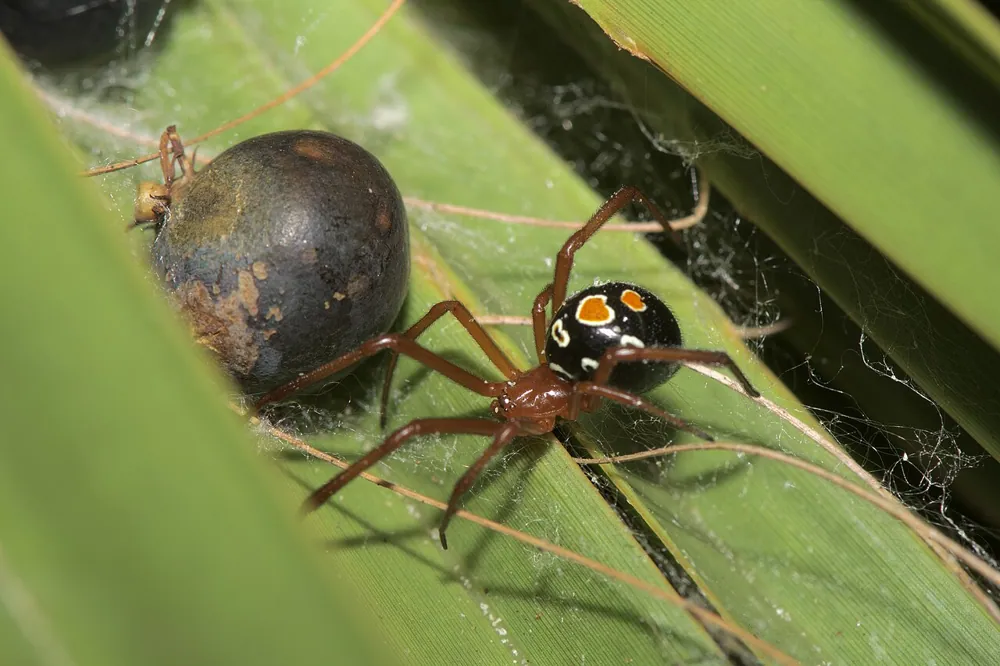
The red widow is a venomous spider that lives only in Florida, in the dry, sandy scrub where sand pine trees grow. It is a close relative of the black widow, but it rarely comes into contact with people, so it is not often met. Its bright red colours make it easy to recognise.1

 Tsela ya go e lemoga
- The cephalothorax (the front part of the body) is red-orange.1
- The abdomen is black, with yellow rings outlining rows of red spots.1
- The legs are vermilion red.1
- The underside does not have the familiar hourglass marking. It usually has one or two small red marks instead.1
- Females are almost double the size of males.1
Gantsi e tlhakanngwa le: It is closely related to the black widow (Latrodectus mactans). The two can be told apart by features of the male and female genitalia, which are examined under magnification. The red widow's male embolus has one fewer loop, and the female's connecting ducts to the spermatheca also have one fewer loop.1
Maatla a botlhole
Botlhole bo tswa ka meno a yone fa e loma.
Botlhole jo e bo tsenyang bo dira eng?
The red widow is venomous like other members of the genus Latrodectus. In a documented bite, the main effect was a mildly painful throbbing sensation that lasted several hours. The median lethal dose (LD50) of its venom in mice is 2.20 mg/kg, and each spider contains about 0.157 mg of venom.1
E kotsi go le kae go batho?
Kotsi go batho: E botlhokoE ka utlwisa botlhoko tota, mme go seoka thata gore e nne masisi.No bites from this spider are recorded in the medical literature. It seldom comes into contact with humans, unlike the black and brown widows, which live close to people. One documented bite caused a mildly painful throbbing that lasted several hours.1
 Fa e loma
- Tlhatswa fa go lomilweng mme o tsenye pakana ya aese mo go gone go fokotsa botlhoko. Batla thuso ya bongaka fa botlhoko bo le bogolo, bo anama kgotsa motho a ikutlwa a sa siama.
Ka gale leletsa nomoro ya gago ya tshoganyetso pele (112, 000, 911). Se ke kaelo e e akaretsang ya thuso ya ntlha, ga se kgakololo ya bongaka. Motheo wa thuso ya ntlha
 Nna o babalesegile
- O se ka wa ama, wa tshwara kgotsa wa tshwenya phologolo ya naga, le fa e le e nnye, le fa e lebega e robetse kgotsa e sule.
- E fe sebaka. Fa o kopana le yone, ritibala, boela morago ka bonya mme o e tlogele e tsamaye ka tsela ya yone.
- Fa e nngwe e go loma: ritibala, o se ka wa tshikinyega, leletsa nomoro ya gago ya tshoganyetso (112, 000, 911) kgotsa o ye bookelong ka bonako. Gopola gore e ne e lebega jang, setshwantsho se a thusa.
Ga e go batle. E dirisa botlhole jwa yone go tshwara dijo kgotsa go itshireletsa, mme e rata go iphitlha go feta. Go le gontsi ka go nna o babalesegile
Kae mo lefatsheng?
E kgolo go le kae?
E telele go le kae?
 e ka nna boleele jo bo lekanang le jwa kelipi ya pampiri
Red widow e kgolo go le kae fa e bapisiwa le WENA?
Ke dipalo fela mo sefetleng sa gago (browser). Ga go sepe se se bolokwang kgotsa se se romelwang gope.
E bonako go le kae?


Dintlha
A bite was filmed and documented in 2023 by biologist Spencer Hoffman, one of the few recorded bites from this species.1
Females are almost double the size of males.1
Its predators are thought to include sphecid wasps and the Florida scrub jay.1
It lives in sand-pine scrub, a habitat found only in Florida and coastal Alabama.1
Mosenyi wa ditlhamane
Tlhamane: All widow spiders have the hourglass marking on the underside.
Nnete: The red widow does not have the familiar hourglass marking. It usually has one or two small red marks instead.1
Kwa dintlha di tswang teng
- Latrodectus bishopi (Wikipedia (CC BY-SA 4.0))
- Latrodectus bishopi (iNaturalist): maina le thulaganyo ya mefuta.
- Venom Wiki: seelo sa kotsi, bogolo jo bo tlwaelegileng le kakanyo ya lebelo ke tsa rona. Bona kafa re di balang ka teng: Kafa re lekanyang kotsi ka teng.
Ntlha nngwe le nngwe mo tsebeng e e na le nomoro e e supang motswedi wa yone. Fa re dirile phoso, maitshwarelo, re barati ba diphologolo, e seng kgatiso ya saense. Re bolelele kwa [email protected] mme re tla e baakanya.
 Phepheng e tshwerwe ke tlala! Venom Wiki ke porojeke ya motho a le mongwe: ke mahala, ga e na dipapatso le ditraka. Mpho e nnye e thusa go e tshegetsa mo inthaneteng.Fepa phepheng
Tse dingwe tsa setlhopha se se tshwanang: Digokgo
 Brown recluse
 Southern black widow
 Northern black widow
 Western black widow
 Bold jumping spider
 Golden silk orb-weaver
E tshela gape kwa: Amerika Bokone
 TerciopeloDivaepara tsa mesima (pit vipers)E a bolaya
 Eastern coral snakeDinoga tsa khoraleE ka bolaya
 Eastern diamondback rattlesnakeDinoga tsa ratheleE ka bolaya
 Eyelash viperDivaepara tsa mesima (pit vipers)E ka bolaya
 Timber rattlesnakeDinoga tsa ratheleE ka bolaya
 Western diamondback rattlesnakeDinoga tsa ratheleE ka bolaya