
 Aforika
 Asia
Asia Yuropa
 Amerika Borwa
 Australia le Oceania
 Antarctica
 Lewatle la Pacific
 Lewatle la Atlantic
 Lewatle la India
 Lewatle la Arctic
 Lewatle la Mediterranean
 Lewatle le Lehibidu
 Lewatle la Caribbean
 Lewatle la Coral
 Lewatle la China Borwa
 Lewatle la Philippines
 Lewatle la Andaman
 Lewatle la Bokone
 Lewatle la Timor le la Arafura
 Kou ya Bengal
 Gulf ya California
Six-spot burnet
 E botlhole go e jaE ja: DimelaE botlhole go e ama kgotsa go e ja, ga e tsenye botlhole
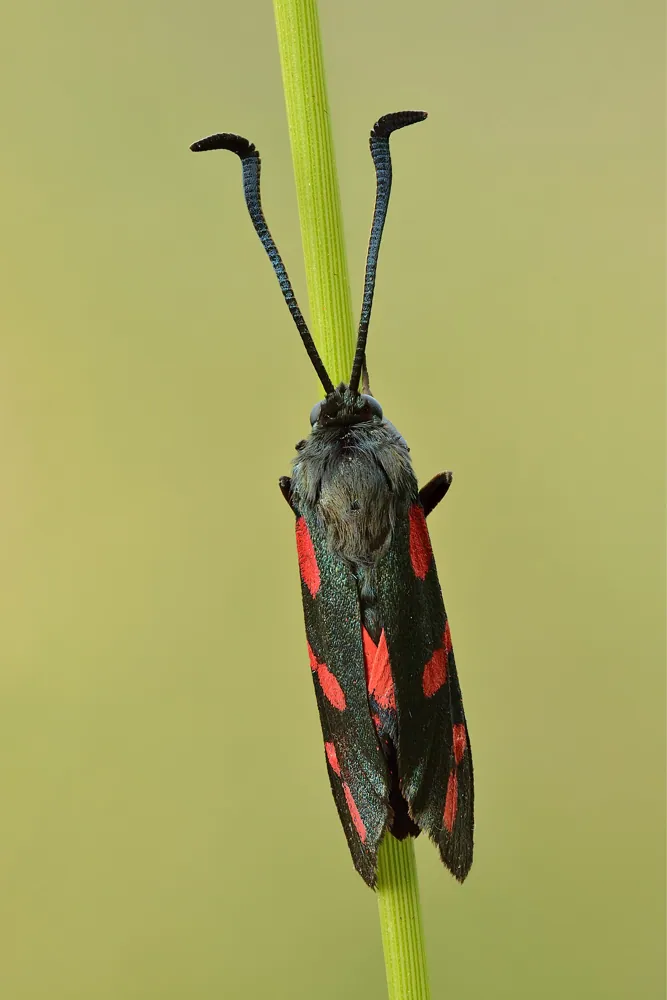
The six-spot burnet is a day-flying moth with dark green wings marked by six bright red spots. It lives in meadows and grassy places across much of Europe and parts of Asia. Its bright colours warn birds and lizards that it is toxic.1



 Tsela ya go e lemoga
- Forewings are dark metallic green with six vivid red spots1
- Sometimes the spots are merged together, or they are yellow or black1
- Hindwings are red with a blackish fringe1
- Wingspan is 30 to 40 mm, and the sexes look similar1
- Adults fly on hot, sunny days from June to August1
- Larva is plump and hairy, usually pale green with rows of black spots1
Gantsi e tlhakanngwa le: It can be confused with the five-spot burnet, especially when the spots on its forewings have merged together.1
Maatla a botlhole
E kotsi fela fa sengwe se e ja.
E kotsi go le kae go batho?
Kotsi go batho: Kotsi e nnyeJaaka go tlhabiwa ke notshe kgotsa go le kwa tlase. Ga e na kotsi go batho.E dira eng fa e tshogile?
When attacked, it releases a liquid containing cyanide, and its bright colours warn predators such as birds and lizards that it is toxic.1
 Fa mongwe a e amile kgotsa a e jele
- Fa mongwe a e jele kgotsa a na le matshwao morago ga go e ja: leletsa nomoro ya gago ya tshoganyetso kgotsa senthara ya botlhole ka yone nako eo.
Ka gale leletsa nomoro ya gago ya tshoganyetso pele (112, 000, 911). Se ke kaelo e e akaretsang ya thuso ya ntlha, ga se kgakololo ya bongaka. Motheo wa thuso ya ntlha
 Nna o babalesegile
- O se ka wa ama, wa tshwara kgotsa wa tshwenya phologolo ya naga, le fa e le e nnye, le fa e lebega e robetse kgotsa e sule.
- E fe sebaka. Fa o kopana le yone, ritibala, boela morago ka bonya mme o e tlogele e tsamaye ka tsela ya yone.
- Fa o e amile kgotsa o e jele: o se ka wa gotlha matlho kgotsa molomo wa gago, tlhatswa diatla mme o batle thuso ya bongaka.
Ga e go batle. Botlhole jwa yone bo teng fela gore sepe se se ka se e je. Go le gontsi ka go nna o babalesegile
Kae mo lefatsheng?
E kgolo go le kae?
E telele go le kae?
 e ka nna boleele jo bo lekanang le jwa kelipi ya pampiri
Six-spot burnet e kgolo go le kae fa e bapisiwa le WENA?
Ke dipalo fela mo sefetleng sa gago (browser). Ga go sepe se se bolokwang kgotsa se se romelwang gope.
E bonako go le kae?


_-_Kulna.jpg)
Dintlha
Ya baitseanape ba botlhole
- Leina la saense
- Zygaena filipendulae
- Setlhopha
- Diphologolo tse dingwe tse di botlhole go di ama kgotsa go di ja
- Lelapa
- Zygaenidae2
- Lekoko
- Lepidoptera
- Dikontinente
- Yuropa
- Masea
- The larva overwinters, pupates in early summer in a papery cocoon attached to a grass stem, and then emerges as an adult.1
- Kotsi go batho
- 1 / 5: Kotsi e nnye3
Kwa dintlha di tswang teng
- Six-spot burnet (Wikipedia (CC BY-SA 4.0))
- Zygaena filipendulae (iNaturalist): maina le thulaganyo ya mefuta.
- Venom Wiki: seelo sa kotsi, bogolo jo bo tlwaelegileng le kakanyo ya lebelo ke tsa rona. Bona kafa re di balang ka teng: Kafa re lekanyang kotsi ka teng.
Ntlha nngwe le nngwe mo tsebeng e e na le nomoro e e supang motswedi wa yone. Fa re dirile phoso, maitshwarelo, re barati ba diphologolo, e seng kgatiso ya saense. Re bolelele kwa [email protected] mme re tla e baakanya.
 Phepheng e tshwerwe ke tlala! Venom Wiki ke porojeke ya motho a le mongwe: ke mahala, ga e na dipapatso le ditraka. Mpho e nnye e thusa go e tshegetsa mo inthaneteng.Fepa phepheng
Tse dingwe tsa setlhopha se se tshwanang: Diphologolo tse dingwe tse di botlhole go di ama kgotsa go di ja
 Spanish flyDiphologolo tse dingwe tse di botlhole go di ama kgotsa go di jaE tlhoka ngakaO se ka wa ama
 Common quailDiphologolo tse dingwe tse di botlhole go di ama kgotsa go di jaE utlwisa botlhoko fela
 Cinnabar mothDiphologolo tse dingwe tse di botlhole go di ama kgotsa go di jaGa e na kotsi
 Black oil beetleDiphologolo tse dingwe tse di botlhole go di ama kgotsa go di jaE utlwisa botlhoko felaO se ka wa ama
 Red-striped oil beetleDiphologolo tse dingwe tse di botlhole go di ama kgotsa go di jaE utlwisa botlhoko felaO se ka wa ama
 Japanese pufferfishDiphologolo tse dingwe tse di botlhole go di ama kgotsa go di jaE a bolaya
E tshela gape kwa: Yuropa
 Common European adderDivaepara le diboloboloE tlhoka ngaka
 Common waspDinotshe, diwasepe le dihoneteE utlwisa botlhoko fela
 European hornetDinotshe, diwasepe le dihoneteE utlwisa botlhoko fela
 Fire salamanderDigwagwa tsa botlhole, digwagwa tse dingwe le dinewtE utlwisa botlhoko felaO se ka wa ama
 Western honey beeDinotshe, diwasepe le dihoneteE utlwisa botlhoko fela
 Blunt-nosed viperDivaepara le diboloboloE ka bolaya