
 Aforika
 Asia
Asia Yuropa
 Amerika Borwa
 Australia le Oceania
 Antarctica
 Lewatle la Pacific
 Lewatle la Atlantic
 Lewatle la India
 Lewatle la Arctic
 Lewatle la Mediterranean
 Lewatle le Lehibidu
 Lewatle la Caribbean
 Lewatle la Coral
 Lewatle la China Borwa
 Lewatle la Philippines
 Lewatle la Andaman
 Lewatle la Bokone
 Lewatle la Timor le la Arafura
 Kou ya Bengal
 Gulf ya California
Sri Lankan ornamental tarantula
 Go loma
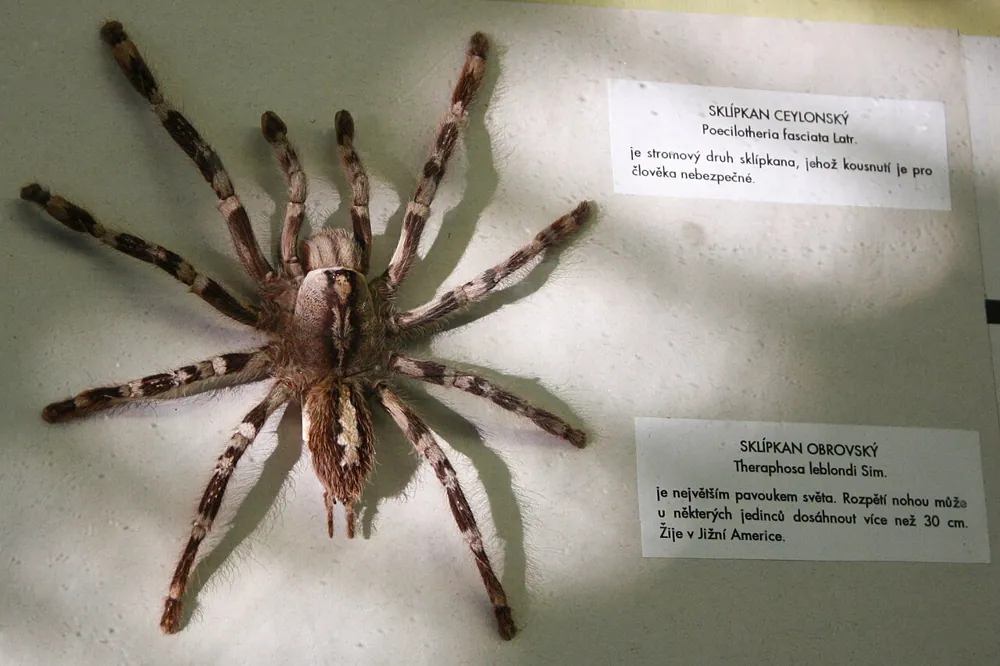
The Sri Lankan ornamental tarantula is a large spider that lives in trees. It is found only in central Sri Lanka, in dry and intermediate zones of the island. It is special because it is rare: its small range has shrunk, and it is now listed as endangered.1
 Tsela ya go e lemoga
- Females are black, white and grey, with cryptic markings on the legs and body.1
- Females have a narrow dark band on the thigh (femur) of the first pair of legs, and a thin broken band on the thigh of the fourth pair.1
- Males are a uniform brown with less intense markings.1
- Males have a dark black line down the abdomen, divided by diamond-shaped chevrons.1
Gantsi e tlhakanngwa le: It is often grouped with other tiger spiders. It can be told apart by the very narrow dark band on the thigh of the first pair of legs, and by the thin broken band on the thigh of the fourth pair.1
Maatla a botlhole
Botlhole bo tswa ka meno a yone fa e loma.
E kotsi go le kae go batho?
Kotsi go batho: E masisiGo lomiwa ke yone go tlhoka ngaka. Go swa go seoka thata.E dira eng fa e tshogile?
When disturbed, it becomes very defensive and quick to move.1
 Fa e loma
- Tlhatswa fa go lomilweng mme o go tsidifatse. Batla thuso ya bongaka fa botlhoko bo le bogolo kgotsa motho a ikutlwa a sa siama.
Ka gale leletsa nomoro ya gago ya tshoganyetso pele (112, 000, 911). Se ke kaelo e e akaretsang ya thuso ya ntlha, ga se kgakololo ya bongaka. Motheo wa thuso ya ntlha
 Nna o babalesegile
- O se ka wa ama, wa tshwara kgotsa wa tshwenya phologolo ya naga, le fa e le e nnye, le fa e lebega e robetse kgotsa e sule.
- E fe sebaka. Fa o kopana le yone, ritibala, boela morago ka bonya mme o e tlogele e tsamaye ka tsela ya yone.
- Fa e nngwe e go loma: ritibala, o se ka wa tshikinyega, leletsa nomoro ya gago ya tshoganyetso (112, 000, 911) kgotsa o ye bookelong ka bonako. Gopola gore e ne e lebega jang, setshwantsho se a thusa.
Ga e go batle. E dirisa botlhole jwa yone go tshwara dijo kgotsa go itshireletsa, mme e rata go iphitlha go feta. Go le gontsi ka go nna o babalesegile
Kae mo lefatsheng?
E kgolo go le kae?
E telele go le kae?
 khutshwane go feta monwana wa gago o monnye
 e ka taboga dimetara di le 100 ka metsotswana e le 180 (motho yo o bonako go gaisa o tlhoka 9,6)
Sri Lankan ornamental tarantula e kgolo go le kae fa e bapisiwa le WENA?
Ke dipalo fela mo sefetleng sa gago (browser). Ga go sepe se se bolokwang kgotsa se se romelwang gope.
E bonako go le kae?


Dintlha
Males are nomadic, moving from place to place, while females stay in one home.1
In 2018 it was listed as an endangered species under the U.S. Endangered Species Act.1
Habitat loss is the main threat, and collection for the pet trade, pesticides and killing out of fear add to the pressure.1
Females are larger than males, and only males wander.1
Its natural range is small, with less than 500 square kilometres of area occupied.1
Kwa dintlha di tswang teng
- Poecilotheria fasciata (Wikipedia (CC BY-SA 4.0))
- Poecilotheria fasciata (iNaturalist): maina le thulaganyo ya mefuta.
- Venom Wiki: seelo sa kotsi, bogolo jo bo tlwaelegileng le kakanyo ya lebelo ke tsa rona. Bona kafa re di balang ka teng: Kafa re lekanyang kotsi ka teng.
Ntlha nngwe le nngwe mo tsebeng e e na le nomoro e e supang motswedi wa yone. Fa re dirile phoso, maitshwarelo, re barati ba diphologolo, e seng kgatiso ya saense. Re bolelele kwa [email protected] mme re tla e baakanya.
 Phepheng e tshwerwe ke tlala! Venom Wiki ke porojeke ya motho a le mongwe: ke mahala, ga e na dipapatso le ditraka. Mpho e nnye e thusa go e tshegetsa mo inthaneteng.Fepa phepheng
Tse dingwe tsa setlhopha se se tshwanang: Ditarantula le di-funnel-web
 Gooty sapphire tarantulaDitarantula le di-funnel-webE tlhoka ngaka
 Indian ornamental tarantulaDitarantula le di-funnel-webE tlhoka ngaka
 Cobalt blue tarantulaDitarantula le di-funnel-webE utlwisa botlhoko fela
 Chinese bird spiderDitarantula le di-funnel-webE tlhoka ngaka
 Chinese black earth tiger tarantulaDitarantula le di-funnel-webE tlhoka ngaka
 Fringed ornamental tarantulaDitarantula le di-funnel-webE tlhoka ngaka
 Deathstalker
 Indian cobra
 Indian saw-scaled viper
 King cobra
 Puff adder
 Phika ya ga Russell