
 Aforika
 Asia
Asia Yuropa
 Amerika Borwa
 Australia le Oceania
 Antarctica
 Lewatle la Pacific
 Lewatle la Atlantic
 Lewatle la India
 Lewatle la Arctic
 Lewatle la Mediterranean
 Lewatle le Lehibidu
 Lewatle la Caribbean
 Lewatle la Coral
 Lewatle la China Borwa
 Lewatle la Philippines
 Lewatle la Andaman
 Lewatle la Bokone
 Lewatle la Timor le la Arafura
 Kou ya Bengal
 Gulf ya California
Venezuelan suntiger
 Go loma
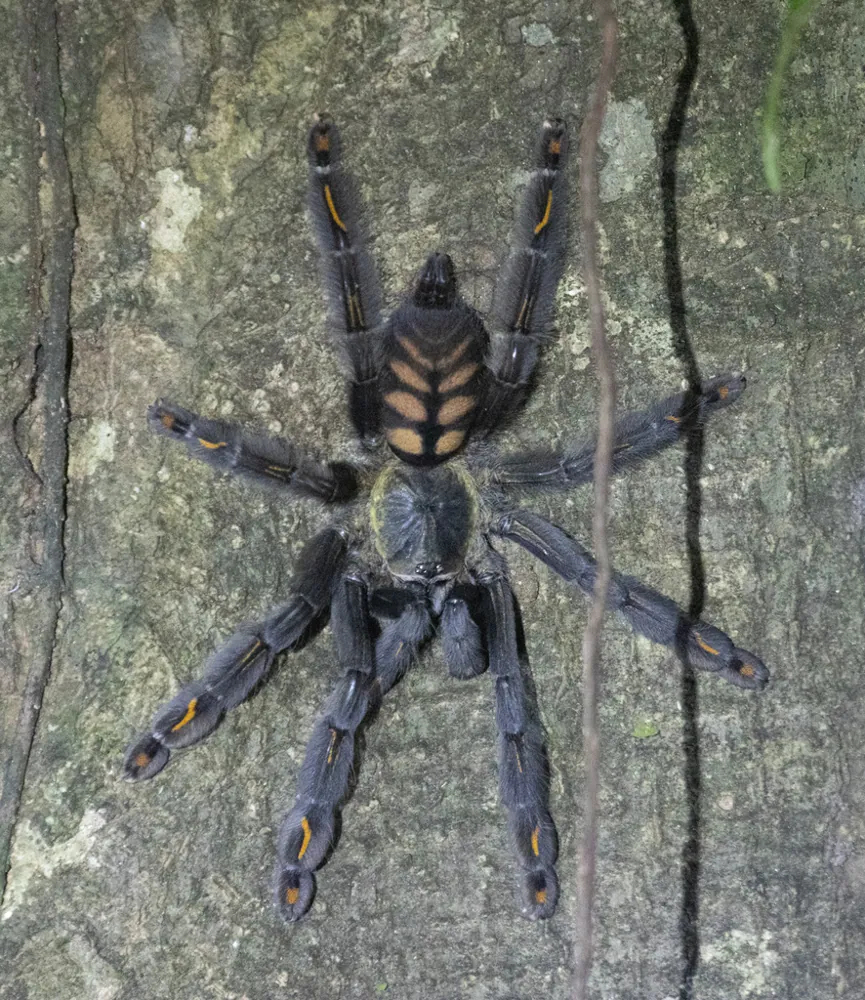
The Venezuelan suntiger is a tarantula that lives in the forests of northern South America. It spends much of its life in holes and crevices above ground, and it is a popular pet in the exotic pet trade. Its striking black and orange colours are the main reason it is so well known.1

 Tsela ya go e lemoga
- Black, with vibrant orange markings on the abdomen and legs.1
- Adults of both sexes have orange 'flame' markings on the legs, and the abdomen has a chevron pattern.1
- Once mature, the male turns entirely grey or grey-brown, keeping orange only on the tarsi (the last leg segments).1
- Mature males have much 'leggier' proportions than females.1
- Spiderlings are orange-red on the carapace (the upper body shell), with black legs and a black abdomen. They gradually gain adult colours with each moult.1
Maatla a botlhole
Botlhole bo tswa ka meno a yone fa e loma.
E kotsi go le kae go batho?
Kotsi go batho: E botlhokoE ka utlwisa botlhoko tota, mme go seoka thata gore e nne masisi.E dira eng fa e tshogile?
When threatened, it may flee into its retreat or raise its front legs and show its fangs in a threat posture. If it cannot escape, it bites. It does not throw urticating hairs, unlike most New World tarantulas.1
 Fa e loma
- Tlhatswa fa go lomilweng mme o go tsidifatse. Batla thuso ya bongaka fa botlhoko bo le bogolo kgotsa motho a ikutlwa a sa siama.
Ka gale leletsa nomoro ya gago ya tshoganyetso pele (112, 000, 911). Se ke kaelo e e akaretsang ya thuso ya ntlha, ga se kgakololo ya bongaka. Motheo wa thuso ya ntlha
 Nna o babalesegile
- O se ka wa ama, wa tshwara kgotsa wa tshwenya phologolo ya naga, le fa e le e nnye, le fa e lebega e robetse kgotsa e sule.
- E fe sebaka. Fa o kopana le yone, ritibala, boela morago ka bonya mme o e tlogele e tsamaye ka tsela ya yone.
- Fa e nngwe e go loma: ritibala, o se ka wa tshikinyega, leletsa nomoro ya gago ya tshoganyetso (112, 000, 911) kgotsa o ye bookelong ka bonako. Gopola gore e ne e lebega jang, setshwantsho se a thusa.
Ga e go batle. E dirisa botlhole jwa yone go tshwara dijo kgotsa go itshireletsa, mme e rata go iphitlha go feta. Go le gontsi ka go nna o babalesegile
Kae mo lefatsheng?
E kgolo go le kae?
E telele go le kae?
 boleele jo bo lekanang le diboloko tsa go aga tsa ditshamekisi di le 4 mo moleng
 e ka taboga dimetara di le 100 ka metsotswana e le 210 (motho yo o bonako go gaisa o tlhoka 9,6)
Venezuelan suntiger e kgolo go le kae fa e bapisiwa le WENA?
Ke dipalo fela mo sefetleng sa gago (browser). Ga go sepe se se bolokwang kgotsa se se romelwang gope.
E bonako go le kae?


Dintlha
Adult males change colour dramatically after their final moult, turning from black with orange to mostly grey.1
The undersides of its tarsi and metatarsi are iridescent, and they are visible during its threat display, which probably helps the display work.1
Psalmopoeus species lack the urticating hairs that most New World tarantulas use to defend themselves.1
Mature males spin special sperm webs, onto which they deposit sperm and then store it in their palpal bulbs (copulatory organs) ready for mating.1
The species is classed as a Psalmopoeus because it has stridulatory setae, also called a lyra, on its maxillae. No other described New World species has this trait.1
Kwa dintlha di tswang teng
- Psalmopoeus irminia (Wikipedia (CC BY-SA 4.0))
- Psalmopoeus irminia (iNaturalist): maina le thulaganyo ya mefuta.
- Venom Wiki: seelo sa kotsi, bogolo jo bo tlwaelegileng le kakanyo ya lebelo ke tsa rona. Bona kafa re di balang ka teng: Kafa re lekanyang kotsi ka teng.
Ntlha nngwe le nngwe mo tsebeng e e na le nomoro e e supang motswedi wa yone. Fa re dirile phoso, maitshwarelo, re barati ba diphologolo, e seng kgatiso ya saense. Re bolelele kwa [email protected] mme re tla e baakanya.
 Phepheng e tshwerwe ke tlala! Venom Wiki ke porojeke ya motho a le mongwe: ke mahala, ga e na dipapatso le ditraka. Mpho e nnye e thusa go e tshegetsa mo inthaneteng.Fepa phepheng
Tse dingwe tsa setlhopha se se tshwanang: Ditarantula le di-funnel-web
 Goliath birdeaterDitarantula le di-funnel-webE utlwisa botlhoko fela
 Brazilian salmon pink birdeaterDitarantula le di-funnel-webGa e na kotsi
 Chilean rose tarantulaDitarantula le di-funnel-webGa e na kotsi
 Greenbottle blue tarantulaDitarantula le di-funnel-webGa e na kotsi
 Pinktoe tarantulaDitarantula le di-funnel-webGa e na kotsi
 Brazilian funnel-web spiderDitarantula le di-funnel-webE tlhoka ngaka
E tshela gape kwa: Amerika Borwa
 Golden poison frogDigwagwa tsa botlhole, digwagwa tse dingwe le dinewtE a bolayaO se ka wa ama
 TerciopeloDivaepara tsa mesima (pit vipers)E a bolaya
 Brazilian wandering spiderDigokgoE ka bolaya
 Eyelash viperDivaepara tsa mesima (pit vipers)E ka bolaya
 Golden lanceheadDivaepara tsa mesima (pit vipers)E ka bolaya
 South American bushmasterDivaepara tsa mesima (pit vipers)E ka bolaya