
 Aforika
 Asia
Asia Yuropa
 Amerika Borwa
 Australia le Oceania
 Antarctica
 Lewatle la Pacific
 Lewatle la Atlantic
 Lewatle la India
 Lewatle la Arctic
 Lewatle la Mediterranean
 Lewatle le Lehibidu
 Lewatle la Caribbean
 Lewatle la Coral
 Lewatle la China Borwa
 Lewatle la Philippines
 Lewatle la Andaman
 Lewatle la Bokone
 Lewatle la Timor le la Arafura
 Kou ya Bengal
 Gulf ya California
Vinchuca kissing bug
 Go loma
The vinchuca, also called the kissing bug, is a blood-sucking bug found in South America. It is the most important carrier of a parasite that causes Chagas disease, and it is common in homes in the Southern Cone region.1

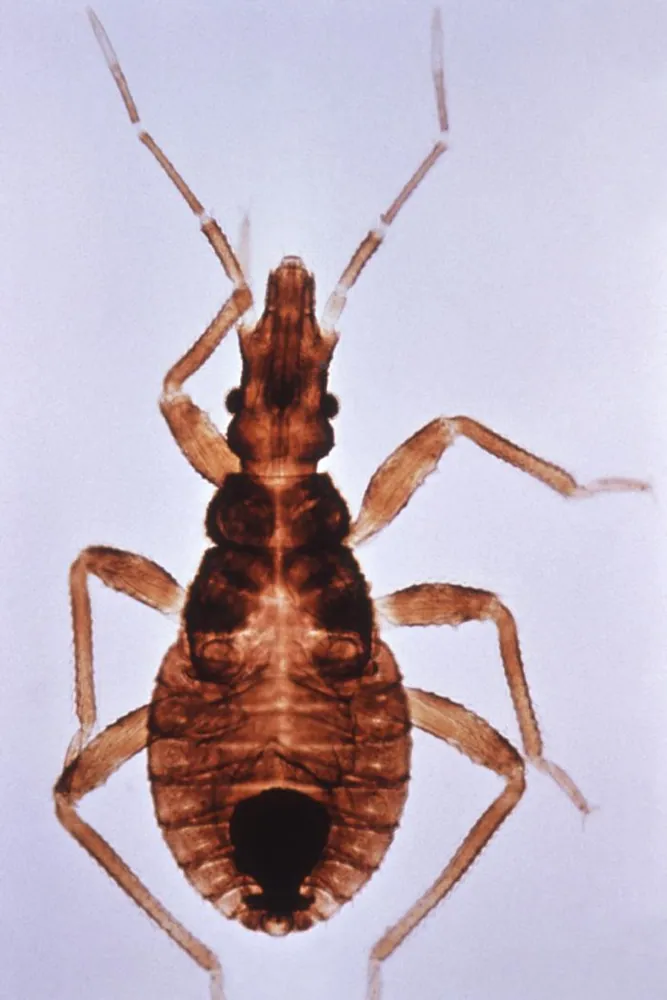
 Tsela ya go e lemoga
Maatla a botlhole
Botlhole bo tswa ka meno a yone fa e loma.
E kotsi go le kae go batho?
Kotsi go batho: E masisiGo lomiwa ke yone go tlhoka ngaka. Go swa go seoka thata.It is the most important carrier of the parasite Trypanosoma cruzi, which can lead to Chagas disease. The parasite is passed on through the bug's faeces, not through feeding. Darwin is speculated to have died from chronic Chagas disease. A regional control programme, the Southern Cone Initiative managed by PAHO, works to control it.1
 Fa e loma
- Ya meriri e e tlhabang ya diboko: e tlose ka theipi e e kgomarelang, morago o tlhatswe letlalo. O se ka wa gotlha.
- Fa e lomile: tlhatswa le go tsidifatsa. Batla thuso ya bongaka fa motho a ikutlwa a sa siama kgotsa a tswa madi bonolo.
Ka gale leletsa nomoro ya gago ya tshoganyetso pele (112, 000, 911). Se ke kaelo e e akaretsang ya thuso ya ntlha, ga se kgakololo ya bongaka. Motheo wa thuso ya ntlha
 Nna o babalesegile
- O se ka wa ama, wa tshwara kgotsa wa tshwenya phologolo ya naga, le fa e le e nnye, le fa e lebega e robetse kgotsa e sule.
- E fe sebaka. Fa o kopana le yone, ritibala, boela morago ka bonya mme o e tlogele e tsamaye ka tsela ya yone.
- Fa e nngwe e go loma: ritibala, o se ka wa tshikinyega, leletsa nomoro ya gago ya tshoganyetso (112, 000, 911) kgotsa o ye bookelong ka bonako. Gopola gore e ne e lebega jang, setshwantsho se a thusa.
Ga e go batle. E dirisa botlhole jwa yone go tshwara dijo kgotsa go itshireletsa, mme e rata go iphitlha go feta. Go le gontsi ka go nna o babalesegile
Kae mo lefatsheng?
E kgolo go le kae?
E telele go le kae?
 e ka nna boleele jo bo lekanang le jwa kelipi ya pampiri
Vinchuca kissing bug e kgolo go le kae fa e bapisiwa le WENA?
Ke dipalo fela mo sefetleng sa gago (browser). Ga go sepe se se bolokwang kgotsa se se romelwang gope.
E bonako go le kae?


Dintlha
Charles Darwin wrote about being attacked by one on 26 March 1835, during the Beagle survey voyage.1
Transmission of the parasite happens through its faeces, not through the act of feeding.1
Transmission rates are higher in areas with few bugs, because bugs in crowded areas interrupt each other's meals and often do not get a full blood meal.1
It tends to displace other Triatominae vectors of Chagas, such as Panstrongylus megistus and T. sordida.1
Brazil's spread of this bug between 1955 and 1964 is likely due to immigrants moving north from the south.1
Kwa dintlha di tswang teng
- Triatoma infestans (Wikipedia (CC BY-SA 4.0))
- Triatoma infestans (iNaturalist): maina le thulaganyo ya mefuta.
- Venom Wiki: seelo sa kotsi, bogolo jo bo tlwaelegileng le kakanyo ya lebelo ke tsa rona. Bona kafa re di balang ka teng: Kafa re lekanyang kotsi ka teng.
Ntlha nngwe le nngwe mo tsebeng e e na le nomoro e e supang motswedi wa yone. Fa re dirile phoso, maitshwarelo, re barati ba diphologolo, e seng kgatiso ya saense. Re bolelele kwa [email protected] mme re tla e baakanya.
 Phepheng e tshwerwe ke tlala! Venom Wiki ke porojeke ya motho a le mongwe: ke mahala, ga e na dipapatso le ditraka. Mpho e nnye e thusa go e tshegetsa mo inthaneteng.Fepa phepheng
Tse dingwe tsa setlhopha se se tshwanang: Diboko le dikhukhwane
 Giant silkworm moth caterpillarDiboko le dikhukhwaneE ka bolayaO se ka wa ama
 Venezuelan fire caterpillarDiboko le dikhukhwaneE ka bolayaO se ka wa ama
 Pararama caterpillarDiboko le dikhukhwaneE tlhoka ngakaO se ka wa ama
 Rhodnius kissing bugDiboko le dikhukhwaneE tlhoka ngaka
 Yellowtail moth of the mangrovesDiboko le dikhukhwaneE utlwisa botlhoko felaO se ka wa ama
 Milkweed assassin bugDiboko le dikhukhwaneGa e na kotsi
E tshela gape kwa: Amerika Borwa
 Golden poison frogDigwagwa tsa botlhole, digwagwa tse dingwe le dinewtE a bolayaO se ka wa ama
 TerciopeloDivaepara tsa mesima (pit vipers)E a bolaya
 Brazilian wandering spiderDigokgoE ka bolaya
 Eyelash viperDivaepara tsa mesima (pit vipers)E ka bolaya
 Golden lanceheadDivaepara tsa mesima (pit vipers)E ka bolaya
 South American bushmasterDivaepara tsa mesima (pit vipers)E ka bolaya