
 Aforika
 Asia
Asia Yuropa
 Amerika Borwa
 Australia le Oceania
 Antarctica
 Lewatle la Pacific
 Lewatle la Atlantic
 Lewatle la India
 Lewatle la Arctic
 Lewatle la Mediterranean
 Lewatle le Lehibidu
 Lewatle la Caribbean
 Lewatle la Coral
 Lewatle la China Borwa
 Lewatle la Philippines
 Lewatle la Andaman
 Lewatle la Bokone
 Lewatle la Timor le la Arafura
 Kou ya Bengal
 Gulf ya California
White widow
 Go loma
The white widow is a spider that is light-coloured, from beige to white, unlike most of its dark relatives. It lives in dry steppes and deserts across North Africa, the Middle East and central Asia. Its bite is venomous and can be medically significant, so it is worth knowing what it looks like.1
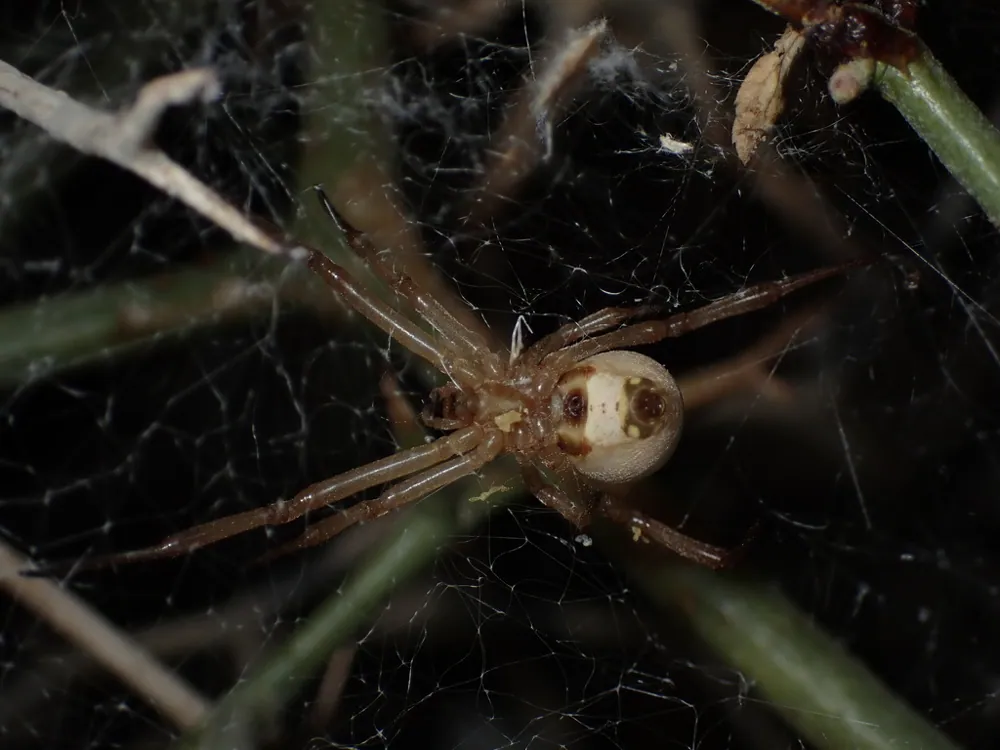
 Tsela ya go e lemoga
- Light-coloured, with a colouring ranging from beige to white1
- Darker legs than the body1
- No bright red markings, unlike other widow spiders such as the black widow or redback spider1
- Otherwise similar in shape to other spiders of the genus Latrodectus1
Gantsi e tlhakanngwa le: Most widow spiders are dark, and the white widow is distinguished mainly by its pale colouring and lack of red markings. Other than colour, it resembles other Latrodectus spiders.1
Maatla a botlhole
Botlhole bo tswa ka meno a yone fa e loma.
Botlhole jo e bo tsenyang bo dira eng?
Its venom is neurotoxic in type, meaning it acts on the nerves, as is typical of Latrodectus species. Toxicology studies report that its venom is similar in structure to that of the Mediterranean black widow, L. tredecimguttatus. It is considered less toxic than the bites of L. mactans or L. hasselti.1
E kotsi go le kae go batho?
Kotsi go batho: E botlhokoE ka utlwisa botlhoko tota, mme go seoka thata gore e nne masisi.The bite is medically significant and can injure humans. It can kill children and people who are infirm, although it is not nearly as toxic as the bites of some other widow spiders. A poster by the Egyptian Society of Natural Toxins describes its venom as moderately venomous.1
 Fa e loma
- Tlhatswa fa go lomilweng mme o tsenye pakana ya aese mo go gone go fokotsa botlhoko. Batla thuso ya bongaka fa botlhoko bo le bogolo, bo anama kgotsa motho a ikutlwa a sa siama.
Ka gale leletsa nomoro ya gago ya tshoganyetso pele (112, 000, 911). Se ke kaelo e e akaretsang ya thuso ya ntlha, ga se kgakololo ya bongaka. Motheo wa thuso ya ntlha
 Nna o babalesegile
- O se ka wa ama, wa tshwara kgotsa wa tshwenya phologolo ya naga, le fa e le e nnye, le fa e lebega e robetse kgotsa e sule.
- E fe sebaka. Fa o kopana le yone, ritibala, boela morago ka bonya mme o e tlogele e tsamaye ka tsela ya yone.
- Fa e nngwe e go loma: ritibala, o se ka wa tshikinyega, leletsa nomoro ya gago ya tshoganyetso (112, 000, 911) kgotsa o ye bookelong ka bonako. Gopola gore e ne e lebega jang, setshwantsho se a thusa.
Ga e go batle. E dirisa botlhole jwa yone go tshwara dijo kgotsa go itshireletsa, mme e rata go iphitlha go feta. Go le gontsi ka go nna o babalesegile
Kae mo lefatsheng?
E kgolo go le kae?
E telele go le kae?
 e ka nna boleele jo bo lekanang le jwa kelipi ya pampiri
White widow e kgolo go le kae fa e bapisiwa le WENA?
Ke dipalo fela mo sefetleng sa gago (browser). Ga go sepe se se bolokwang kgotsa se se romelwang gope.
E bonako go le kae?


Dintlha
Males are sometimes cannibalised by the female after mating.1
After maturity, male widow spiders do not feed and spend most of their lives searching for females, which is why they are smaller than females.1
Widow spider males generally live with a female for a long period and provide energy-demanding courtship displays.1
The white widow is comparatively rare compared to other widow spiders in its region.1
Kwa dintlha di tswang teng
- Latrodectus pallidus (Wikipedia (CC BY-SA 4.0))
- Latrodectus pallidus (iNaturalist): maina le thulaganyo ya mefuta.
- Venom Wiki: seelo sa kotsi, bogolo jo bo tlwaelegileng le kakanyo ya lebelo ke tsa rona. Bona kafa re di balang ka teng: Kafa re lekanyang kotsi ka teng.
Ntlha nngwe le nngwe mo tsebeng e e na le nomoro e e supang motswedi wa yone. Fa re dirile phoso, maitshwarelo, re barati ba diphologolo, e seng kgatiso ya saense. Re bolelele kwa [email protected] mme re tla e baakanya.
 Phepheng e tshwerwe ke tlala! Venom Wiki ke porojeke ya motho a le mongwe: ke mahala, ga e na dipapatso le ditraka. Mpho e nnye e thusa go e tshegetsa mo inthaneteng.Fepa phepheng
 Mediterranean black widow
 Six-eyed sand spider
 Brown widow
 Diving bell spider
 European yellow sac spider
 Noble false widow
 Deathstalker
 Indian cobra
 Indian saw-scaled viper
 King cobra
 Puff adder
 Phika ya ga Russell