
 Aforika
 Asia
Asia Yuropa
 Amerika Borwa
 Australia le Oceania
 Antarctica
 Lewatle la Pacific
 Lewatle la Atlantic
 Lewatle la India
 Lewatle la Arctic
 Lewatle la Mediterranean
 Lewatle le Lehibidu
 Lewatle la Caribbean
 Lewatle la Coral
 Lewatle la China Borwa
 Lewatle la Philippines
 Lewatle la Andaman
 Lewatle la Bokone
 Lewatle la Timor le la Arafura
 Kou ya Bengal
 Gulf ya California
Yellow-bellied sea snake
 Go loma
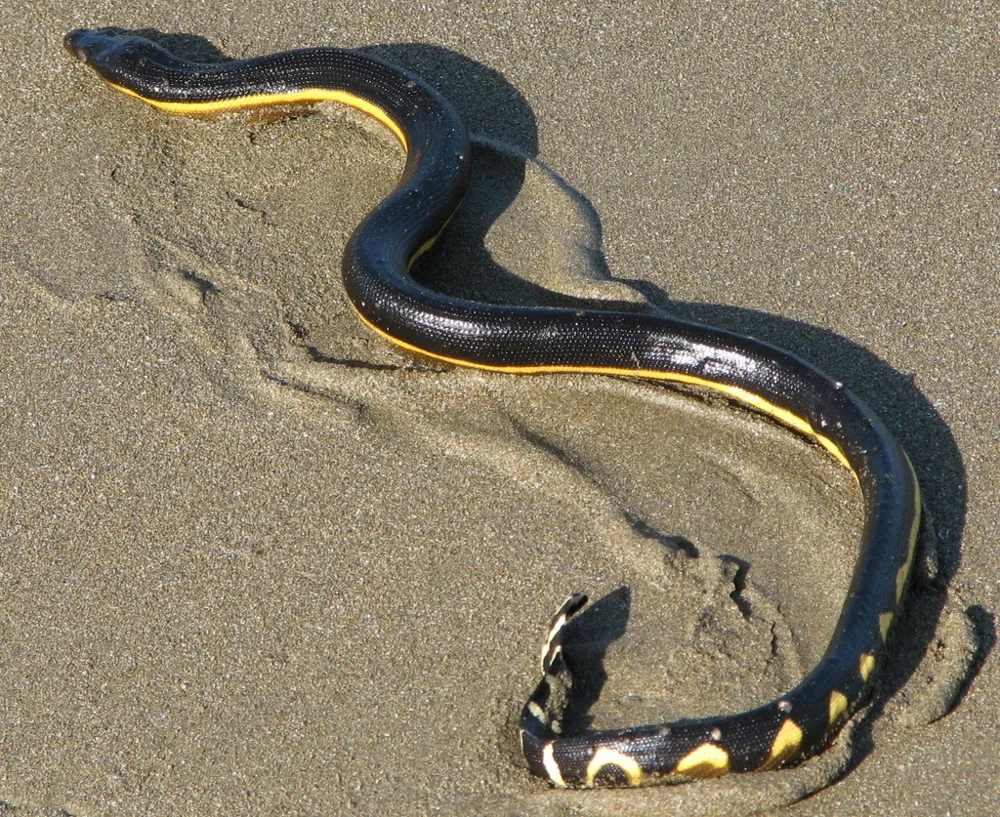
The yellow-bellied sea snake is a sea snake with a strongly venomous bite. It lives in warm tropical oceans and spends its whole life at sea, floating on the surface. Its yellow belly and brown back make it easy to tell apart from most other sea snakes.1

 Tsela ya go e lemoga
- Sharply bicoloured: black or dark brown on the back, with a yellow or brown underside.1
- The yellow belly may have black spots, bars or crossbars, or a narrow black stripe along the back.1
- Has a flattened, paddle-shaped tail for swimming.1
- Adults are usually up to about 72 cm (males) or 88 cm (females) long.1
Maatla a botlhole
Botlhole bo tswa ka meno a yone fa e loma.
Botlhole jo e bo tsenyang bo dira eng?
The venom is highly potent and contains several different neurotoxins, which attack the nerves, along with two other isotoxins. Sea snake venom can damage skeletal muscle, which may release myoglobin into the urine (myoglobinuria), and can cause neuromuscular paralysis or direct kidney damage. Juvenile venom is on average less concentrated than adult venom.1
E kotsi go le kae go batho?
Kotsi go batho: E masisiGo lomiwa ke yone go tlhoka ngaka. Go swa go seoka thata.Bites are rare. The most common victims are fishermen who try to remove the snakes from fishing nets. No deaths have been recorded from bites in Australian waters.1
 Dikgang tse di molemo: dingaka di na le molemo (antivenom) kgotsa kalafi ya se.1
E dira eng fa e tshogile?
It is not considered aggressive but will defend itself if threatened.1
 Fa e loma
- The venom is neutralised with sea snake antivenom (Enhydrina schistosa). If that is not available, tiger snake or polyvalent antivenom should be used.1
- Go gatelela le go sa tshikinyege (pressure immobilisation): bofa bandeiji e e gogegang e e tiileng mo godimo ga fa go lomilweng mme o tswelele o bofe setho sotlhe go ya kwa godimo, se tshegetse ka sepilinti (splint), mme o dire gore motho a nne a sa tshikinyege gotlhelele go fitlha thuso e goroga.
- Ntsha motho mo metsing mme o mo ise bookelong ka bonako.
Ka gale leletsa nomoro ya gago ya tshoganyetso pele (112, 000, 911). Se ke kaelo e e akaretsang ya thuso ya ntlha, ga se kgakololo ya bongaka. Motheo wa thuso ya ntlha
 Nna o babalesegile
- O se ka wa ama, wa tshwara kgotsa wa tshwenya phologolo ya naga, le fa e le e nnye, le fa e lebega e robetse kgotsa e sule.
- E fe sebaka. Fa o kopana le yone, ritibala, boela morago ka bonya mme o e tlogele e tsamaye ka tsela ya yone.
- Fa e nngwe e go loma: ritibala, o se ka wa tshikinyega, leletsa nomoro ya gago ya tshoganyetso (112, 000, 911) kgotsa o ye bookelong ka bonako. Gopola gore e ne e lebega jang, setshwantsho se a thusa.
Ga e go batle. E dirisa botlhole jwa yone go tshwara dijo kgotsa go itshireletsa, mme e rata go iphitlha go feta. Go le gontsi ka go nna o babalesegile
Kae mo lefatsheng?
E kgolo go le kae?
E telele go le kae?
 boleele jo bo lekanang le dikatse tsa ntlo di le 2 go tloga kwa nkong go ya mogatleng
 boleele jo bo lekanang le dipanana di le 5 di latelana
 e ka thuma boleele jwa bodiba jo bogolo jwa go thuma (50 m) ka metsotswana e le 49
Yellow-bellied sea snake e kgolo go le kae fa e bapisiwa le WENA?
Ke dipalo fela mo sefetleng sa gago (browser). Ga go sepe se se bolokwang kgotsa se se romelwang gope.
E bonako go le kae?
Dintlha
It can swim backwards, which is an unusual ability and a distinguishing feature of this species.1
It breathes partly through its skin, taking oxygen from seawater while diving and swimming at the surface.1
It can survive severe dehydration for up to 7 months during seasonal drought.1
Large groups of thousands have been seen floating together on the surface in oceanic drift lines.1
It is the only sea snake known to have reached the Hawaiian Islands.1
Strays wash up so often on New Zealand's coasts that it is considered native to the country and protected under the Wildlife Act 1953.1
Mosenyi wa ditlhamane
Tlhamane: Sea snakes drink seawater and filter out the salt through a special salt gland in the lower jaw.
Nnete: Sea snakes drink only fresh water. The salt gland was once thought to filter salt, but it is not used for that purpose. The yellow-bellied sea snake likely drinks from freshwater lenses that form on the sea surface after heavy rain.1
Ya baitseanape ba botlhole
- Leina la saense
- Hydrophis platurus
- Setlhopha
- Dinoga tsa lewatle
- Lelapa
- Elapidae2
- Lekoko
- Squamata
- Dikontinente
- Lewatle la Pacific, Lewatle la India, Lewatle la Coral, Lewatle la China Borwa, Lewatle la Philippines, Lewatle la Andaman, Lewatle la Arabia le Gulf ya Peresia, Lewatle la Timor le la Arafura, Kou ya Bengal, Gulf ya California, Mawatle
- Masea
- It gives birth to live young (ovoviviparous) after a gestation period of around 6 months, and females bear them in tidal pools.1
- Kotsi go batho
- 3 / 5: E masisi3
Kwa dintlha di tswang teng
- Yellow-bellied sea snake (Wikipedia (CC BY-SA 4.0))
- Hydrophis platurus (iNaturalist): maina le thulaganyo ya mefuta.
- Venom Wiki: seelo sa kotsi, bogolo jo bo tlwaelegileng le kakanyo ya lebelo ke tsa rona. Bona kafa re di balang ka teng: Kafa re lekanyang kotsi ka teng.
Ntlha nngwe le nngwe mo tsebeng e e na le nomoro e e supang motswedi wa yone. Fa re dirile phoso, maitshwarelo, re barati ba diphologolo, e seng kgatiso ya saense. Re bolelele kwa [email protected] mme re tla e baakanya.
 Phepheng e tshwerwe ke tlala! Venom Wiki ke porojeke ya motho a le mongwe: ke mahala, ga e na dipapatso le ditraka. Mpho e nnye e thusa go e tshegetsa mo inthaneteng.Fepa phepheng
Tse dingwe tsa setlhopha se se tshwanang: Dinoga tsa lewatle
 Beaked sea snake
 Belcher's sea snake
 Black-banded sea krait
 Blue-lipped sea krait
 Dubois' sea snake
 Olive sea snake
E tshela gape kwa: Lewatle la Pacific
 Australian box jellyfishDijelifishi le dibopiwa tsa lewatle tse di tlhabangE a bolayaO se ka wa ama
 Geography coneDikgopa tsa khouno le diokotopaseE a bolaya
 Greater blue-ringed octopusDikgopa tsa khouno le diokotopaseE a bolaya
 Japanese pufferfishDiphologolo tse dingwe tse di botlhole go di ama kgotsa go di jaE a bolaya
 Southern blue-ringed octopusDikgopa tsa khouno le diokotopaseE a bolaya
 Hawksbill sea turtleDiphologolo tse dingwe tse di botlhole go di ama kgotsa go di jaE ka bolaya