
 Aforika
 Asia
Asia Yuropa
 Amerika Borwa
 Australia le Oceania
 Antarctica
 Lewatle la Pacific
 Lewatle la Atlantic
 Lewatle la India
 Lewatle la Arctic
 Lewatle la Mediterranean
 Lewatle le Lehibidu
 Lewatle la Caribbean
 Lewatle la Coral
 Lewatle la China Borwa
 Lewatle la Philippines
 Lewatle la Andaman
 Lewatle la Bokone
 Lewatle la Timor le la Arafura
 Kou ya Bengal
 Gulf ya California
Yellow garden spider
 Go loma
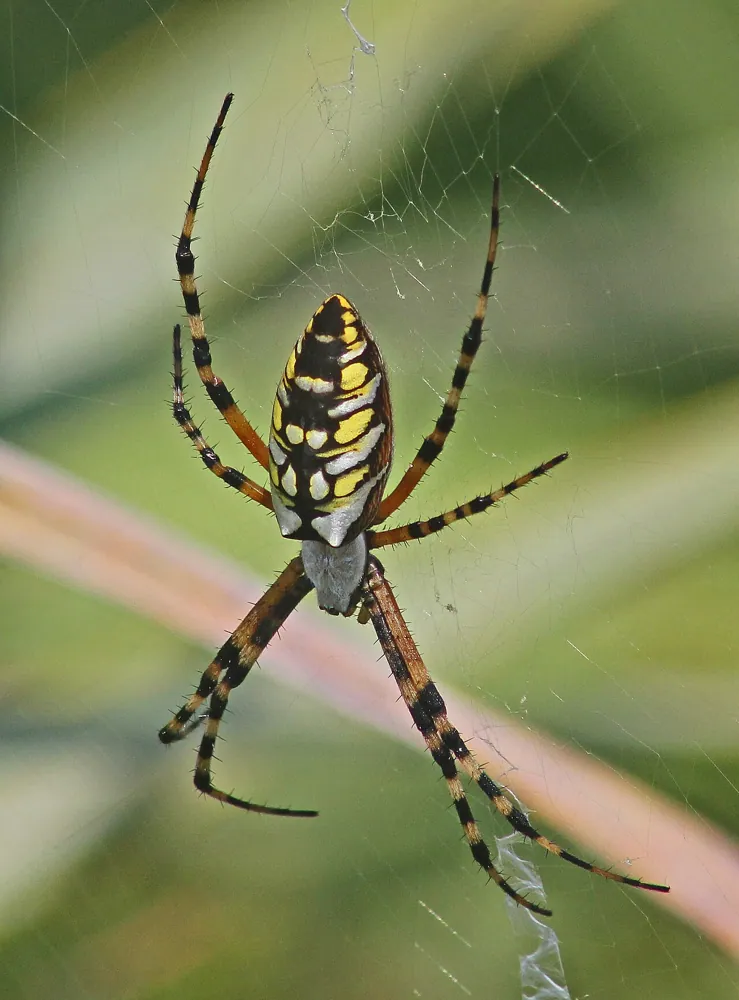
The yellow garden spider is a large, colourful spider with yellow and black markings on its abdomen. It builds big round webs in sunny fields, gardens and along the eaves of houses in North America, Mexico and Central America. It bites only if disturbed or handled, and its bite is comparable to a bee sting.1


 Tsela ya go e lemoga
- Yellow and black markings on the abdomen (the rear part of the body).1
- A mostly white front body section (cephalothorax).1
- A large, circular web up to 60 cm across, with a dense zigzag of silk in the centre.1
- The female sits in the centre of the web, usually facing straight down.1
- Females measure 19–28 mm in body length, while males are much smaller at 5–9 mm.1
Maatla a botlhole
Botlhole bo tswa ka meno a yone fa e loma.
Botlhole jo e bo tsenyang bo dira eng?
The venom contains polyamine toxins, including one called argiotoxin ArgTX-636, which are being studied for possible medical uses. For most people the venom is harmless, and a bite causes redness and swelling, similar to a bee sting. It is harmless to people who are not allergic.1
E kotsi go le kae go batho?
Kotsi go batho: Kotsi e nnyeJaaka go tlhabiwa ke notshe kgotsa go le kwa tlase. Ga e na kotsi go batho.These spiders are not aggressive and only bite if grabbed or disturbed. For a healthy adult, a bite is not considered an issue. People who are very young, elderly, or have weakened immune systems should take the same care they would around a beehive or hornet nest.1
E dira eng fa e tshogile?
If disturbed by a possible predator, the female may drop from her web and hide on the ground nearby, and she can shake the web vigorously while staying attached in the centre.1
 Fa e loma
- Tlhatswa fa go lomilweng mme o tsenye pakana ya aese mo go gone go fokotsa botlhoko. Batla thuso ya bongaka fa botlhoko bo le bogolo, bo anama kgotsa motho a ikutlwa a sa siama.
Ka gale leletsa nomoro ya gago ya tshoganyetso pele (112, 000, 911). Se ke kaelo e e akaretsang ya thuso ya ntlha, ga se kgakololo ya bongaka. Motheo wa thuso ya ntlha
 Nna o babalesegile
- O se ka wa ama, wa tshwara kgotsa wa tshwenya phologolo ya naga, le fa e le e nnye, le fa e lebega e robetse kgotsa e sule.
- E fe sebaka. Fa o kopana le yone, ritibala, boela morago ka bonya mme o e tlogele e tsamaye ka tsela ya yone.
- Fa e nngwe e go loma: ritibala, o se ka wa tshikinyega, leletsa nomoro ya gago ya tshoganyetso (112, 000, 911) kgotsa o ye bookelong ka bonako. Gopola gore e ne e lebega jang, setshwantsho se a thusa.
Ga e go batle. E dirisa botlhole jwa yone go tshwara dijo kgotsa go itshireletsa, mme e rata go iphitlha go feta. Go le gontsi ka go nna o babalesegile
Kae mo lefatsheng?
E kgolo go le kae?
E telele go le kae?
 e ka nna boleele jo bo lekanang le jwa kelipi ya pampiri
 e ka taboga dimetara di le 100 ka metsotswana e le 280 (motho yo o bonako go gaisa o tlhoka 9,6)
Yellow garden spider e kgolo go le kae fa e bapisiwa le WENA?
Ke dipalo fela mo sefetleng sa gago (browser). Ga go sepe se se bolokwang kgotsa se se romelwang gope.
E bonako go le kae?


Dintlha
The female can shake her web vigorously to make it harder for wasps and birds to target her, and to fully tangle an insect before it cuts itself free.1
After mating, the male often dies and is sometimes eaten by the female, as he inserts his second palpal bulb.1
The zigzag silk in the web, called a stabilimentum, may camouflage the spider, attract prey, or warn birds away, but its purpose is still disputed.1
In a case observed in Georgia, a European hornet cut free prey caught in a yellow garden spider's web, and the spider did not fight it, probably because it dropped from the web and hid.1
Mosenyi wa ditlhamane
Tlhamane: Yellow garden spiders are dangerous and their bite can seriously harm a healthy adult.
Nnete: The venom is harmless to people who are not allergic. A bite is comparable to a bumblebee sting and is not considered an issue for healthy adults.1
Ya baitseanape ba botlhole
- Leina la saense
- Argiope aurantia
- Setlhopha
- Digokgo
- Lelapa
- Araneidae2
- Lekoko
- Araneae
- Dikontinente
- Amerika Bokone
- Masea
- Each female produces one to four egg sacs, each holding perhaps over a thousand eggs, and in spring the tiny spiderlings emerge and some are carried away on silk strands by the breeze.1
- Kotsi go batho
- 1 / 5: Kotsi e nnye3
Kwa dintlha di tswang teng
- Argiope aurantia (Wikipedia (CC BY-SA 4.0))
- Argiope aurantia (iNaturalist): maina le thulaganyo ya mefuta.
- Venom Wiki: seelo sa kotsi, bogolo jo bo tlwaelegileng le kakanyo ya lebelo ke tsa rona. Bona kafa re di balang ka teng: Kafa re lekanyang kotsi ka teng.
Ntlha nngwe le nngwe mo tsebeng e e na le nomoro e e supang motswedi wa yone. Fa re dirile phoso, maitshwarelo, re barati ba diphologolo, e seng kgatiso ya saense. Re bolelele kwa [email protected] mme re tla e baakanya.
 Phepheng e tshwerwe ke tlala! Venom Wiki ke porojeke ya motho a le mongwe: ke mahala, ga e na dipapatso le ditraka. Mpho e nnye e thusa go e tshegetsa mo inthaneteng.Fepa phepheng
Tse dingwe tsa setlhopha se se tshwanang: Digokgo
 Brown recluse
 Southern black widow
 Northern black widow
 Western black widow
 Bold jumping spider
 Golden silk orb-weaver
E tshela gape kwa: Amerika Bokone
 TerciopeloDivaepara tsa mesima (pit vipers)E a bolaya
 Eastern coral snakeDinoga tsa khoraleE ka bolaya
 Eastern diamondback rattlesnakeDinoga tsa ratheleE ka bolaya
 Eyelash viperDivaepara tsa mesima (pit vipers)E ka bolaya
 Timber rattlesnakeDinoga tsa ratheleE ka bolaya
 Western diamondback rattlesnakeDinoga tsa ratheleE ka bolaya