
 Afrig
Afrig Asi
Asi Tugal
Tugal Amerig gu Bëj-saalum
 Ostarali ak Oseyani
 Antarktig
 Mbàmbulaanu Pasifik
 Mbàmbulaanu Atlantig
 Mbàmbulaanu End
 Mbàmbulaanu Arktik
 Géeju Mediteraane
 Géej gu Xonq
 Géeju Karayib
 Géeju Koraay
 Géeju Siin gu Bëj-saalum
 Géeju Filipin
 Géeju Andaman
 Géeju Bëj-gànnaar
 Géeju Timor ak Arafura
 Golfu Bengal
 Golfu Kaliforni
American toad
 Daŋar ci deramDafay lekk: GunóorAm daŋar ci yaram, du màtt walla jam
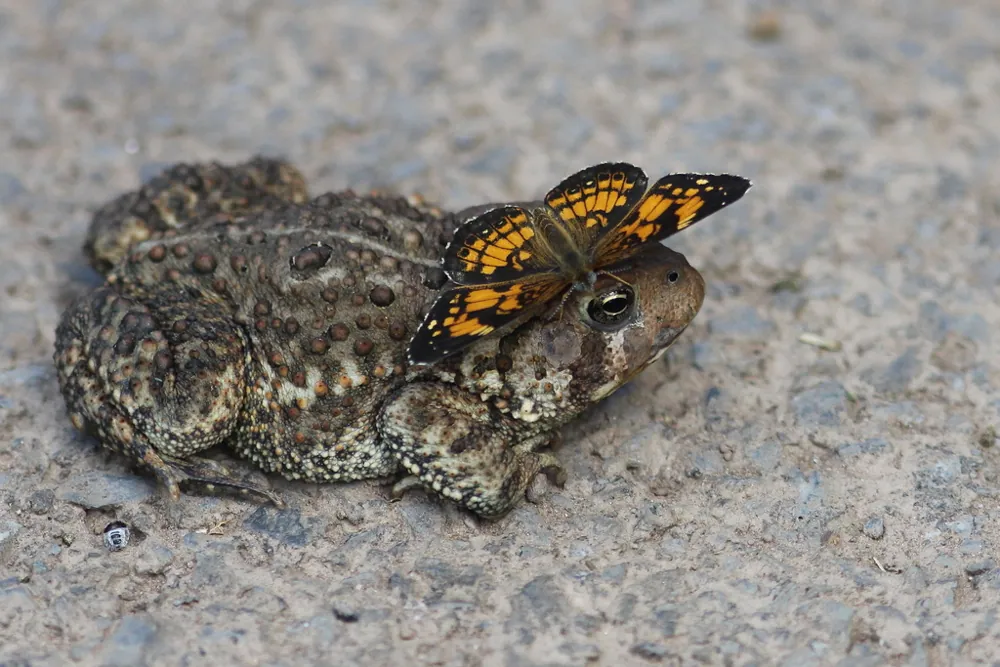
The American toad is a common toad found across the eastern half of Canada and the United States. It lives in forests, grasslands and gardens, and it breeds in shallow ponds and pools. It matters because it eats many insects and other small creatures, and its skin releases a substance that can irritate eyes and harm small animals such as dogs.1


 Ni ngay ko xàmmee
- Adults are usually 5 to 9 cm long.1
- Skin colour varies from yellow to brown to black, and can be solid or speckled. It changes with habitat colours, humidity, stress and temperature.1
- Spots on the back contain only one or two warts, and the lower legs have enlarged warts.1
- The parotoid glands are the same colour as the surrounding skin.1
- Breeding males give a high trill lasting 6 to 30 seconds that sounds like a ringing telephone.1
Ñu ngi koy faral di jaxasoo ak: Fowler's toad, Woodhouse's toad, the Canadian toad, the southern toad and the Gulf Coast toad can look similar. Fowler's toad never has a spotted belly, and its cranial crests touch the parotoid glands. The American toad's crests almost never touch the glands. The Canadian toad's crests join to form a raised bump, which the American toad's do not. The southern toad's crests form two distinct knobs.1
Kàttanu daŋar
Deram am na daŋar. Musiba la ci laal, mar walla lekk.
Lan la daŋar bi ci yaramam di def?
The American toad does not inject venom. Its parotoid glands secrete bufotoxin, a poisonous substance that makes the toad unpalatable to predators. It is a mild poison compared with other poisonous toads and frogs, but it can irritate human eyes and mucous membranes and is dangerous to smaller animals such as dogs when swallowed.1
Ni mu lore nit ñi?
Musiba ci nit: WoyofNi jamu yamb walla lu ko yées. Lu jege, amul lor ci nit.Bufotoxin is a mild poison. It can irritate human eyes and mucous membranes, and it is dangerous to smaller animals, such as dogs, if they swallow it.1
Lan lay def bu tiitee?
When threatened, the toad releases bufotoxin from its parotoid glands, which makes it unpleasant to eat.1
 Su kenn laalee ko walla mu lekk ko
- Su kenn laalee benn: raxas loxo yi bu baax te bul laal bët yi walla gémmiñ gi. Su ab xale walla ab mala bu kër maree benn walla mu lekk benn: woo sa centre antipoison walla sa nimerob urgence.
Saa su nekk, woo jëkk sa nimerob urgence (112, 000, 911). Lii ay ndigal yu yaatu ci ndimbal yu jëkk la, du ndigalu doktoor. Li war a xam ci ndimbal yu jëkk
 Sàmmal sa bopp
- Bul laal mukk, bul jàpp, bul sonal ab rab bu àll, doonte bu ndaw la, te doonte dafa mel ni dafa nelaw walla dafa dee.
- May ko bérab. Su nga ko gisee, dalal, dellu ginnaaw ndànk-ndànk te bàyyi ko mu dem yoonam.
- Su nga ko laalee walla nga lekk ko: bul moos say bët walla sa gémmiñ, raxas say loxo te wutal ndimbal doktoor.
Du la wut. Daŋaram nekk na rekk ngir kenn bañ ko lekk. Yeneen ci ni ngay sàmme sa bopp
Ni mu réye?
Ni mu guddoo?
 guddu na ni 3 bloku tabax yu ñu toftale
 mën na daw 100 meetar ci 180 segond (nit ki gën a gaaw soxla na 9,6)
American toad ni mu réye ci wetu YOW?
Ay waññ rekk ci sa navigateur. Dara du denc te dara du yónnee fenn.
Ni mu gaawe?


Xibaar
Some American toads have lived for over 30 years, and one female was reported to be living healthily into her late 30s.1
Toads avoid mating with their siblings. Males' calls seem to help females recognise their close relatives.1
Toad tadpoles produce toxic chemicals in their skin that discourage some predators. Most fish learn quickly to avoid eating them.1
Their skin colour can change with their surroundings, humidity, stress and temperature.1
Tadpoles swim in very shallow water, often among thick grass, and gather in schools during the day to reduce predation.1
Toadlets often leave the water together in large groups and migrate to shaded forest areas near where they were bred.1
Ngir boroom xam-xam ci daŋar
- Turu xam-xam
- Anaxyrus americanus
- Mbooloo
- Mbott yu am daŋar, crapaud ak triton
- Njaboot
- Bufonidae2
- Toftal
- Anura
- Kontinaa yi
- Amerig gu Bëj-gànnaar
- Liir yi
- Females lay two long ropes containing 2,000 to 20,000 small black eggs, each 1 to 2 mm across, surrounded by jelly. The eggs hatch into tadpoles in 3 to 12 days.1
- Diiru dund
- lu tollu ci 30 at1
- Musiba ci nit
- 1 / 5: Woyof3
Fa xibaar yi jóge
- American toad (Wikipedia (CC BY-SA 4.0))
- Anaxyrus americanus (iNaturalist): tur ak ni ñu leen séddale.
- Venom Wiki: tolluwaayu musiba bi, réyaay bu yem bi ak xalaatu gaawaay bi, nun ñoo leen defar. Seetal ni nu leen waññe: Ni nuy natte musiba.
Xibaar bu nekk ci xët wii am na ab nimero buy won fa mu jóge. Su nu juumee, baal nu, nun ay nit ñu bëgg rab lanu, du ab jurnaalu xam-xam. Wax nu ko ci [email protected] te dinanu ko jubbanti.
 Jiit bi dafa xiif! Venom Wiki ab liggéeyu kenn la: amul pay, amul piblisite te amul traceur. Ab may bu tuuti dafay dimbali ngir mu des ci internet.Leel jiit bi
Yeneen ci mbooloo mi: Mbott yu am daŋar, crapaud ak triton
 Cane toadMbott yu am daŋar, crapaud ak tritonSoxla na doktoorBul laal
 Strawberry poison-dart frogMbott yu am daŋar, crapaud ak tritonDafay metti rekkBul laal
 California newtMbott yu am daŋar, crapaud ak tritonMën na reyBul laal
 Rough-skinned newtMbott yu am daŋar, crapaud ak tritonMën na reyBul laal
 Colorado River toadMbott yu am daŋar, crapaud ak tritonSoxla na doktoorBul laal
 Panamanian golden frogMbott yu am daŋar, crapaud ak tritonSoxla na doktoorBul laal
 Terciopelo
 Eastern coral snake
 Eastern diamondback rattlesnake
 Eyelash viper
 Timber rattlesnake
 Western diamondback rattlesnake