
 Afrig
Afrig Asi
Asi Tugal
Tugal Amerig gu Bëj-saalum
 Ostarali ak Oseyani
 Antarktig
 Mbàmbulaanu Pasifik
 Mbàmbulaanu Atlantig
 Mbàmbulaanu End
 Mbàmbulaanu Arktik
 Géeju Mediteraane
 Géej gu Xonq
 Géeju Karayib
 Géeju Koraay
 Géeju Siin gu Bëj-saalum
 Géeju Filipin
 Géeju Andaman
 Géeju Bëj-gànnaar
 Géeju Timor ak Arafura
 Golfu Bengal
 Golfu Kaliforni
Asian needle ant
 Dafay jam
The Asian needle ant is a small stinging ant that is native to Japan and mainland Asia. It has spread to the United States, where it is now common across much of the American South and along the East Coast. It matters because its sting can cause serious allergic reactions in some people, and it crowds out native ants.1

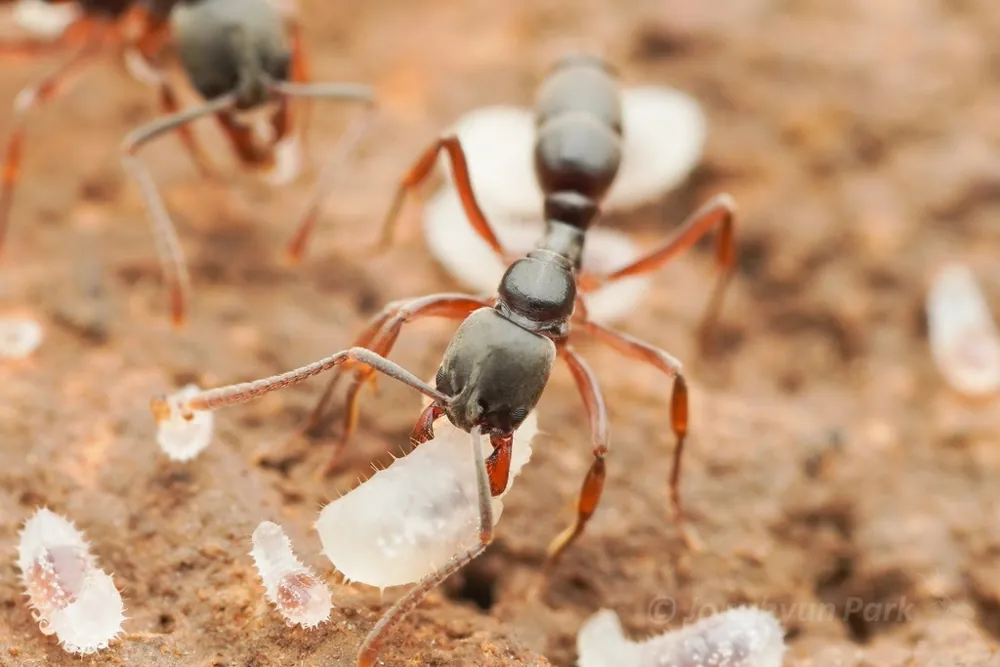
 Ni ngay ko xàmmee
- A stinging ant from the ponerine group1
- Often nests near termite colonies, which are a reliable food source1
- Looks very similar to Brachyponera luteipes, B. nigrita and B. obscurans, so it is often mistaken for them1
Ñu ngi koy faral di jaxasoo ak: It is commonly mistaken for Brachyponera luteipes, Brachyponera nigrita and Brachyponera obscurans because they look similar. Misidentification can mean people do not realise the seriousness of the sting.1
Kàttanu daŋar
Daŋar bi dafay génn ci ab dag buy jam.
Lan la daŋar biy sóob di def?
Its venom contains proteins that can trigger allergic reactions. The sting is painful and can leave people in distress. In some cases, allergic reactions cause anaphylaxis, a severe whole-body reaction, or urticaria, which is hives.1
Ni mu lore nit ñi?
Musiba ci nit: Dafay mettiMën na metti lool, waaye lu bon du faral di am.The ant is not aggressive but will sting when disturbed. Its sting can cause anaphylaxis in some people. As it spreads into more urban areas, encounters with people are likely to increase.1
Lan lay def bu tiitee?
Although not aggressive, it will sting when it is disturbed.1
 Su jamee
- Raxas te sedal fa mu jam.
- Su nit ki am jafe-jafe ci noyyi, kanamam walla putam funki, walla mu bëgg a xëm, allergie bu metti la (urgence): woo sa nimerob urgence.
Saa su nekk, woo jëkk sa nimerob urgence (112, 000, 911). Lii ay ndigal yu yaatu ci ndimbal yu jëkk la, du ndigalu doktoor. Li war a xam ci ndimbal yu jëkk
 Sàmmal sa bopp
- Bul laal mukk, bul jàpp, bul sonal ab rab bu àll, doonte bu ndaw la, te doonte dafa mel ni dafa nelaw walla dafa dee.
- May ko bérab. Su nga ko gisee, dalal, dellu ginnaaw ndànk-ndànk te bàyyi ko mu dem yoonam.
- Su benn jamee la: dalal, bul yëngu, woo sa nimerob urgence (112, 000, 911) walla dem lopitaan ci gaaw. Bul fàtte ni mu meloon, ab nataal dina dimbali.
Du la wut. Dafay jëfandikoo daŋaram ngir jàpp lu muy lekk walla ngir aar boppam, te nëbbu moo ko gën a neex. Yeneen ci ni ngay sàmme sa bopp
Ni mu réye?
Ni mu guddoo?
 tuuti ba mën a toog ci sa wewu baaraam
Asian needle ant ni mu réye ci wetu YOW?
Ay waññ rekk ci sa navigateur. Dara du denc te dara du yónnee fenn.
Ni mu gaawe?


Xibaar
In invaded areas, the native ant Aphaenogaster rudis was reduced by 96%.1
A study in North Carolina found that the Asian needle ant outnumbered all native ant species in most sample areas.1
Workers carry nestmates from one place to another when the colony moves nests. Unlike many ant species, they likely use visual cues rather than pheromone trails to do this.1
Queen ants have a special pouch that stores sperm, so they can mate once and keep reproducing for their whole lives.1
The European Union has listed it as an invasive alien species of Union concern, so it cannot be imported, bred, transported, sold or intentionally released in any EU member state.1
Fa xibaar yi jóge
- Brachyponera chinensis (Wikipedia (CC BY-SA 4.0))
- Brachyponera chinensis (iNaturalist): tur ak ni ñu leen séddale.
- Venom Wiki: tolluwaayu musiba bi, réyaay bu yem bi ak xalaatu gaawaay bi, nun ñoo leen defar. Seetal ni nu leen waññe: Ni nuy natte musiba.
Xibaar bu nekk ci xët wii am na ab nimero buy won fa mu jóge. Su nu juumee, baal nu, nun ay nit ñu bëgg rab lanu, du ab jurnaalu xam-xam. Wax nu ko ci [email protected] te dinanu ko jubbanti.
 Jiit bi dafa xiif! Venom Wiki ab liggéeyu kenn la: amul pay, amul piblisite te amul traceur. Ab may bu tuuti dafay dimbali ngir mu des ci internet.Leel jiit bi
 Green weaver ant
 Red wood ant
 Arboreal bicoloured ant
 European fire ant
 Indian jumping ant
 Samsum ant
 Deathstalker
 Indian cobra
 Indian saw-scaled viper
 King cobra
 Jaan wu ñuul wi (Bitis arietans)
 Jaan wu Russell