
 Afrig
Afrig Asi
Asi Tugal
Tugal Amerig gu Bëj-saalum
 Ostarali ak Oseyani
 Antarktig
 Mbàmbulaanu Pasifik
 Mbàmbulaanu Atlantig
 Mbàmbulaanu End
 Mbàmbulaanu Arktik
 Géeju Mediteraane
 Géej gu Xonq
 Géeju Karayib
 Géeju Koraay
 Géeju Siin gu Bëj-saalum
 Géeju Filipin
 Géeju Andaman
 Géeju Bëj-gànnaar
 Géeju Timor ak Arafura
 Golfu Bengal
 Golfu Kaliforni
Indian saw-scaled viper
 Dafay màtt
The saw-scaled viper is a small, venomous snake of the Middle East, Central Asia and the Indian subcontinent. It is the smallest of the 'big four' Indian snakes that cause the most snakebite cases and deaths. It is easy to miss, which is one reason it causes so many bites.1



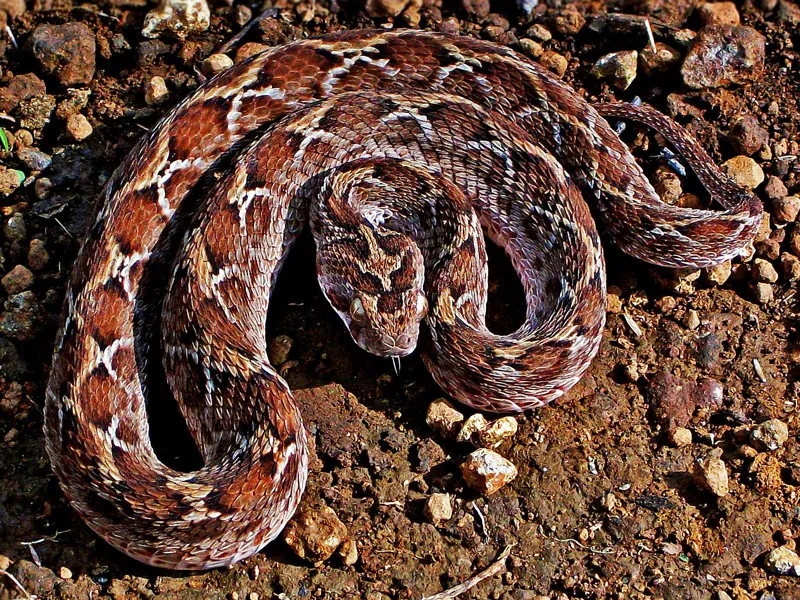
 Ni ngay ko xàmmee
- Small, usually no more than 60 cm long in total1
- Pale buff, grey, reddish, olive or pale brown body with whitish spots edged in dark brown1
- A whitish cross or trident pattern on the top of the head1
- A faint stripe running from the eye to the angle of the jaw1
- Whitish to pinkish belly, sometimes with brown dots1
Kàttanu daŋar
Daŋar bi dafay génn ci bëñam yi su màttee.
Lan la daŋar biy sóob di def?
Its venom causes swelling and pain within minutes of a bite, and the swelling can spread up the whole limb within 12 to 24 hours, with blisters forming on the skin. The more dangerous effects are whole-body: bleeding and clotting problems, bleeding from the stomach, lungs, nose or urine, and possible shock. Most patients produce little or no urine within a few hours to six days after the bite.1
Ni mu lore nit ñi?
Musiba ci nit: Mën a reyBenn ci rab yi gën a am musiba ci àddina.About 20% of its bites used to be fatal, but deaths are now quite rare because antivenom is available. It is one of the species responsible for the most snakebite cases because it is inconspicuous and extremely aggressive.1
 Xibaar bu baax: doktoor yi am nañu garab (sérum antivenimeux) walla ab paj ngir lii.1
Lan lay def bu tiitee?
When threatened it forms a double coil in a figure of eight, with its head in the centre, so it can lash out like a released spring.1
 Su màttee
- Antivenin therapy and intravenous hydration within hours of the bite are vital for survival.1
- Def ba nit ki bañ a yëngu te dal, yemale cër bi ñu màtt ak kawewaayu xol bi, dindi jaaro yi ak lu xat lépp, te yóbbu ko lopitaan ci gaaw.
Saa su nekk, woo jëkk sa nimerob urgence (112, 000, 911). Lii ay ndigal yu yaatu ci ndimbal yu jëkk la, du ndigalu doktoor. Li war a xam ci ndimbal yu jëkk
 Sàmmal sa bopp
- Bul laal mukk, bul jàpp, bul sonal ab rab bu àll, doonte bu ndaw la, te doonte dafa mel ni dafa nelaw walla dafa dee.
- May ko bérab. Su nga ko gisee, dalal, dellu ginnaaw ndànk-ndànk te bàyyi ko mu dem yoonam.
- Su benn màttee la: dalal, bul yëngu, woo sa nimerob urgence (112, 000, 911) walla dem lopitaan ci gaaw. Bul fàtte ni mu meloon, ab nataal dina dimbali.
Du la wut. Dafay jëfandikoo daŋaram ngir jàpp lu muy lekk walla ngir aar boppam, te nëbbu moo ko gën a neex. Yeneen ci ni ngay sàmme sa bopp
Ni mu réye?
Ni mu guddoo?
 guddu na ni 1,5 muusu kër, bakkan ba geen
 guddu na ni 4 banaana yu ñu toftale
 mën na daw 100 meetar ci 110 segond (nit ki gën a gaaw soxla na 9,6)
Indian saw-scaled viper ni mu réye ci wetu YOW?
Ay waññ rekk ci sa navigateur. Dara du denc te dara du yónnee fenn.
Ni mu gaawe?


Xibaar
On average it produces about 18 mg of dry venom, with a recorded maximum of 72 mg. The lethal dose for an adult is estimated at only 5 mg.1
When it rains, up to 80% of the adult population may climb into bushes and trees. Once, about 20 individuals were seen massed on one cactus or small shrub.1
It moves mainly by sidewinding, a method it is very skilled at and surprisingly quick with. Only two points of its body touch the hot ground, which may help it avoid overheating.1
Its venom is used to make several drugs, including echistatin, an anticoagulant that can be made by chemical synthesis, and ecarin, used in a clotting test.1
In the northern parts of its range, it hibernates in winter.1
Fa xibaar yi jóge
- Echis carinatus (Wikipedia (CC BY-SA 4.0))
- Echis carinatus (iNaturalist): tur ak ni ñu leen séddale.
- Venom Wiki: tolluwaayu musiba bi, réyaay bu yem bi ak xalaatu gaawaay bi, nun ñoo leen defar. Seetal ni nu leen waññe: Ni nuy natte musiba.
Xibaar bu nekk ci xët wii am na ab nimero buy won fa mu jóge. Su nu juumee, baal nu, nun ay nit ñu bëgg rab lanu, du ab jurnaalu xam-xam. Wax nu ko ci [email protected] te dinanu ko jubbanti.
 Jiit bi dafa xiif! Venom Wiki ab liggéeyu kenn la: amul pay, amul piblisite te amul traceur. Ab may bu tuuti dafay dimbali ngir mu des ci internet.Leel jiit bi
 Jaan wu ñuul wi (Bitis arietans)
 Jaan wu Russell
 Common European adder
 Eastern Russell's viper
 Northeast African carpet viper
 Armenian viper
 Deathstalker
 Indian cobra
 King cobra
 Asian giant hornet
 Komodo dragon
 Spanish fly
_Photographed_By_Shantanu_Kuveskar.jpg)