
 Afrig
Afrig Asi
Asi Tugal
Tugal Amerig gu Bëj-saalum
 Ostarali ak Oseyani
 Antarktig
 Mbàmbulaanu Pasifik
 Mbàmbulaanu Atlantig
 Mbàmbulaanu End
 Mbàmbulaanu Arktik
 Géeju Mediteraane
 Géej gu Xonq
 Géeju Karayib
 Géeju Koraay
 Géeju Siin gu Bëj-saalum
 Géeju Filipin
 Géeju Andaman
 Géeju Bëj-gànnaar
 Géeju Timor ak Arafura
 Golfu Bengal
 Golfu Kaliforni
Asp viper
 Dafay màtt
The asp viper is a venomous snake of south-western Europe. It lives in warm, sunny places with dry soil, often in hills and rocky areas. Its bite can be more severe than that of the European adder, so it is important to know what it looks like.1

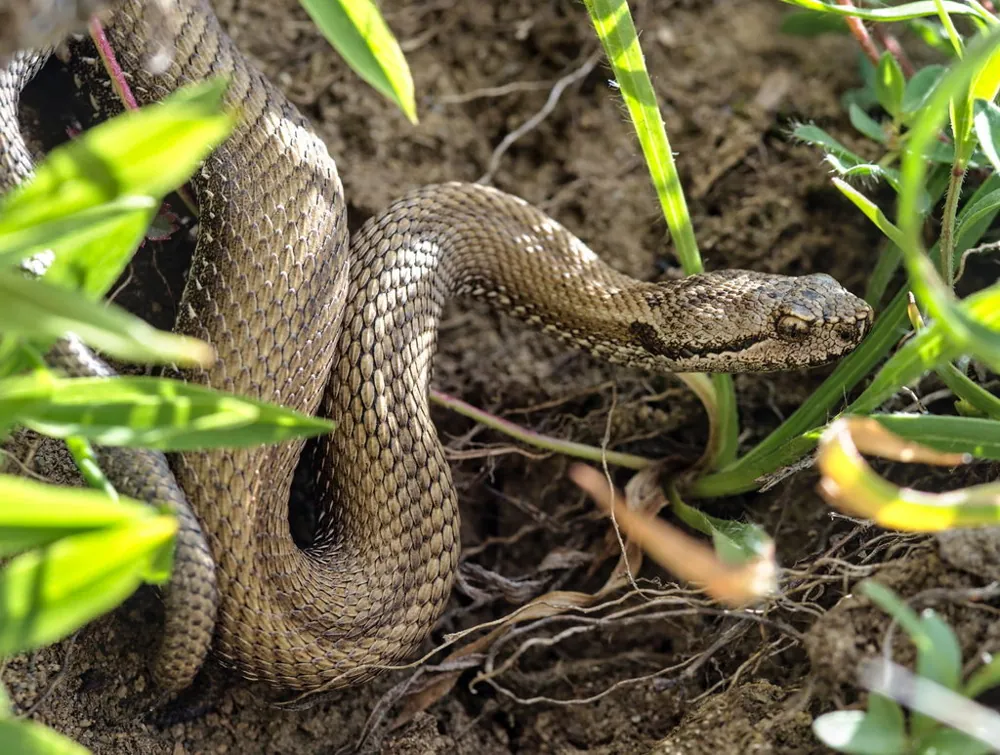
 Ni ngay ko xàmmee
- Average total length is 60–65 cm. Males can reach 85 cm, while females are rarely longer than 75 cm.1
- The head is broad and triangular, and it is clearly separate from the neck.1
- The tip of the snout is slightly but distinctly turned up.1
- The tail is very short, and males are a little slimmer than females.1
- The pattern on the back varies a lot. It rarely forms a clear zigzag, unlike the European adder.1
Ñu ngi koy faral di jaxasoo ak: The European adder (Vipera berus) is a close relative. The asp's back pattern rarely forms a clear zigzag, as the adder's often does. Bites from the asp can be more severe than those from the adder.1
Kàttanu daŋar
Daŋar bi dafay génn ci bëñam yi su màttee.
Lan la daŋar biy sóob di def?
Its venom causes rapidly spreading, severe pain, followed by swelling and skin discolouration. Severe bleeding and tissue death can happen within a few hours. Vision may be badly affected, and in some cases victims developed breathing and swallowing difficulties and paralysis of the bitten limb.1
Ni mu lore nit ñi?
Musiba ci nit: Lu bonMàtt laaj na doktoor. Ñi ciy dee dañoo néew lool.About 4% of untreated bites are fatal. In Italy, this species causes 90% of snakebite cases and is the only snake in Italian mountains that can be potentially lethal. Its bites can be more severe than those of the European adder.1
 Su màttee
- Def ba nit ki bañ a yëngu te dal, yemale cër bi ñu màtt ak kawewaayu xol bi, dindi jaaro yi ak lu xat lépp, te yóbbu ko lopitaan ci gaaw.
Saa su nekk, woo jëkk sa nimerob urgence (112, 000, 911). Lii ay ndigal yu yaatu ci ndimbal yu jëkk la, du ndigalu doktoor. Li war a xam ci ndimbal yu jëkk
 Sàmmal sa bopp
- Bul laal mukk, bul jàpp, bul sonal ab rab bu àll, doonte bu ndaw la, te doonte dafa mel ni dafa nelaw walla dafa dee.
- May ko bérab. Su nga ko gisee, dalal, dellu ginnaaw ndànk-ndànk te bàyyi ko mu dem yoonam.
- Su benn màttee la: dalal, bul yëngu, woo sa nimerob urgence (112, 000, 911) walla dem lopitaan ci gaaw. Bul fàtte ni mu meloon, ab nataal dina dimbali.
Du la wut. Dafay jëfandikoo daŋaram ngir jàpp lu muy lekk walla ngir aar boppam, te nëbbu moo ko gën a neex. Yeneen ci ni ngay sàmme sa bopp
Ni mu réye?
Ni mu guddoo?
 guddu na ni 1,5 muusu kër, bakkan ba geen
 guddu na ni 5 banaana yu ñu toftale
 mën na daw 100 meetar ci 110 segond (nit ki gën a gaaw soxla na 9,6)
Asp viper ni mu réye ci wetu YOW?
Ay waññ rekk ci sa navigateur. Dara du denc te dara du yónnee fenn.
Ni mu gaawe?


Xibaar
Ancient writers named the snake that supposedly killed Queen Cleopatra as an asp. Experts think a cobra would have been too big, over 5 feet long, to smuggle in a basket.1
In the past, the word "asp" was used to mean any venomous snake.1
In 2006, a number of these vipers were found in a wooded area near Poortugaal in the Netherlands. The species is not native there, so it was probably released or escaped.1
Asp vipers have been found at over 2,100 m above sea level in the Pyrenees, even though they are not strongly linked to high altitudes.1
The venom yield is relatively low. One study recorded a daily extraction of 9–10 mg.1
Tasukatu léeb
Xalaat bu juum: Queen Cleopatra was killed by a cobra.
Dëgg: Ancient sources named the snake an asp. Experts think a cobra would have been too big to smuggle in a basket.1
Fa xibaar yi jóge
- Vipera aspis (Wikipedia (CC BY-SA 4.0))
- Vipera aspis (iNaturalist): tur ak ni ñu leen séddale.
- Venom Wiki: tolluwaayu musiba bi, réyaay bu yem bi ak xalaatu gaawaay bi, nun ñoo leen defar. Seetal ni nu leen waññe: Ni nuy natte musiba.
Xibaar bu nekk ci xët wii am na ab nimero buy won fa mu jóge. Su nu juumee, baal nu, nun ay nit ñu bëgg rab lanu, du ab jurnaalu xam-xam. Wax nu ko ci [email protected] te dinanu ko jubbanti.
 Jiit bi dafa xiif! Venom Wiki ab liggéeyu kenn la: amul pay, amul piblisite te amul traceur. Ab may bu tuuti dafay dimbali ngir mu des ci internet.Leel jiit bi
Yeneen ci mbooloo mi: Vipère
 Common European adder
 Blunt-nosed viper
 Nose-horned viper
 Ottoman viper
 Lataste's viper
 Meadow viper
Dafay dund itam ci: Tugal
 Spanish flyYeneen rab yu am daŋar ci seen yaramSoxla na doktoorBul laal
 Common waspYamb, guêpe ak frelonDafay metti rekk
 European hornetYamb, guêpe ak frelonDafay metti rekk
 Fire salamanderMbott yu am daŋar, crapaud ak tritonDafay metti rekkBul laal
 Western honey beeYamb, guêpe ak frelonDafay metti rekk
 Mediterranean black widowJargoñSoxla na doktoor