
 Afrig
Afrig Asi
Asi Tugal
Tugal Amerig gu Bëj-saalum
 Ostarali ak Oseyani
 Antarktig
 Mbàmbulaanu Pasifik
 Mbàmbulaanu Atlantig
 Mbàmbulaanu End
 Mbàmbulaanu Arktik
 Géeju Mediteraane
 Géej gu Xonq
 Géeju Karayib
 Géeju Koraay
 Géeju Siin gu Bëj-saalum
 Géeju Filipin
 Géeju Andaman
 Géeju Bëj-gànnaar
 Géeju Timor ak Arafura
 Golfu Bengal
 Golfu Kaliforni
Black sea nettle
 Tentacule yuy jam
The black sea nettle is a large jellyfish with a dark purple to nearly black bell. It lives in the Pacific Ocean off western North America, and it is rare to see except in big swarms that appear in some years. Its stinging tentacles can cause a painful sting to people.1


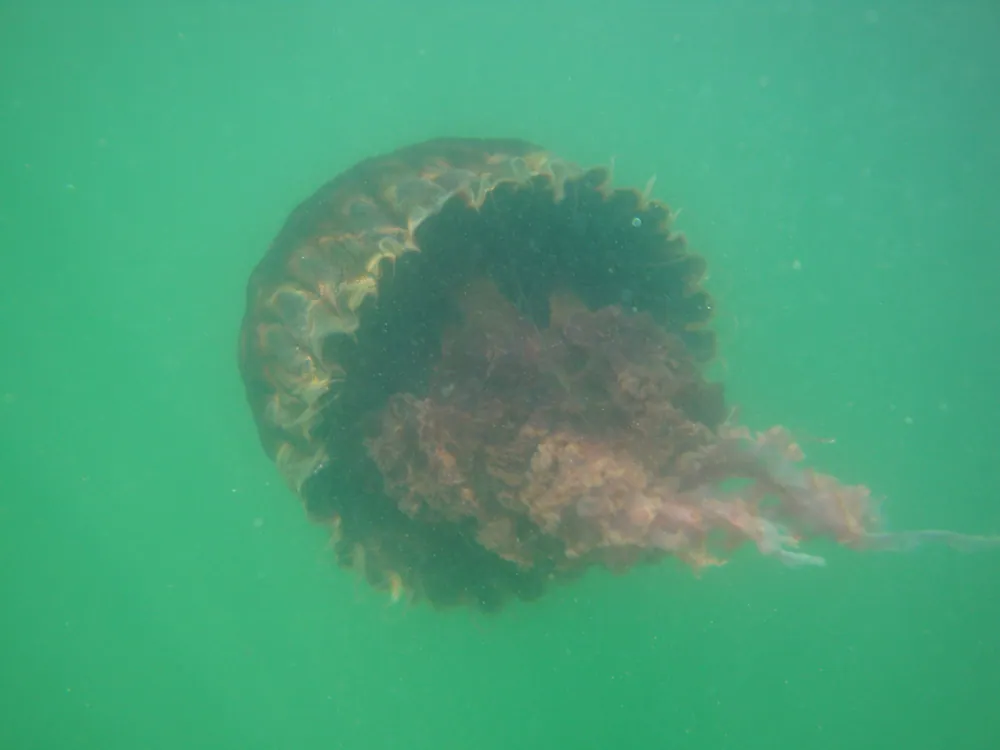
 Ni ngay ko xàmmee
- The bell is an opaque dark purple to nearly black colour.1
- The edge of the bell has a lighter brown, net-like (reticulated) pattern.1
- The bell can reach about 1 metre across, and the oral arms can extend 5 or 6 metres.1
- There are marginal sense organs around the bell edge, one after every set of 3 tentacles, 8 in total.1
Ñu ngi koy faral di jaxasoo ak: No other West Coast jelly that visits nearshore waters has this dark pigmentation, so the very dark colour is the main way to tell it apart.1
Kàttanu daŋar
Junniy cellule yu ndaw-ndaw yuy jam dañuy fetti su dara laalee leen.
Lan la daŋar biy sóob di def?
Each tentacle is covered in thousands of microscopic stinging cells called nematocysts. When touched, they fire a filament that injects toxins, which can kill smaller prey or stun predators. In people, the sting is usually not lethal but is painful and can last for forty minutes.1
Ni mu lore nit ñi?
Musiba ci nit: Dafay mettiMën na metti lool, waaye lu bon du faral di am.The sting is usually not lethal to people, but it is painful and can last for about forty minutes.1
Lan lay def bu tiitee?
Its stinging tentacles fire venom-filled filaments on contact, which stun or deter anything that threatens it.1
 Su jamee
- Génn ci ndox mi te dindi tentacule yi (ak gant walla ab tissu).
- Ci méduse-boîte yu tropik: tuuru vinaigre ci fa mu jam, 30 segond lu mu néew néew, woo ndimbal te pare ngir def RCP (massage cardiaque). Ci galère portugaise ak lu ëpp ci yeneen yi: raxas ak ndoxu géej, ginnaaw gi ndox mu tàng ngir metit wi.
Saa su nekk, woo jëkk sa nimerob urgence (112, 000, 911). Lii ay ndigal yu yaatu ci ndimbal yu jëkk la, du ndigalu doktoor. Li war a xam ci ndimbal yu jëkk
 Sàmmal sa bopp
- Bul laal mukk, bul jàpp, bul sonal ab rab bu àll, doonte bu ndaw la, te doonte dafa mel ni dafa nelaw walla dafa dee.
- May ko bérab. Su nga ko gisee, dalal, dellu ginnaaw ndànk-ndànk te bàyyi ko mu dem yoonam.
- Su benn jamee la: dalal, bul yëngu, woo sa nimerob urgence (112, 000, 911) walla dem lopitaan ci gaaw. Bul fàtte ni mu meloon, ab nataal dina dimbali.
Du la wut. Dafay jëfandikoo daŋaram ngir jàpp lu muy lekk walla ngir aar boppam, te nëbbu moo ko gën a neex. Yeneen ci ni ngay sàmme sa bopp
Fan ci àddina?
Ni mu réye?
Ni mu guddoo?
 guddu na ni 2 muusu kër, bakkan ba geen
 guddu na ni 6 banaana yu ñu toftale
 mën na féey guddaayu pisin bu réy (50 m) ci 95 segond
Black sea nettle ni mu réye ci wetu YOW?
Ay waññ rekk ci sa navigateur. Dara du denc te dara du yónnee fenn.
Ni mu gaawe?

Xibaar
It is thought to be the largest invertebrate described in the 20th century.1
Its stomach is lined with fibrous vessels that attach to prey, and its mouth-like openings, called darkmaws, close when exposed to bright light.1
It was only officially described in 1997, after large groups were found on the Pacific coast.1
Its swarms seem to coincide with red tides, which are blooms of the zooplankton it feeds on.1
Fa xibaar yi jóge
- Chrysaora achlyos (Wikipedia (CC BY-SA 4.0))
- Chrysaora achlyos (iNaturalist): tur ak ni ñu leen séddale.
- Venom Wiki: tolluwaayu musiba bi, réyaay bu yem bi ak xalaatu gaawaay bi, nun ñoo leen defar. Seetal ni nu leen waññe: Ni nuy natte musiba.
Xibaar bu nekk ci xët wii am na ab nimero buy won fa mu jóge. Su nu juumee, baal nu, nun ay nit ñu bëgg rab lanu, du ab jurnaalu xam-xam. Wax nu ko ci [email protected] te dinanu ko jubbanti.
 Jiit bi dafa xiif! Venom Wiki ab liggéeyu kenn la: amul pay, amul piblisite te amul traceur. Ab may bu tuuti dafay dimbali ngir mu des ci internet.Leel jiit bi
Yeneen ci mbooloo mi: Méduse ak mbindeefi géej yuy jam
 Australian box jellyfishMéduse ak mbindeefi géej yuy jamMën a reyBul laal
 Irukandji jellyfishMéduse ak mbindeefi géej yuy jamMën na reyBul laal
 Portuguese man o' warMéduse ak mbindeefi géej yuy jamSoxla na doktoorBul laal
 Lion's mane jellyfishMéduse ak mbindeefi géej yuy jamDafay metti rekkBul laal
 Moon jellyfishMéduse ak mbindeefi géej yuy jamAmul lor
 Common kingslayerMéduse ak mbindeefi géej yuy jamMën na reyBul laal
Dafay dund itam ci: Mbàmbulaanu Atlantig
 Hawksbill sea turtleYeneen rab yu am daŋar ci seen yaramMën na rey
 Blue sea dragonCône ak pieuvreDafay metti rekk
 Greenland sharkYeneen rab yu am daŋar ci seen yaramDafay metti rekk
 Common octopusCône ak pieuvreAmul lor
 Common stingrayJën yu am daŋarSoxla na doktoor
 Greater weeverJën yu am daŋarSoxla na doktoorBul laal