
 Afrig
Afrig Asi
Asi Tugal
Tugal Amerig gu Bëj-saalum
 Ostarali ak Oseyani
 Antarktig
 Mbàmbulaanu Pasifik
 Mbàmbulaanu Atlantig
 Mbàmbulaanu End
 Mbàmbulaanu Arktik
 Géeju Mediteraane
 Géej gu Xonq
 Géeju Karayib
 Géeju Koraay
 Géeju Siin gu Bëj-saalum
 Géeju Filipin
 Géeju Andaman
 Géeju Bëj-gànnaar
 Géeju Timor ak Arafura
 Golfu Bengal
 Golfu Kaliforni
Chinese black earth tiger tarantula
 Dafay màtt
The Chinese black earth tiger tarantula is a large, dark spider that lives in burrows on the island of Hainan, off southern China. It is one of several spiders from China and Vietnam known as the Chinese bird spider. Scientists study its venom because it is considered highly venomous.1

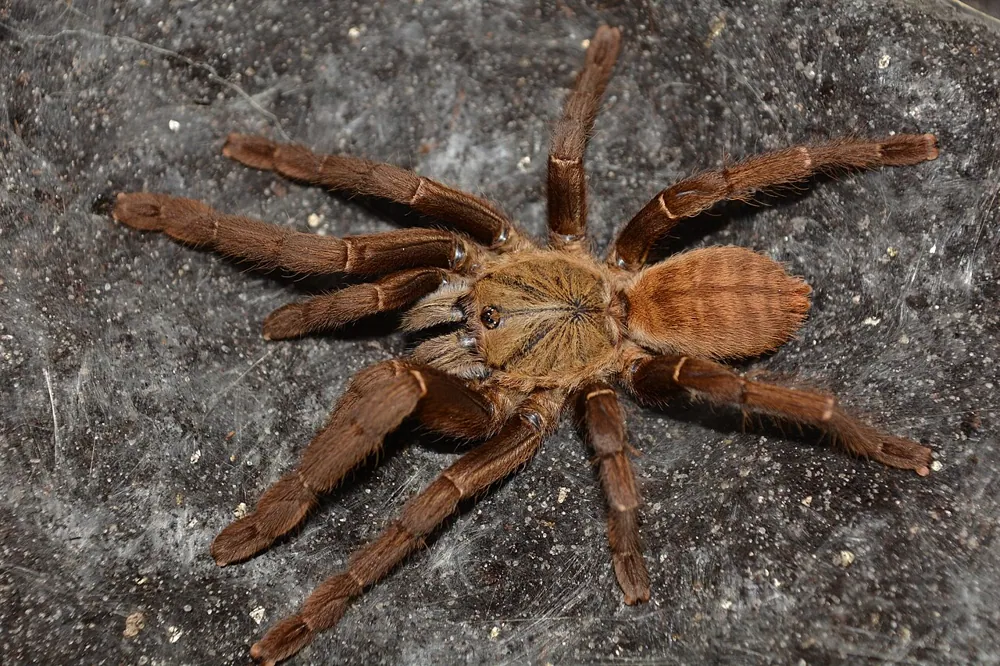
 Ni ngay ko xàmmee
- Dark black-brown body1
- Abdomen (rear body) is dark brown with six black stripes running across it and a black stripe down the centre of the upper surface1
- Carapace (upper front body) is black-brown, and the underside of the front body is red-brown1
- Females are about 60 mm long (body plus chelicerae, the fang-bearing mouthparts), with longer legs than males1
- Males are smaller, about 34 mm long, but have legs of a similar length to the female's1
Ñu ngi koy faral di jaxasoo ak: It resembles Cyriopagopus schmidti. The Chinese black earth tiger tarantula can be told apart by its dark black-brown body and by the longer thorns on the forward-facing side of the maxillae (the mouthparts that hold the fangs).1
Kàttanu daŋar
Daŋar bi dafay génn ci bëñam yi su màttee.
Lan la daŋar biy sóob di def?
Its venom is a complex neurotoxin, meaning it attacks the nervous system. It contains many compounds that block neurotransmitters, the chemical messengers that carry signals between nerves, including neurotoxic peptides called hainantoxins. The effects of its bite on humans are not well documented.1
Ni mu lore nit ñi?
Musiba ci nit: Lu bonMàtt laaj na doktoor. Ñi ciy dee dañoo néew lool.The effects of its bite on people are not well documented. In laboratory tests, its venom is often lethal to mice and rats in small doses, so it is generally regarded as a highly venomous species.1
Lan lay def bu tiitee?
It stays hidden in its silk-lined burrow during the day, and its silk alarm lines radiate from the burrow mouth.1
 Su màttee
- Raxas fa mu màtt te sedal ko. Wutal ndimbal doktoor su metit wi dëgëree walla yaramu nit ki baaxul.
Saa su nekk, woo jëkk sa nimerob urgence (112, 000, 911). Lii ay ndigal yu yaatu ci ndimbal yu jëkk la, du ndigalu doktoor. Li war a xam ci ndimbal yu jëkk
 Sàmmal sa bopp
- Bul laal mukk, bul jàpp, bul sonal ab rab bu àll, doonte bu ndaw la, te doonte dafa mel ni dafa nelaw walla dafa dee.
- May ko bérab. Su nga ko gisee, dalal, dellu ginnaaw ndànk-ndànk te bàyyi ko mu dem yoonam.
- Su benn màttee la: dalal, bul yëngu, woo sa nimerob urgence (112, 000, 911) walla dem lopitaan ci gaaw. Bul fàtte ni mu meloon, ab nataal dina dimbali.
Du la wut. Dafay jëfandikoo daŋaram ngir jàpp lu muy lekk walla ngir aar boppam, te nëbbu moo ko gën a neex. Yeneen ci ni ngay sàmme sa bopp
Ni mu réye?
Ni mu guddoo?
 guddu na ni 2 bloku tabax yu ñu toftale
 mën na daw 100 meetar ci 200 segond (nit ki gën a gaaw soxla na 9,6)
Chinese black earth tiger tarantula ni mu réye ci wetu YOW?
Ay waññ rekk ci sa navigateur. Dara du denc te dara du yónnee fenn.
Ni mu gaawe?


Xibaar
Although the effects of its bite on humans are poorly recorded, its venom is often lethal to laboratory mice and rats in small doses.1
Its venom contains neurotoxic peptides called hainantoxins, which block the chemical signals that nerves use to communicate.1
It lives on very steep, south-facing mountain slopes, at angles of 75 to 85 degrees.1
Despite the male being much smaller than the female, his legs are nearly as long as hers.1
Fa xibaar yi jóge
- Cyriopagopus hainanus (Wikipedia (CC BY-SA 4.0))
- Cyriopagopus hainanus (iNaturalist): tur ak ni ñu leen séddale.
- Venom Wiki: tolluwaayu musiba bi, réyaay bu yem bi ak xalaatu gaawaay bi, nun ñoo leen defar. Seetal ni nu leen waññe: Ni nuy natte musiba.
Xibaar bu nekk ci xët wii am na ab nimero buy won fa mu jóge. Su nu juumee, baal nu, nun ay nit ñu bëgg rab lanu, du ab jurnaalu xam-xam. Wax nu ko ci [email protected] te dinanu ko jubbanti.
 Jiit bi dafa xiif! Venom Wiki ab liggéeyu kenn la: amul pay, amul piblisite te amul traceur. Ab may bu tuuti dafay dimbali ngir mu des ci internet.Leel jiit bi
Yeneen ci mbooloo mi: Tarentule ak atrax
 Gooty sapphire tarantulaTarentule ak atraxSoxla na doktoor
 Indian ornamental tarantulaTarentule ak atraxSoxla na doktoor
 Cobalt blue tarantulaTarentule ak atraxDafay metti rekk
 Chinese bird spiderTarentule ak atraxSoxla na doktoor
 Fringed ornamental tarantulaTarentule ak atraxSoxla na doktoor
 Japanese funnel-web spiderTarentule ak atraxSoxla na doktoor
 Deathstalker
 Indian cobra
 Indian saw-scaled viper
 King cobra
 Jaan wu ñuul wi (Bitis arietans)
 Jaan wu Russell