
 Afrig
Afrig Asi
Asi Tugal
Tugal Amerig gu Bëj-saalum
 Ostarali ak Oseyani
 Antarktig
 Mbàmbulaanu Pasifik
 Mbàmbulaanu Atlantig
 Mbàmbulaanu End
 Mbàmbulaanu Arktik
 Géeju Mediteraane
 Géej gu Xonq
 Géeju Karayib
 Géeju Koraay
 Géeju Siin gu Bëj-saalum
 Géeju Filipin
 Géeju Andaman
 Géeju Bëj-gànnaar
 Géeju Timor ak Arafura
 Golfu Bengal
 Golfu Kaliforni
Komodo dragon
 Dafay màtt
The Komodo dragon is a very large lizard, and it is the biggest lizard alive today. It lives on a few small islands in Eastern Indonesia, where it hunts deer and pigs and sits at the top of its food chain. Adults occasionally attack people, so it is a dangerous animal to keep your distance from.1



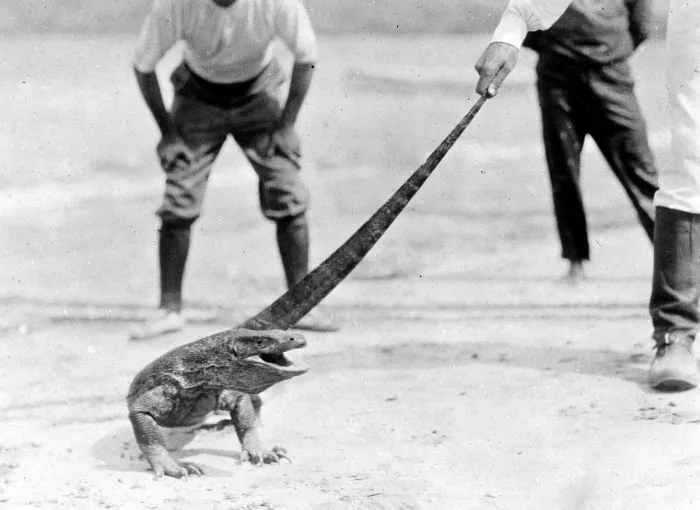
 Ni ngay ko xàmmee
- A very large, heavy-bodied lizard. Males can reach 3 m in length.1
- A tail about as long as its body.1
- Armoured, bony scales that give the skin a rugged, chain-mail look.1
- Serrated, saw-like teeth, and saliva that is often tinged with blood.1
- A long, yellow, deeply forked tongue that it flicks like a snake.1
Kàttanu daŋar
Daŋar bi dafay génn ci bëñam yi su màttee.
Ni mu lore nit ñi?
Musiba ci nit: Am na musiba loolMën na rey nit ku ñu fajul.Adult Komodo dragons occasionally attack humans, so they should be treated as dangerous. Their size and strength make any attack serious.1
 Su màttee
- Raxas gaañu-gaañu bi, def ba nit ki dal te wutal ndimbal doktoor.
Saa su nekk, woo jëkk sa nimerob urgence (112, 000, 911). Lii ay ndigal yu yaatu ci ndimbal yu jëkk la, du ndigalu doktoor. Li war a xam ci ndimbal yu jëkk
 Sàmmal sa bopp
- Bul laal mukk, bul jàpp, bul sonal ab rab bu àll, doonte bu ndaw la, te doonte dafa mel ni dafa nelaw walla dafa dee.
- May ko bérab. Su nga ko gisee, dalal, dellu ginnaaw ndànk-ndànk te bàyyi ko mu dem yoonam.
- Su benn màttee la: dalal, bul yëngu, woo sa nimerob urgence (112, 000, 911) walla dem lopitaan ci gaaw. Bul fàtte ni mu meloon, ab nataal dina dimbali.
Du la wut. Dafay jëfandikoo daŋaram ngir jàpp lu muy lekk walla ngir aar boppam, te nëbbu moo ko gën a neex. Yeneen ci ni ngay sàmme sa bopp
Ni mu réye?
Ni mu guddoo?
Ni mu diise?
 guddu na ni 3 xaj, bakkan ba geen
 guddu na ni 17 banaana yu ñu toftale
 mën na daw 100 meetar ci 18 segond (nit ki gën a gaaw soxla na 9,6)
Komodo dragon ni mu réye ci wetu YOW?
Ay waññ rekk ci sa navigateur. Dara du denc te dara du yónnee fenn.
Ni mu gaawe?

Xibaar
The Komodo dragon is the largest living lizard, and its size is unusual among reptiles.1
Its teeth are replaced about every 40 days, and it has up to five replacement teeth for each tooth position at any time.1
Fossils show that Komodo dragons once lived in Australia, where they existed alongside megalania, the largest land lizard ever.1
The 1926 expedition by W. Douglas Burden inspired the 1933 film King Kong.1
Tasukatu léeb
Xalaat bu juum: Komodo dragons are deaf.
Dëgg: They were once thought to be deaf, but a London Zoo keeper trained one to come to her voice even when she was out of sight. They hear low-pitched sounds, roughly between 400 and 2,000 hertz.1
Ngir boroom xam-xam ci daŋar
- Turu xam-xam
- Varanus komodoensis
- Mbooloo
- Lézard yu am daŋar
- Njaboot
- Varanidae2
- Toftal
- Squamata
- Kontinaa yi
- Asi
- Liir yi
- Mating happens between May and August, and females lay up to 20 eggs in September, in an abandoned megapode nest or a hole they dig themselves. The eggs take seven to eight months to hatch, usually in April. Young Komodo dragons take 8 to 11 years to mature.1
- Diiru dund
- lu tollu ci 30 at1
- Ni mu nekke ci àll bi
- Endangered1
- Musiba ci nit
- 4 / 5: Am na musiba lool3
Fa xibaar yi jóge
- Komodo dragon (Wikipedia (CC BY-SA 4.0))
- Varanus komodoensis (iNaturalist): tur ak ni ñu leen séddale.
- Venom Wiki: tolluwaayu musiba bi, réyaay bu yem bi ak xalaatu gaawaay bi, nun ñoo leen defar. Seetal ni nu leen waññe: Ni nuy natte musiba.
Xibaar bu nekk ci xët wii am na ab nimero buy won fa mu jóge. Su nu juumee, baal nu, nun ay nit ñu bëgg rab lanu, du ab jurnaalu xam-xam. Wax nu ko ci [email protected] te dinanu ko jubbanti.
 Jiit bi dafa xiif! Venom Wiki ab liggéeyu kenn la: amul pay, amul piblisite te amul traceur. Ab may bu tuuti dafay dimbali ngir mu des ci internet.Leel jiit bi
 Desert monitor
 Gila monster
 Mexican beaded lizard
 Lace monitor
 Perentie
 Spiny-tailed monitor
 Deathstalker
 Indian cobra
 Indian saw-scaled viper
 King cobra
 Jaan wu ñuul wi (Bitis arietans)
 Jaan wu Russell