
 Afrig
Afrig Asi
Asi Tugal
Tugal Amerig gu Bëj-saalum
 Ostarali ak Oseyani
 Antarktig
 Mbàmbulaanu Pasifik
 Mbàmbulaanu Atlantig
 Mbàmbulaanu End
 Mbàmbulaanu Arktik
 Géeju Mediteraane
 Géej gu Xonq
 Géeju Karayib
 Géeju Koraay
 Géeju Siin gu Bëj-saalum
 Géeju Filipin
 Géeju Andaman
 Géeju Bëj-gànnaar
 Géeju Timor ak Arafura
 Golfu Bengal
 Golfu Kaliforni
Oriental hornet
 Dafay jam
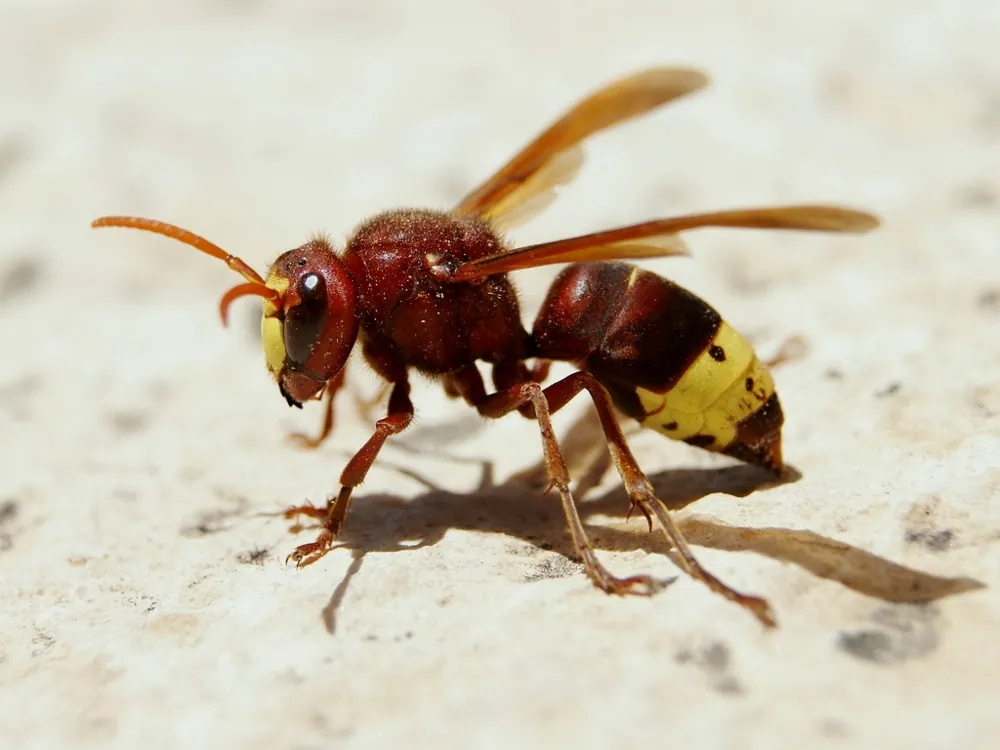
The Oriental hornet is a large social wasp that lives in colonies of thousands of insects, led by a single queen. It lives in parts of Southwest Asia, Northeast Africa, the Middle East and Southern Europe, and it is one of the main pests of honey bees. Its sting can be very painful.1



 Ni ngay ko xàmmee
- Reddish-brown body1
- Thick yellow bands across the abdomen1
- Yellow patches on the head between the eyes1
- Body 25 to 35 mm long; the queen and drones are larger than workers1
- Very strong jaws, and will bite if provoked1
Ñu ngi koy faral di jaxasoo ak: It looks similar to the European hornet (Vespa crabro). The Asian giant hornet of East Asia should not be confused with it. Males (drones) have 13 antenna segments, while workers and the queen have 12.1
Kàttanu daŋar
Daŋar bi dafay génn ci ab dag buy jam.
Lan la daŋar biy sóob di def?
The sting is quite painful to people. Some people are allergic to these stings. Tests on the venom showed that it slowed the growth of some Gram-positive bacteria, a group of bacteria, so it may be useful as a medicine.1
Ni mu lore nit ñi?
Musiba ci nit: Dafay mettiMën na metti lool, waaye lu bon du faral di am.The sting can be quite painful, and some people are allergic to it.1
Lan lay def bu tiitee?
Workers defend the colony, and will bite if provoked.1
 Su jamee
- Xuufal dagu yamb bi ba mu génn, te sedal fa mu jam.
- Su nit ki am jafe-jafe ci noyyi, kanamam walla putam funki, walla mu bëgg a xëm, allergie bu metti la (urgence): woo sa nimerob urgence te jëfandikoo stylo adrénaline bi mu am, su am.
Saa su nekk, woo jëkk sa nimerob urgence (112, 000, 911). Lii ay ndigal yu yaatu ci ndimbal yu jëkk la, du ndigalu doktoor. Li war a xam ci ndimbal yu jëkk
 Sàmmal sa bopp
- Bul laal mukk, bul jàpp, bul sonal ab rab bu àll, doonte bu ndaw la, te doonte dafa mel ni dafa nelaw walla dafa dee.
- May ko bérab. Su nga ko gisee, dalal, dellu ginnaaw ndànk-ndànk te bàyyi ko mu dem yoonam.
- Su benn jamee la: dalal, bul yëngu, woo sa nimerob urgence (112, 000, 911) walla dem lopitaan ci gaaw. Bul fàtte ni mu meloon, ab nataal dina dimbali.
Du la wut. Dafay jëfandikoo daŋaram ngir jàpp lu muy lekk walla ngir aar boppam, te nëbbu moo ko gën a neex. Yeneen ci ni ngay sàmme sa bopp
Ni mu réye?
Ni mu guddoo?
 guddu na lu tollu ci trombone
 mën na naaw ci benn terrain bu futbal bu mat ci 12 segond
Oriental hornet ni mu réye ci wetu YOW?
Ay waññ rekk ci sa navigateur. Dara du denc te dara du yónnee fenn.
Ni mu gaawe?


Xibaar
The yellow stripe on its exoskeleton can absorb sunlight and generate a small electrical potential, which may help supply energy for digging.1
A 2024 study found that hornets fed sugary solutions containing up to 80% ethanol for a week showed no harmful effects on behaviour or lifespan. Most animals tolerate only up to 4%.1
It is the primary pest that attacks honey bee colonies in many countries.1
It is the only member of the genus Vespa that lives in desert climates, such as those in North Africa and the Middle East.1
Unlike most wasps, which are most active early in the morning, it is most active in the middle of the day.1
Its sisters are closely related, with each worker on average 75% related to her sisters, so workers help raise the colony's young.1
Ngir boroom xam-xam ci daŋar
Fa xibaar yi jóge
- Oriental hornet (Wikipedia (CC BY-SA 4.0))
- Vespa orientalis (iNaturalist): tur ak ni ñu leen séddale.
- Venom Wiki: tolluwaayu musiba bi, réyaay bu yem bi ak xalaatu gaawaay bi, nun ñoo leen defar. Seetal ni nu leen waññe: Ni nuy natte musiba.
Xibaar bu nekk ci xët wii am na ab nimero buy won fa mu jóge. Su nu juumee, baal nu, nun ay nit ñu bëgg rab lanu, du ab jurnaalu xam-xam. Wax nu ko ci [email protected] te dinanu ko jubbanti.
 Jiit bi dafa xiif! Venom Wiki ab liggéeyu kenn la: amul pay, amul piblisite te amul traceur. Ab may bu tuuti dafay dimbali ngir mu des ci internet.Leel jiit bi
Yeneen ci mbooloo mi: Yamb, guêpe ak frelon
 Asian giant hornetYamb, guêpe ak frelonMën na rey
 Common waspYamb, guêpe ak frelonDafay metti rekk
 European hornetYamb, guêpe ak frelonDafay metti rekk
 Western honey beeYamb, guêpe ak frelonDafay metti rekk
 Giant honey beeYamb, guêpe ak frelonSoxla na doktoor
 Asian hornetYamb, guêpe ak frelonDafay metti rekk
 Common European adder
 Spanish fly
 Fire salamander
 Blunt-nosed viper
 Nose-horned viper
 Ottoman viper