
 Afrig
Afrig Asi
Asi Tugal
Tugal Amerig gu Bëj-saalum
 Ostarali ak Oseyani
 Antarktig
 Mbàmbulaanu Pasifik
 Mbàmbulaanu Atlantig
 Mbàmbulaanu End
 Mbàmbulaanu Arktik
 Géeju Mediteraane
 Géej gu Xonq
 Géeju Karayib
 Géeju Koraay
 Géeju Siin gu Bëj-saalum
 Géeju Filipin
 Géeju Andaman
 Géeju Bëj-gànnaar
 Géeju Timor ak Arafura
 Golfu Bengal
 Golfu Kaliforni
Six-spot burnet
 Am daŋar su ñu ko lekkeeDafay lekk: GàncaxAm daŋar ci yaram, du màtt walla jam
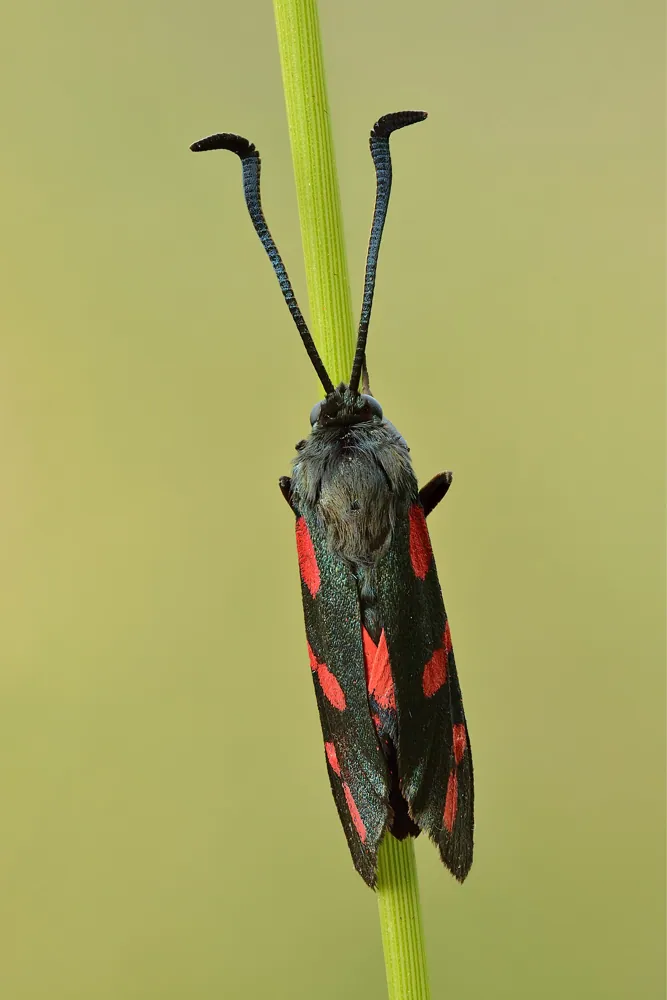
The six-spot burnet is a day-flying moth with dark green wings marked by six bright red spots. It lives in meadows and grassy places across much of Europe and parts of Asia. Its bright colours warn birds and lizards that it is toxic.1



 Ni ngay ko xàmmee
- Forewings are dark metallic green with six vivid red spots1
- Sometimes the spots are merged together, or they are yellow or black1
- Hindwings are red with a blackish fringe1
- Wingspan is 30 to 40 mm, and the sexes look similar1
- Adults fly on hot, sunny days from June to August1
- Larva is plump and hairy, usually pale green with rows of black spots1
Ñu ngi koy faral di jaxasoo ak: It can be confused with the five-spot burnet, especially when the spots on its forewings have merged together.1
Kàttanu daŋar
Lor na rekk su dara lekkee ko.
Ni mu lore nit ñi?
Musiba ci nit: WoyofNi jamu yamb walla lu ko yées. Lu jege, amul lor ci nit.Lan lay def bu tiitee?
When attacked, it releases a liquid containing cyanide, and its bright colours warn predators such as birds and lizards that it is toxic.1
 Su kenn laalee ko walla mu lekk ko
- Su kenn lekkee ko walla mu am ay màndarga ginnaaw bi mu ko lekkee: woo sa nimerob urgence walla centre antipoison ci saa si.
Saa su nekk, woo jëkk sa nimerob urgence (112, 000, 911). Lii ay ndigal yu yaatu ci ndimbal yu jëkk la, du ndigalu doktoor. Li war a xam ci ndimbal yu jëkk
 Sàmmal sa bopp
- Bul laal mukk, bul jàpp, bul sonal ab rab bu àll, doonte bu ndaw la, te doonte dafa mel ni dafa nelaw walla dafa dee.
- May ko bérab. Su nga ko gisee, dalal, dellu ginnaaw ndànk-ndànk te bàyyi ko mu dem yoonam.
- Su nga ko laalee walla nga lekk ko: bul moos say bët walla sa gémmiñ, raxas say loxo te wutal ndimbal doktoor.
Du la wut. Daŋaram nekk na rekk ngir kenn bañ ko lekk. Yeneen ci ni ngay sàmme sa bopp
Ni mu réye?
Ni mu guddoo?
 guddu na lu tollu ci trombone
Six-spot burnet ni mu réye ci wetu YOW?
Ay waññ rekk ci sa navigateur. Dara du denc te dara du yónnee fenn.
Ni mu gaawe?


_-_Kulna.jpg)
Xibaar
Ngir boroom xam-xam ci daŋar
Fa xibaar yi jóge
- Six-spot burnet (Wikipedia (CC BY-SA 4.0))
- Zygaena filipendulae (iNaturalist): tur ak ni ñu leen séddale.
- Venom Wiki: tolluwaayu musiba bi, réyaay bu yem bi ak xalaatu gaawaay bi, nun ñoo leen defar. Seetal ni nu leen waññe: Ni nuy natte musiba.
Xibaar bu nekk ci xët wii am na ab nimero buy won fa mu jóge. Su nu juumee, baal nu, nun ay nit ñu bëgg rab lanu, du ab jurnaalu xam-xam. Wax nu ko ci [email protected] te dinanu ko jubbanti.
 Jiit bi dafa xiif! Venom Wiki ab liggéeyu kenn la: amul pay, amul piblisite te amul traceur. Ab may bu tuuti dafay dimbali ngir mu des ci internet.Leel jiit bi
Yeneen ci mbooloo mi: Yeneen rab yu am daŋar ci seen yaram
 Spanish flyYeneen rab yu am daŋar ci seen yaramSoxla na doktoorBul laal
 Common quailYeneen rab yu am daŋar ci seen yaramDafay metti rekk
 Cinnabar mothYeneen rab yu am daŋar ci seen yaramAmul lor
 Black oil beetleYeneen rab yu am daŋar ci seen yaramDafay metti rekkBul laal
 Red-striped oil beetleYeneen rab yu am daŋar ci seen yaramDafay metti rekkBul laal
 Japanese pufferfishYeneen rab yu am daŋar ci seen yaramMën a rey
Dafay dund itam ci: Tugal
 Common European adderVipèreSoxla na doktoor
 Common waspYamb, guêpe ak frelonDafay metti rekk
 European hornetYamb, guêpe ak frelonDafay metti rekk
 Fire salamanderMbott yu am daŋar, crapaud ak tritonDafay metti rekkBul laal
 Western honey beeYamb, guêpe ak frelonDafay metti rekk
 Blunt-nosed viperVipèreMën na rey