
 Afrig
Afrig Asi
Asi Tugal
Tugal Amerig gu Bëj-saalum
 Ostarali ak Oseyani
 Antarktig
 Mbàmbulaanu Pasifik
 Mbàmbulaanu Atlantig
 Mbàmbulaanu End
 Mbàmbulaanu Arktik
 Géeju Mediteraane
 Géej gu Xonq
 Géeju Karayib
 Géeju Koraay
 Géeju Siin gu Bëj-saalum
 Géeju Filipin
 Géeju Andaman
 Géeju Bëj-gànnaar
 Géeju Timor ak Arafura
 Golfu Bengal
 Golfu Kaliforni
Japanese pufferfish
 Am daŋar su ñu ko lekkee
The Japanese pufferfish, also called the tiger puffer or torafugu, is a fish that lives in cold, shallow seas off East Asia. It is famous as a food in Japan, but its liver and ovaries contain a strong toxin, so it must be prepared with great care. It is also a key animal in genetics research.1
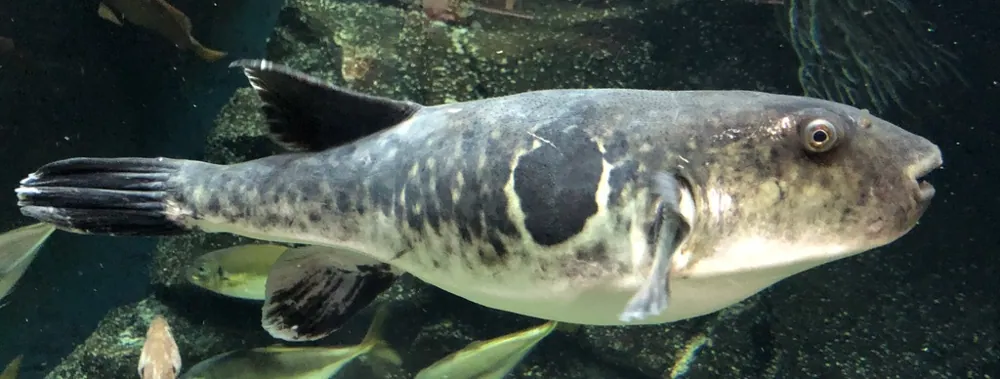
Kàttanu daŋar
Lor na rekk su dara lekkee ko.
Lan la daŋar bi ci yaramam di def?
This pufferfish is poisonous rather than venomous. Some of its organs contain tetrodotoxin, a highly toxic substance, which is concentrated in the liver and ovaries, slightly present in the intestines and flesh, and absent from the skin and testes.1
Ni mu lore nit ñi?
Musiba ci nit: Mën a reyBenn ci rab yi gën a am musiba ci àddina.Its organs are highly toxic, so the liver and ovaries are the dangerous parts to eat. Only the flesh and skin are the parts that are safe to eat in regulated preparation.1
 Su kenn laalee ko walla mu lekk ko
- Su kenn lekkee ko walla mu am ay màndarga ginnaaw bi mu ko lekkee: woo sa nimerob urgence walla centre antipoison ci saa si.
Saa su nekk, woo jëkk sa nimerob urgence (112, 000, 911). Lii ay ndigal yu yaatu ci ndimbal yu jëkk la, du ndigalu doktoor. Li war a xam ci ndimbal yu jëkk
 Sàmmal sa bopp
- Bul laal mukk, bul jàpp, bul sonal ab rab bu àll, doonte bu ndaw la, te doonte dafa mel ni dafa nelaw walla dafa dee.
- May ko bérab. Su nga ko gisee, dalal, dellu ginnaaw ndànk-ndànk te bàyyi ko mu dem yoonam.
- Su nga ko laalee walla nga lekk ko: bul moos say bët walla sa gémmiñ, raxas say loxo te wutal ndimbal doktoor.
Du la wut. Daŋaram nekk na rekk ngir kenn bañ ko lekk. Yeneen ci ni ngay sàmme sa bopp
Fan ci àddina?
Ni mu réye?
Ni mu guddoo?
 guddu na ni 2 banaana yu ñu toftale
 guddu na ni 12 bloku tabax yu ñu toftale
 mën na féey guddaayu pisin bu réy (50 m) ci 45 segond
Japanese pufferfish ni mu réye ci wetu YOW?
Ay waññ rekk ci sa navigateur. Dara du denc te dara du yónnee fenn.
Ni mu gaawe?
Xibaar
A genetically modified type called 22-seiki fugu, meaning 22nd-century fugu, has had four leptin receptor genes removed, which increases appetite. It grows on average 1.9 times faster than normal torafugu and is sold as food.1
Its genome is one of the smallest known among vertebrates, and it was the first vertebrate genome after the human genome to be made publicly available.1
Its genome has about 6% of the base pairs of the human genome, yet it has 22 chromosomes, close to the 23 in humans.1
It is one of the most valuable commercial fishes in Japan.1
It is used as a reference genome to help identify genes in human and other vertebrate genomes.1
Ngir boroom xam-xam ci daŋar
- Turu xam-xam
- Takifugu rubripes
- Mbooloo
- Yeneen rab yu am daŋar ci seen yaram
- Njaboot
- Tetraodontidae2
- Toftal
- Tetraodontiformes
- Kontinaa yi
- Mbàmbulaanu Pasifik, Mbàmbulaan yi
- Liir yi
- Spawning takes place in estuaries. Young fish stay in river mouths and lagoons for about one year before migrating permanently to the open ocean.1
- Ni mu nekke ci àll bi
- Near Threatened1
- Musiba ci nit
- 5 / 5: Mën a rey3
Fa xibaar yi jóge
- Takifugu rubripes (Wikipedia (CC BY-SA 4.0))
- Takifugu rubripes (iNaturalist): tur ak ni ñu leen séddale.
- Venom Wiki: tolluwaayu musiba bi, réyaay bu yem bi ak xalaatu gaawaay bi, nun ñoo leen defar. Seetal ni nu leen waññe: Ni nuy natte musiba.
Xibaar bu nekk ci xët wii am na ab nimero buy won fa mu jóge. Su nu juumee, baal nu, nun ay nit ñu bëgg rab lanu, du ab jurnaalu xam-xam. Wax nu ko ci [email protected] te dinanu ko jubbanti.
 Jiit bi dafa xiif! Venom Wiki ab liggéeyu kenn la: amul pay, amul piblisite te amul traceur. Ab may bu tuuti dafay dimbali ngir mu des ci internet.Leel jiit bi
Yeneen ci mbooloo mi: Yeneen rab yu am daŋar ci seen yaram
 Hawksbill sea turtleYeneen rab yu am daŋar ci seen yaramMën na rey
 Greenland sharkYeneen rab yu am daŋar ci seen yaramDafay metti rekk
 Silver-cheeked toadfishYeneen rab yu am daŋar ci seen yaramMën a rey
 Blackspotted pufferYeneen rab yu am daŋar ci seen yaramMën na rey
 White-spotted pufferYeneen rab yu am daŋar ci seen yaramMën na rey
 Long-spine porcupinefishYeneen rab yu am daŋar ci seen yaramSoxla na doktoor
Dafay dund itam ci: Mbàmbulaanu Pasifik
 Australian box jellyfishMéduse ak mbindeefi géej yuy jamMën a reyBul laal
 Geography coneCône ak pieuvreMën a rey
 Greater blue-ringed octopusCône ak pieuvreMën a rey
 Southern blue-ringed octopusCône ak pieuvreMën a rey
 Irukandji jellyfishMéduse ak mbindeefi géej yuy jamMën na reyBul laal
 Reef stonefishJën yu am daŋarMën na reyBul laal