
 Afrig
Afrig Asi
Asi Tugal
Tugal Amerig gu Bëj-saalum
 Ostarali ak Oseyani
 Antarktig
 Mbàmbulaanu Pasifik
 Mbàmbulaanu Atlantig
 Mbàmbulaanu End
 Mbàmbulaanu Arktik
 Géeju Mediteraane
 Géej gu Xonq
 Géeju Karayib
 Géeju Koraay
 Géeju Siin gu Bëj-saalum
 Géeju Filipin
 Géeju Andaman
 Géeju Bëj-gànnaar
 Géeju Timor ak Arafura
 Golfu Bengal
 Golfu Kaliforni
Tadpole madtom
 Dag yu am daŋar
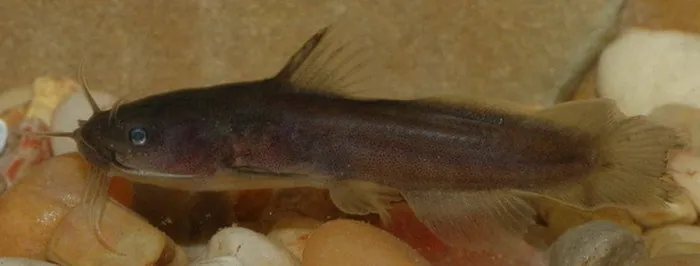
The tadpole madtom is a small freshwater fish that lives in slow, weedy waters in Canada and the United States. It has two spines near its chest that carry a venom, which it uses to defend itself from predators. Its name comes partly from its rounded tail fin, which makes it look a little like a tadpole.1



 Ni ngay ko xàmmee
- Dark brown back with lighter brown sides and a yellow or white belly1
- A dark horizontal streak along each side, from bands of dark pigment on the jaws1
- A large, round tail fin that is joined to the small fin on its back, giving it a tadpole-like shape1
- Two spines on the pectoral (chest) fins, which carry venom1
Kàttanu daŋar
Ay dag yu ñaw ñoo yor daŋar bi. Teg tànk ci kawam walla jàpp ko dafay metti.
Lan la daŋar biy sóob di def?
Two pectoral spines transmit an anti-predatory venom. The spines are used to deter predators that get stuck by them.1
Ni mu lore nit ñi?
Musiba ci nit: Dafay mettiMën na metti lool, waaye lu bon du faral di am.Lan lay def bu tiitee?
When startled, it darts about in all directions, and it uses its venomous spines against predators.1
 Su ay dagam jamee la
- Teg gaañu-gaañu bi ci ndox mu tàng, lu nit ki mën a muñ waaye bu dul ko lakk (seetal ko ak sa loxo), diir bu dale 30 ba 90 minit. Wutal ndimbal doktoor, rawatina ci jënu-doj ak raie.
Saa su nekk, woo jëkk sa nimerob urgence (112, 000, 911). Lii ay ndigal yu yaatu ci ndimbal yu jëkk la, du ndigalu doktoor. Li war a xam ci ndimbal yu jëkk
 Sàmmal sa bopp
- Bul laal mukk, bul jàpp, bul sonal ab rab bu àll, doonte bu ndaw la, te doonte dafa mel ni dafa nelaw walla dafa dee.
- May ko bérab. Su nga ko gisee, dalal, dellu ginnaaw ndànk-ndànk te bàyyi ko mu dem yoonam.
- Su ay dagam jamee la: dalal, bul yëngu, woo sa nimerob urgence (112, 000, 911) walla dem lopitaan ci gaaw. Bul fàtte ni mu meloon, ab nataal dina dimbali.
Du la wut. Dafay jëfandikoo daŋaram ngir jàpp lu muy lekk walla ngir aar boppam, te nëbbu moo ko gën a neex. Yeneen ci ni ngay sàmme sa bopp
Ni mu réye?
Ni mu guddoo?
 guddu na ni 4 bloku tabax yu ñu toftale
 mën na féey guddaayu pisin bu réy (50 m) ci 47 segond
Tadpole madtom ni mu réye ci wetu YOW?
Ay waññ rekk ci sa navigateur. Dara du denc te dara du yónnee fenn.
Ni mu gaawe?
Xibaar
It does not build a nest. It sometimes lays its eggs on submerged rubbish such as drink cans.1
Males sometimes use abandoned crayfish burrows as places to house eggs.1
Breeding males develop swollen lips and enlarged muscles on top of the head.1
Researchers in Wisconsin found that its stomach contents were about 44% insects and 28% small crustaceans.1
Tasukatu léeb
Xalaat bu juum: It is a tadpole.
Dëgg: It is a fish. Its rounded tail fin gives it the appearance of a tadpole, which is where part of its name comes from.1
Ngir boroom xam-xam ci daŋar
- Turu xam-xam
- Noturus gyrinus
- Mbooloo
- Jën yu am daŋar
- Njaboot
- Ictaluridae2
- Toftal
- Siluriformes
- Kontinaa yi
- Amerig gu Bëj-gànnaar
- Liir yi
- The female lays several clutches of 75 to 200 eggs during the breeding season, usually in June or July. The eggs are attached to solid objects such as rocks, logs or vegetation, and the male guards them until they hatch.1
- Ni mu nekke ci àll bi
- Secure in most areas. Critically endangered in Pennsylvania, and considered vulnerable in several other regions.1
- Musiba ci nit
- 2 / 5: Dafay metti3
Fa xibaar yi jóge
- Tadpole madtom (Wikipedia (CC BY-SA 4.0))
- Noturus gyrinus (iNaturalist): tur ak ni ñu leen séddale.
- Venom Wiki: tolluwaayu musiba bi, réyaay bu yem bi ak xalaatu gaawaay bi, nun ñoo leen defar. Seetal ni nu leen waññe: Ni nuy natte musiba.
Xibaar bu nekk ci xët wii am na ab nimero buy won fa mu jóge. Su nu juumee, baal nu, nun ay nit ñu bëgg rab lanu, du ab jurnaalu xam-xam. Wax nu ko ci [email protected] te dinanu ko jubbanti.
 Jiit bi dafa xiif! Venom Wiki ab liggéeyu kenn la: amul pay, amul piblisite te amul traceur. Ab may bu tuuti dafay dimbali ngir mu des ci internet.Leel jiit bi
Yeneen ci mbooloo mi: Jën yu am daŋar
 Channel catfishJën yu am daŋarDafay metti rekkBul laal
 Brown bullheadJën yu am daŋarDafay metti rekkBul laal
 Carolina madtomJën yu am daŋarDafay metti rekkBul laal
 Margined madtomJën yu am daŋarDafay metti rekkBul laal
 StonecatJën yu am daŋarDafay metti rekkBul laal
 Reef stonefishJën yu am daŋarMën na reyBul laal
 Terciopelo
 Eastern coral snake
 Eastern diamondback rattlesnake
 Eyelash viper
 Timber rattlesnake
 Western diamondback rattlesnake