
 Áfíríkà
 Éṣíà
Éṣíà Yúróòpù
 Gúúsù Amẹ́ríkà
 Ọsirélíà àti Òṣéáníà
 Antáktíkà
 Òkun Pàsífíìkì
 Òkun Àtìláńtíìkì
 Òkun Íńdíà
 Òkun Áktíkì
 Òkun Mẹditaréníà
 Òkun Pupa
 Òkun Káríbíànù
 Òkun Coral
 Òkun Gúúsù Ṣáínà
 Òkun Fílípínì
 Òkun Andaman
 Òkun Àríwá
 Òkun Tímọ̀ àti Òkun Àráfúrà
 Ìyawọlẹ̀ Òkun Bẹ̀ngál
 Ìyawọlẹ̀ Òkun Kalifọ́níà
Radiant sea urchin
 Ẹ̀gún olóró
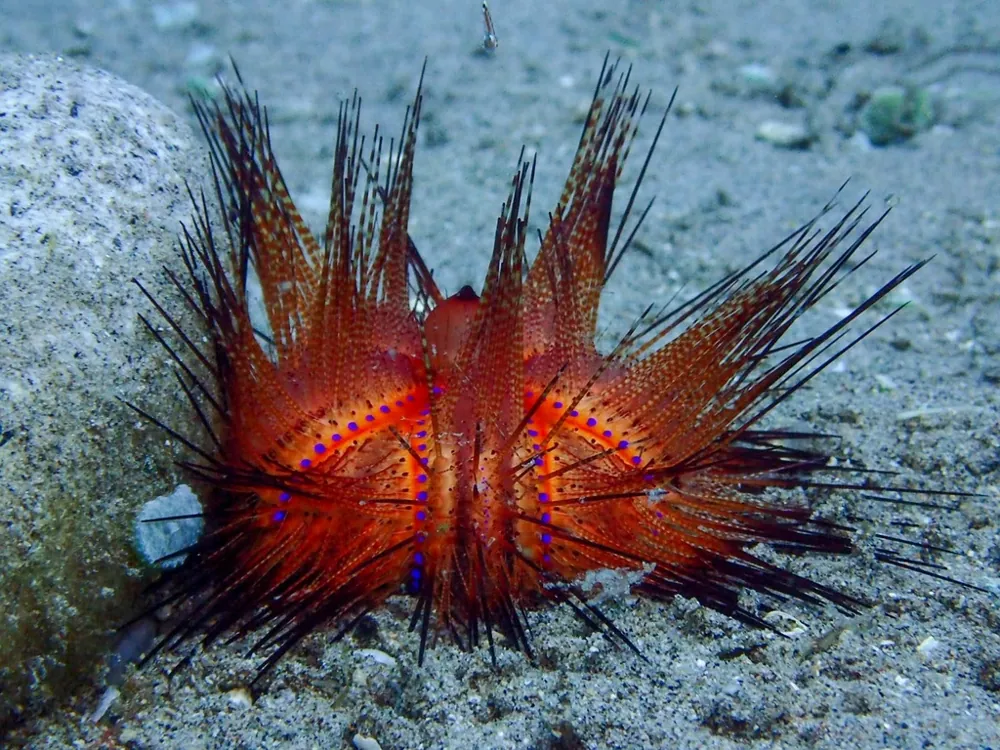
The radiant sea urchin is a large, colourful sea urchin with long, spiky spines. It lives in warm, shallow seas across the Indo-Pacific, from the African coast to Hawaii and Australia. Its spines are venomous, so it is one to admire from a distance.1

 Bí o ṣe lè dá a mọ̀
- A large urchin, with a body (test) up to 20 cm across.1
- Long, hollow spines up to 4 cm, in five vertical clusters.1
- Between the clusters are bare, V-shaped red areas with lines of iridescent blue dots.1
- The rest of the body and spines range from reddish brown to purple, dark brown or nearly black.1
- Juveniles have spines with banding across them, and this sometimes stays into adulthood.1
A sábà máa ń ṣì í mọ̀ sí: It is often called the false fire urchin to tell it apart from the true fire urchin, Asthenosoma varium.1
Agbára oró
Ẹ̀gún mímú ló ń gbé oró náà. Títẹ̀ ẹ́ mọ́lẹ̀ tàbí dídì í mú máa ń dunni.
Kí ni oró rẹ̀ máa ń ṣe?
Its spines are venomous and can cause painful wounds. The spines are long and hollow, and the shorter of the two kinds are the venomous ones.1
Báwo ló ṣe léwu tó fún ènìyàn?
Ewu fún ènìyàn: Ó ń dunniÓ lè dunni gan-an, ṣùgbọ́n kì í fẹ́rẹ̀ẹ́ le rárá.It is not deadly to humans, but its spines can cause painful wounds. Because it is large and brightly coloured, divers can usually see it, so injuries from stepping on one are fairly rare. On the 'Kings of Pain' pain index it scores 12 out of 30.1
Kí ni ó máa ń ṣe nígbà tí ẹ̀rù bá bà á?
It is sensitive to light and can angle its spines towards an approaching threat.1
 Bí ẹ̀gún rẹ̀ bá gún ọ
- Fi ọgbẹ́ náà sínú omi gbígbóná, tó gbóná tó bí ẹni náà ṣe lè fara dà á láìjóná, kí o sì wá ìrànlọ́wọ́ ìṣègùn láti yọ ẹ̀gún náà. Má ṣe gbẹ́ wọn jáde fúnra rẹ.
Máa kọ́kọ́ pe nọ́ńbà pàjáwìrì rẹ nígbà gbogbo (112, 000, 911). Èyí jẹ́ ìtọ́sọ́nà ìtọ́jú àkọ́kọ́ gbogbogbò, kì í ṣe ìmọ̀ràn ìṣègùn. Ìpìlẹ̀ ìtọ́jú àkọ́kọ́
 Wà láìléwu
- Má ṣe fọwọ́ kan, mú tàbí yọ ẹranko igbó lẹ́nu láéláé, kódà bí ó bá kéré, kódà bí ó bá dà bí ẹni pé ó ń sùn tàbí ó ti kú.
- Fún un ní àyè. Bí o bá pàdé ọ̀kan, farabalẹ̀, sẹ́yìn díẹ̀díẹ̀ kí o sì jẹ́ kí ó máa bá ọ̀nà rẹ̀ lọ.
- Bí ẹ̀gún rẹ̀ bá gún ọ: farabalẹ̀, má ṣe mira, pe nọ́ńbà pàjáwìrì rẹ (112, 000, 911) tàbí lọ sí ilé ìwòsàn kíákíá. Rántí bí ó ṣe rí, fọ́tò máa ń ṣèrànwọ́.
Kò wá ọ kiri láti ṣe ọ́ léṣe. Ó ń lo oró rẹ̀ láti mú oúnjẹ tàbí láti dáàbò bo ara rẹ̀, ó sì fẹ́ràn láti farapamọ́ jù. Sí i nípa wíwà láìléwu
Níbo ní ayé?
Báwo ló ṣe tóbi tó?
Báwo ló ṣe gùn tó?
 ó gùn tó bíríkì ìṣeré 6 tí a tò sí ìlà kan
 ó lọ́ra ju ìgbín inú ọgbà lọ
Báwo ni Radiant sea urchin ṣe tóbi tó tí a bá fi wé ÌWỌ?
Ìṣirò nìkan nínú bráwúsà rẹ. A kò fi ohunkóhun pamọ́, a kò sì fi ránṣẹ́ sí ibikíbi.
Báwo ló ṣe yára tó?

Òtítọ́
A crab called Dorippe frascone carries the urchin on its back.1
Several shrimps, crabs and small fish live among its spines for shelter.1
Its scientific name refers to a star-shaped pattern around its anus, not to the animal's shape as a whole.1
Its bright colours and size make it a favourite subject for underwater photographers and some expert fish-keepers.1
Its young larvae drift in the ocean as plankton before they settle on the seabed.1
Fún àwọn amòye oró
- Orúkọ sáyẹ́ǹsì
- Astropyga radiata
- Ẹgbẹ́
- Sea urchin, ẹja ìràwọ̀ àti kòkòrò inú òkun
- Ìdílé
- Diadematidae2
- Ètò
- Diadematoida
- Àwọn kọ́ńtínẹ́ńtì
- Òkun Íńdíà, Òkun Pàsífíìkì, Òkun Coral, Òkun Fílípínì, Òkun Tímọ̀ àti Òkun Àráfúrà, Ìyawọlẹ̀ Òkun Bẹ̀ngál, Àwọn òkun ńlá
- Àwọn ọmọ
- Males and females are separate. Eggs and sperm are released into the water, and the larvae drift as plankton through several stages before settling on the seabed and becoming juveniles.1
- Ewu fún ènìyàn
- 2 / 5: Ó ń dunni3
Ibi tí àwọn òtítọ́ ti wá
- Astropyga radiata (Wikipedia (CC BY-SA 4.0))
- Astropyga radiata (iNaturalist): orúkọ àti ìpínsísọ̀rí.
- Venom Wiki: ìpele ewu, ìtóbi déédé àti àfojúbù ìyára jẹ́ tiwa. Wo bí a ṣe ń ṣírò wọn: Bí a ṣe ń díwọ̀n ewu.
Gbogbo òtítọ́ ojú-ìwé yìí ní nọ́ńbà tó tọ́ka sí orísun rẹ̀. Bí a bá ṣe àṣìṣe, má bínú, olólùfẹ́ ẹranko ni wá, kì í ṣe ìwé ìròyìn sáyẹ́ǹsì. Sọ fún wa ní [email protected] a ó sì tún un ṣe.
 Ebi ń pa àkekèé! Iṣẹ́ akanṣe ẹnì kan ṣoṣo ni Venom Wiki: ọ̀fẹ́ ni, kò sí ìpolówó, kò sì sí olùtọpinpin. Ẹ̀bùn kékeré ń ràn án lọ́wọ́ láti wà lórí íńtánẹ́ẹ̀tì.Bọ́ àkekèé
Sí i láti inú ẹgbẹ́ kan náà: Sea urchin, ẹja ìràwọ̀ àti kòkòrò inú òkun
 Crown-of-thorns starfishSea urchin, ẹja ìràwọ̀ àti kòkòrò inú òkunÓ nílò dókítàMá ṣe fọwọ́ kàn án
 Flower urchinSea urchin, ẹja ìràwọ̀ àti kòkòrò inú òkunÓ lè pani
 Fire urchinSea urchin, ẹja ìràwọ̀ àti kòkòrò inú òkunÓ nílò dókítàMá ṣe fọwọ́ kàn án
 Bearded firewormSea urchin, ẹja ìràwọ̀ àti kòkòrò inú òkunÓ kàn ń dunniMá ṣe fọwọ́ kàn án
 Black long-spined urchinSea urchin, ẹja ìràwọ̀ àti kòkòrò inú òkunÓ kàn ń dunniMá ṣe fọwọ́ kàn án
 BloodwormSea urchin, ẹja ìràwọ̀ àti kòkòrò inú òkunÓ kàn ń dunni
Ó tún ń gbé ní: Òkun Íńdíà
 Australian box jellyfishJellyfish àti àwọn ẹ̀dá òkun tó ń ta niApaniMá ṣe fọwọ́ kàn án
 Geography coneÌgbín cone àti octopusApani
 Greater blue-ringed octopusÌgbín cone àti octopusApani
 Southern blue-ringed octopusÌgbín cone àti octopusApani
 Hawksbill sea turtleÀwọn ẹranko onímájèlé mìírànÓ lè pani
 Irukandji jellyfishJellyfish àti àwọn ẹ̀dá òkun tó ń ta niÓ lè paniMá ṣe fọwọ́ kàn án