
 I-Afrika
 I-Asia
 I-Yurophu
 INingizimu Melika
 I-Australia ne-Oceania
 I-Antarctica
 ULwandlekazi iPacific
 ULwandlekazi i-Atlantic
 ULwandlekazi i-India
 ULwandlekazi i-Arctic
 Ulwandle iMediterranean
 Ulwandle Olubomvu
 Ulwandle iCaribbean
 Ulwandle iCoral
 Ulwandle lwaseNingizimu China
 Ulwandle lwasePhilippines
 Ulwandle i-Andaman
 Ulwandle i-North Sea
 Ulwandle lwaseTimor ne-Arafura
 Ichweba laseBengal
 Ichweba laseCalifornia
Many-banded krait
 Ukuluma
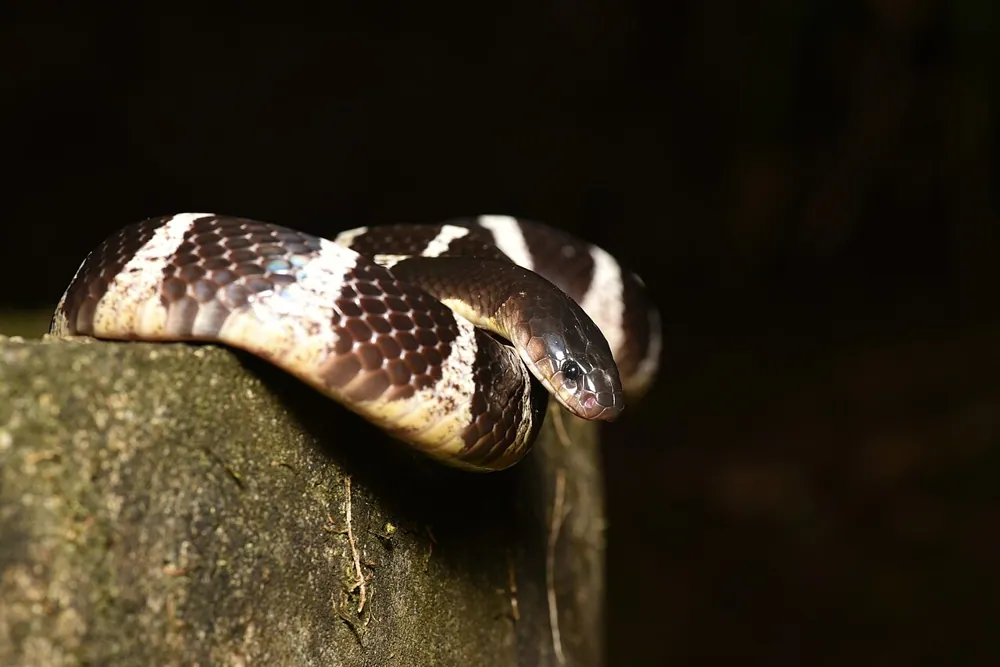
The many-banded krait is an extremely venomous snake found in central and southern China and much of Southeast Asia. It is black or bluish-black with many white bands across its body. It matters because its bite can be fatal, and it is one of the most venomous land snakes in the world.1



 Indlela yokusibona
- The body is black to dark bluish-black.1
- It has about 21 to 30 white or creamy white cross bands along its upper body.1
- The short, pointed tail is black with 7 to 11 white cross bands.1
- The head is mostly black, broad and oval, and slightly flat.1
- Young snakes often have whitish blotches on the underside of the head.1
Ivamise ukudidaniswa ne: The Malayan krait (Bungarus candidus) is easily confused with this species. A 2017 genetic study found that many museum specimens labelled as many-banded kraits in China were actually Malayan kraits.1
Amandla obuthi
Ubuthi buphuma ngamazinyo aso obuthi noma ngamazinyo uma siluma.
Ubuthi baso benzani?
Its venom contains neurotoxins, which attack the nerves and the connections between nerves and muscles. Local effects are usually mild, with slight itching and numbness rather than serious swelling or pain. Symptoms usually start one to six hours after a bite and can include drooping eyelids, double vision, weakness, tongue paralysis, loss of voice and difficulty breathing.1
Siyingozi kangakanani ebantwini?
Ingozi ebantwini: KuyabulalaEsinye sezilwane eziyingozi kakhulu emhlabeni.Estimated death rates from untreated bites vary between studies, from 25–35% to 70–100%. In a serious bite, breathing can stop and lead to death. In 2001, a juvenile bit the herpetologist Joe Slowinski in Myanmar and he died 29 hours later.1
Senzani uma sesabile?
It is generally timid and placid, but it is more defensive at night and thrashes about when handled.1
 Uma siluma
- Gcina umuntu engashukumi futhi ezolile, khipha izindandatho nezinto eziqinile, bese umusa esibhedlela ngokushesha: i-antivenom iyikhambi.
Njalo shayela kuqala inombolo yezimo eziphuthumayo (112, 000, 911). Lokhu kuyiseluleko sosizo lokuqala esijwayelekile, akusona iseluleko sezokwelapha. Izisekelo zosizo lokuqala
 Hlala uphephile
- Ungalokothi uthinte, ubambe noma ugcone isilwane sasendle, ngisho noma sincane, futhi ngisho noma sibukeka silele noma sifile.
- Sinike isikhala. Uma uhlangana naso, hlala uzolile, uhlehle kancane bese usiyeka sihambe ngendlela yaso.
- Uma sikuluma: hlala uzolile, ungashukumi, shayela inombolo yezimo eziphuthumayo (112, 000, 911) noma uye esibhedlela ngokushesha. Khumbula ukuthi besibukeka kanjani, isithombe siyasiza.
Asikuzingeli wena. Sisebenzisa ubuthi baso ukuze sibambe ukudla noma ukuzivikela, futhi singancamela ukucasha. Okwengeziwe mayelana nokuhlala uphephile
Sikhulu kangakanani?
Side kangakanani?
 side njengamakati asekhaya angu-4 kusuka ekhaleni kuya emsileni
 side njengobhanana abangu-10 abalandelanayo
 singahamba amamitha ali-100 ngemizuzwana engu-49 (umuntu oshesha kunabo bonke udinga engu-9,6)
Many-banded krait mkhulu kangakanani uma uqhathanisa NAWE?
Yizibalo nje kusiphequluli sakho. Akukho okulondolozwayo noma okuthunyelwa ndawo.
Sishesha kangakanani?


Amaqiniso
Its venom is among the most potent of any land snake, based on lab tests on mice dating back to 1943.1
In 2001, a juvenile bite in Myanmar killed Joe Slowinski, which drew worldwide attention to the species.1
The snake that bit Slowinski was first thought to be this species, but it was later classified as a different species.1
It is active from April and retreats into hibernation in November.1
Umqothuli wezinganekwane
Inganekwane: American soldiers in the Vietnam War called it the "two-step snake", believing its venom could kill a person within two steps.
Iqiniso: Its symptoms usually start one to six hours after a bite, and death can take much longer. The two-step belief is wrong, and a bite still needs urgent medical care.1
Okongoti bobuthi
- Igama lesayensi
- Bungarus multicinctus
- Iqembu
- Izimfezi, izimamba nama-krait
- Umndeni
- Elapidae2
- Ukuhleleka
- Squamata
- Amazwekazi
- I-Asia
- Izinsana
- It lays eggs. Females usually lay 3 to 15 eggs, and up to 20 are possible. The eggs hatch about six weeks later, and the young are about 25 cm long.1
- Isikhathi sokuphila
- cishe iminyaka engu-13.71
- Ingozi ebantwini
- 5 / 5: Kuyabulala3
Lapho amaqiniso evela khona
- Many-banded krait (Wikipedia (CC BY-SA 4.0))
- Bungarus multicinctus (iNaturalist): amagama nokuhlelwa ngezigaba.
- Venom Wiki: izinga lengozi, usayizi ojwayelekile nesiqagela sejubane kungokwethu. Bona ukuthi sikubala kanjani: Indlela esilinganisa ngayo ingozi.
Iqiniso ngalinye kuleli khasi linenombolo ekhomba umthombo walo. Uma senze iphutha, uxolo, singabathandi bezilwane, hhayi iphephabhuku lesayensi. Sitshele ku-[email protected] futhi sizolilungisa.
 Ufezela ulambile! I-Venom Wiki iwumsebenzi womuntu oyedwa: imahhala, ayinazo izikhangiso noma izilandeli. Isipho esincane sisiza ukuyigcina ku-inthanethi.Phakela ufezela
Okunye okuvela eqenjini elifanayo: Izimfezi, izimamba nama-krait
 Indian cobraIzimfezi, izimamba nama-kraitKuyabulala
 King cobraIzimfezi, izimamba nama-kraitKuyabulala
 Caspian cobraIzimfezi, izimamba nama-kraitKuyabulala
 Common kraitIzimfezi, izimamba nama-kraitKuyabulala
 Malayan kraitIzimfezi, izimamba nama-kraitKuyabulala
 Monocled cobraIzimfezi, izimamba nama-kraitKuyabulala
 Deathstalker
 Indian saw-scaled viper
 Ibululu
 Inhlangwane kaRussell
 Asian giant hornet
 Komodo dragon