
 Abibirem
 Asia
Asia Yuropu
 Amerika Anaafoɔ
 Australia ne Oceania
 Antarctica
 Pacific Po
 Atlantic Po
 India Po
 Arctic Po
 Mediterranean Po
 Po Kɔkɔɔ
 Caribbean Po
 Coral Po
 China Anaafoɔ Po
 Philippine Po
 Andaman Po
 Atifi Po
 Timor ne Arafura Po
 Bengal Ɛpo Ano
 California Ɛpo Ano
Giant Caribbean sea anemone
 Nhama (tentacles) a ɛwɔ
The giant Caribbean sea anemone is a large, colourful sea animal that looks like a soft, flower-shaped blob on the seabed. It lives in shallow reefs and calm inshore waters in the Caribbean and western Atlantic. Its sting is strong enough to stun the fish and shrimp it eats.1



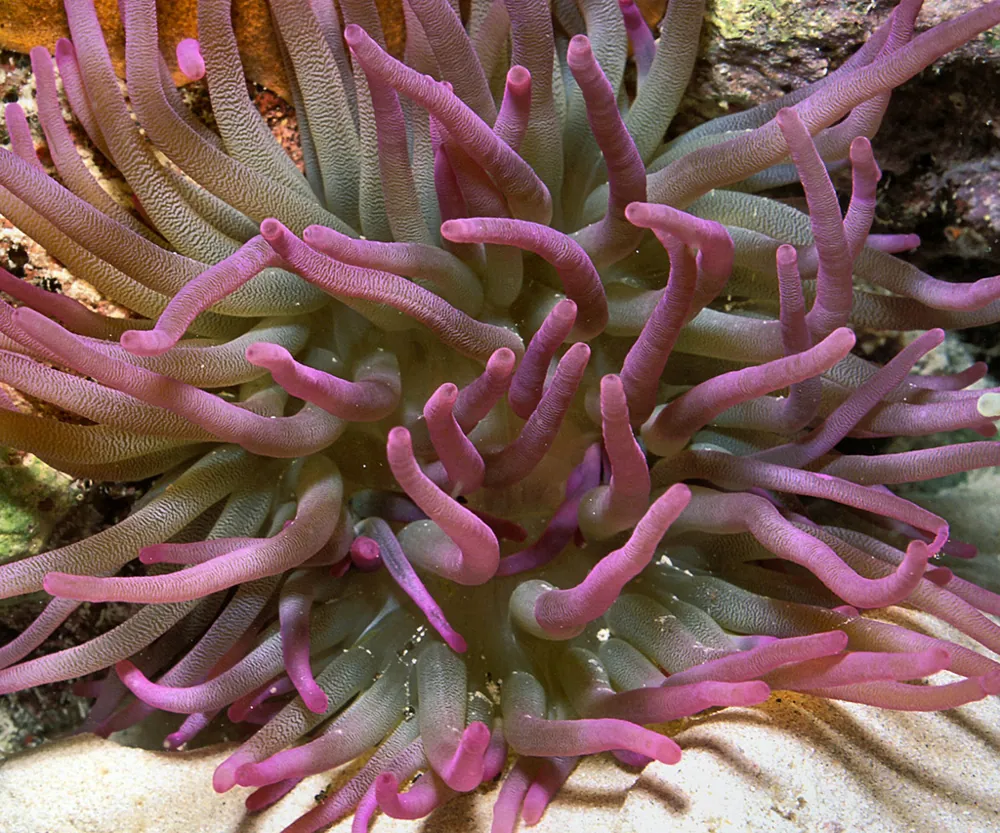
 Sɛdeɛ wobɛhunu no
- Grows about 15 cm high and 30 cm wide, with a disc up to about 40 cm across1
- Body can be white, light blue, pink, orange, pale red or light brown1
- More than 100 tentacles surround the mouth1
- Tentacle tips may be purple or rose-coloured, or may be paler than the body1
- Grows singly or in loose groups, never as colonies1
Bɔre ahoɔden
Nwowaa (cells) nketewa mpempem a ɛwɔ tow wɔn bɔre bere a biribi de ne ho ka wɔn.
Ne bɔre yɛ dɛn?
Its stinging cells (nematocysts) at the tentacle tips contain a toxin called CgNa. When the stinging cells fire, they impale the attacker and release the toxin, which causes extreme pain and paralysis.1
Ne asiane ma nnipa te sɛn?
Asiane ma nnipa: Ɛnyɛ denƐte sɛ wowa wɔ anaa ɛnnu saa. Ɛkame ayɛ sɛ ɛnni asiane ma nnipa.Ɛyɛ dɛn bere a ehu aka no?
When threatened it shrinks by pulling its tentacles into its body and forcing out most of the water, which reduces the surface a predator can attack.1
 Sɛ ɛwɔ a
- Fi nsuo no mu na yi nhama (tentacles) biara a ɛda so (fa nsa kotokuo anaa ntoma).
- Box jellyfish a ɛwɔ nsuo hyew mu: hwie vinegar gu baabi a ɛwɔɔ no so anibu 30 anaa deɛ ɛsen saa, frɛ ma wɔmmɛboa na siesie wo ho sɛ wobɛyɛ CPR. Bluebottles ne afoforɔ dodoɔ no: fa ɛpo nsuo hohoro, na afei nsuo hyew ma yaw no.
Di kan frɛ wo ahohiahia nɔma (112, 000, 911). Yei yɛ mmoa a ɛdi kan ho akwankyerɛ, ɛnyɛ dɔkota afotuo. Mmoa a ɛdi kan ho nsɛm titiriw
 Hwɛ wo ho so
- Mfa wo nsa nka wiram aboa biara, nkyere no na mfa no nni agorɔ, sɛ ɔyɛ ketewa mpo, na sɛ ɛte sɛ ɔrededa anaa wawu mpo a.
- Ma no kwan. Sɛ wohyia baako a, ma wo bo nnwo, san w'akyi brɛoo na ma ɔnkɔ ne kwan.
- Sɛ baako wɔ wo a: ma wo bo nnwo, tena dinn, frɛ wo ahohiahia nɔma (112, 000, 911) anaa kɔ ayaresabea ntɛm. Kae sɛdeɛ na ɛte, mfonini bɛboa.
Ɛnhwehwɛ wo sɛ ɛbɛpira wo. Ɛde ne bɔre kyere aduane anaa ɛbɔ ne ho ban, na ɛpɛ sɛ ɛhinta sene biribiara. Nsɛm pii fa ahobammɔ ho
Wiase mu baabi bɛn?
Ne kɛseɛ te sɛn?
Ne tenten te sɛn?
 ne tenten te sɛ agodeɛ blɔk 5 a wɔde to ntoatoasoɔ mu
 ɛyɛ brɛoo sen nwa a ɔte turom
Giant Caribbean sea anemone kɛseɛ te sɛn sɛ wode toto WO ho a?
Akontabuo kɛkɛ wɔ wo browser mu. Wɔnkora hwee, na wɔmfa hwee nkɔ baabiara.
Ne ntɛm te sɛn?

Nsɛm
Its nerve cells contain proteins that are molecularly similar to those in mammal nerve cells, which helps scientists study how nervous systems evolved.1
Fish and cleaner shrimp shelter among its tentacles, and it serves as a base station for fish cleaning.1
Although mostly stuck in place, it can crawl very slowly on its base, the pedal disc.1
Its larvae carry their own food in a yolk, so starvation is unlikely and they can drift far to spread out.1
Most individuals are either male or female, with a roughly equal ratio of the two sexes, though they occasionally have both.1
Ma bɔre ho animdefoɔ
- Nyansahu din
- Condylactis gigantea
- Kuo
- Jellyfish ne ɛpo mu mmoa a wɔwɔ
- Abusua
- Actiniidae2
- Nhyehyɛeɛ (Order)
- Actiniaria
- Asaase akɛseɛ
- Atlantic Po, Caribbean Po, Mexico Ɛpo Ano, Po akɛseɛ
- Mmofra nketewa
- Eggs and sperm are released into the water, where fertilisation happens. The fertilised egg becomes a larva that settles on the seabed and grows into an adult.1
- Asiane ma nnipa
- 1 / 5: Ɛnyɛ den3
Baabi a nsɛm no fi
- Condylactis gigantea (Wikipedia (CC BY-SA 4.0))
- Condylactis gigantea (iNaturalist): din ne nkyekyɛmu.
- Venom Wiki: asiane gyinabea, kɛseɛ a ɛtaa yɛ ne ntɛm susuo no yɛ yɛn ankasa deɛ. Hwɛ sɛdeɛ yɛbu no: Sɛdeɛ yɛkyerɛ asiane gyinabea.
Nsɛm biara a ɛwɔ kratafa yi so wɔ nɔma a ɛkyerɛ ne fibea. Sɛ yɛfom biribi a, kafra, yɛyɛ mmoa ho akɔnnɔfoɔ, ɛnyɛ nyansahu nwoma. Ka kyerɛ yɛn wɔ [email protected] na yɛbɛsiesie.
 Ɔkɔm de akekantwerɛ no! Onipa baako na ɔyɛ Venom Wiki: ɛyɛ kwa, dawurubɔ nni so na biribiara nni so a ɛdi w'akyi. Akyɛdeɛ ketewa bi boa ma ɛkɔ so tena internet so.Ma akekantwere no aduane
Pii fi kuo korɔ no mu: Jellyfish ne ɛpo mu mmoa a wɔwɔ
 Australian box jellyfishJellyfish ne ɛpo mu mmoa a wɔwɔƐkumMfa wo nsa nka
 Irukandji jellyfishJellyfish ne ɛpo mu mmoa a wɔwɔƐtumi kumMfa wo nsa nka
 Portuguese man o' warJellyfish ne ɛpo mu mmoa a wɔwɔƐhia dɔkotaMfa wo nsa nka
 Lion's mane jellyfishJellyfish ne ɛpo mu mmoa a wɔwɔƐyɛ yaw kɛkɛMfa wo nsa nka
 Moon jellyfishJellyfish ne ɛpo mu mmoa a wɔwɔƐnni asiane
 Common kingslayerJellyfish ne ɛpo mu mmoa a wɔwɔƐtumi kumMfa wo nsa nka
Ɔte nso wɔ: Atlantic Po
 Hawksbill sea turtleMmoa afoforɔ a wɔn ho yɛ awuduroƐtumi kum
 Blue sea dragonCone snails ne octopusƐyɛ yaw kɛkɛ
 Greenland sharkMmoa afoforɔ a wɔn ho yɛ awuduroƐyɛ yaw kɛkɛ
 Common octopusCone snails ne octopusƐnni asiane
 Common stingrayApataa a wɔwɔ bɔreƐhia dɔkota
 Greater weeverApataa a wɔwɔ bɔreƐhia dɔkotaMfa wo nsa nka