
 Abibirem
 Asia
Asia Yuropu
 Amerika Anaafoɔ
 Australia ne Oceania
 Antarctica
 Pacific Po
 Atlantic Po
 India Po
 Arctic Po
 Mediterranean Po
 Po Kɔkɔɔ
 Caribbean Po
 Coral Po
 China Anaafoɔ Po
 Philippine Po
 Andaman Po
 Atifi Po
 Timor ne Arafura Po
 Bengal Ɛpo Ano
 California Ɛpo Ano
Many-banded krait
 Ka
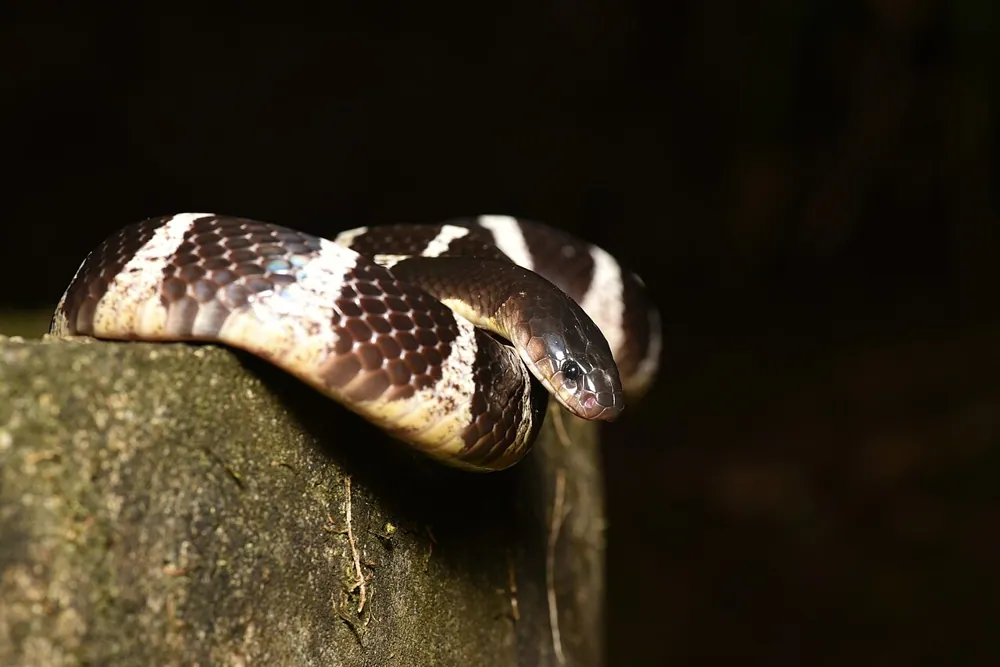
KaThe many-banded krait is an extremely venomous snake found in central and southern China and much of Southeast Asia. It is black or bluish-black with many white bands across its body. It matters because its bite can be fatal, and it is one of the most venomous land snakes in the world.1



 Sɛdeɛ wobɛhunu no
- The body is black to dark bluish-black.1
- It has about 21 to 30 white or creamy white cross bands along its upper body.1
- The short, pointed tail is black with 7 to 11 white cross bands.1
- The head is mostly black, broad and oval, and slightly flat.1
- Young snakes often have whitish blotches on the underside of the head.1
Wɔtaa fa no sɛ: The Malayan krait (Bungarus candidus) is easily confused with this species. A 2017 genetic study found that many museum specimens labelled as many-banded kraits in China were actually Malayan kraits.1
Bɔre ahoɔden
Bɔre fi ne se mu ba bere a ɔka.
Ne bɔre yɛ dɛn?
Its venom contains neurotoxins, which attack the nerves and the connections between nerves and muscles. Local effects are usually mild, with slight itching and numbness rather than serious swelling or pain. Symptoms usually start one to six hours after a bite and can include drooping eyelids, double vision, weakness, tongue paralysis, loss of voice and difficulty breathing.1
Ne asiane ma nnipa te sɛn?
Asiane ma nnipa: ƐkumMmoa a asiane wɔ wɔn ho sen biara wɔ wiase no mu baako.Estimated death rates from untreated bites vary between studies, from 25–35% to 70–100%. In a serious bite, breathing can stop and lead to death. In 2001, a juvenile bit the herpetologist Joe Slowinski in Myanmar and he died 29 hours later.1
Ɛyɛ dɛn bere a ehu aka no?
It is generally timid and placid, but it is more defensive at night and thrashes about when handled.1
 Sɛ ɛka a
- Ma onipa no ntena dinn na ne bo nnwo, yi kawa ne nneɛma a ɛkyere no den, na kɔ ayaresabea ntɛm: antivenom ne ayaresa no.
Di kan frɛ wo ahohiahia nɔma (112, 000, 911). Yei yɛ mmoa a ɛdi kan ho akwankyerɛ, ɛnyɛ dɔkota afotuo. Mmoa a ɛdi kan ho nsɛm titiriw
 Hwɛ wo ho so
- Mfa wo nsa nka wiram aboa biara, nkyere no na mfa no nni agorɔ, sɛ ɔyɛ ketewa mpo, na sɛ ɛte sɛ ɔrededa anaa wawu mpo a.
- Ma no kwan. Sɛ wohyia baako a, ma wo bo nnwo, san w'akyi brɛoo na ma ɔnkɔ ne kwan.
- Sɛ baako ka wo a: ma wo bo nnwo, tena dinn, frɛ wo ahohiahia nɔma (112, 000, 911) anaa kɔ ayaresabea ntɛm. Kae sɛdeɛ na ɛte, mfonini bɛboa.
Ɛnhwehwɛ wo sɛ ɛbɛpira wo. Ɛde ne bɔre kyere aduane anaa ɛbɔ ne ho ban, na ɛpɛ sɛ ɛhinta sene biribiara. Nsɛm pii fa ahobammɔ ho
Wiase mu baabi bɛn?
Ne kɛseɛ te sɛn?
Ne tenten te sɛn?
 ne tenten te sɛ fie agyinamoa 4 a wɔde hwene ne dua to ntoatoasoɔ mu
 ne tenten te sɛ kwadu 10 a wɔde to ntoatoasoɔ mu
 ɛbɛtumi atu mita 100 wɔ anibu 49 mu (onipa a ɔwɔ ntɛm sen biara hia 9.6)
Many-banded krait kɛseɛ te sɛn sɛ wode toto WO ho a?
Akontabuo kɛkɛ wɔ wo browser mu. Wɔnkora hwee, na wɔmfa hwee nkɔ baabiara.
Ne ntɛm te sɛn?


Nsɛm
Its venom is among the most potent of any land snake, based on lab tests on mice dating back to 1943.1
In 2001, a juvenile bite in Myanmar killed Joe Slowinski, which drew worldwide attention to the species.1
The snake that bit Slowinski was first thought to be this species, but it was later classified as a different species.1
It is active from April and retreats into hibernation in November.1
Atosɛm sɛefoɔ
Atosɛm: American soldiers in the Vietnam War called it the "two-step snake", believing its venom could kill a person within two steps.
Nokorɛ: Its symptoms usually start one to six hours after a bite, and death can take much longer. The two-step belief is wrong, and a bite still needs urgent medical care.1
Ma bɔre ho animdefoɔ
- Nyansahu din
- Bungarus multicinctus
- Kuo
- Cobra, mamba ne krait
- Abusua
- Elapidae2
- Nhyehyɛeɛ (Order)
- Squamata
- Asaase akɛseɛ
- Asia
- Mmofra nketewa
- It lays eggs. Females usually lay 3 to 15 eggs, and up to 20 are possible. The eggs hatch about six weeks later, and the young are about 25 cm long.1
- Mfeɛ a ɔtena ase
- bɛyɛ mfeɛ 13,71
- Asiane ma nnipa
- 5 / 5: Ɛkum3
Baabi a nsɛm no fi
- Many-banded krait (Wikipedia (CC BY-SA 4.0))
- Bungarus multicinctus (iNaturalist): din ne nkyekyɛmu.
- Venom Wiki: asiane gyinabea, kɛseɛ a ɛtaa yɛ ne ntɛm susuo no yɛ yɛn ankasa deɛ. Hwɛ sɛdeɛ yɛbu no: Sɛdeɛ yɛkyerɛ asiane gyinabea.
Nsɛm biara a ɛwɔ kratafa yi so wɔ nɔma a ɛkyerɛ ne fibea. Sɛ yɛfom biribi a, kafra, yɛyɛ mmoa ho akɔnnɔfoɔ, ɛnyɛ nyansahu nwoma. Ka kyerɛ yɛn wɔ [email protected] na yɛbɛsiesie.
 Ɔkɔm de akekantwerɛ no! Onipa baako na ɔyɛ Venom Wiki: ɛyɛ kwa, dawurubɔ nni so na biribiara nni so a ɛdi w'akyi. Akyɛdeɛ ketewa bi boa ma ɛkɔ so tena internet so.Ma akekantwere no aduane
 Indian cobra
 King cobra
 Caspian cobra
 Common krait
 Malayan krait
 Monocled cobra
 Deathstalker
 Indian saw-scaled viper
 Puff adder
 Russell ɔnanka
 Asian giant hornet
 Komodo dragon