
 Abibirem
 Asia
Asia Yuropu
 Amerika Anaafoɔ
 Australia ne Oceania
 Antarctica
 Pacific Po
 Atlantic Po
 India Po
 Arctic Po
 Mediterranean Po
 Po Kɔkɔɔ
 Caribbean Po
 Coral Po
 China Anaafoɔ Po
 Philippine Po
 Andaman Po
 Atifi Po
 Timor ne Arafura Po
 Bengal Ɛpo Ano
 California Ɛpo Ano
Red-naped snake
 Ka
KaThe red-naped snake is a small venomous snake with a bright red or orange patch on the back of its neck. It lives in many parts of eastern and central Australia, mostly hunting at night. It is special because it looks very like the young eastern brown snake, which is far more dangerous.1

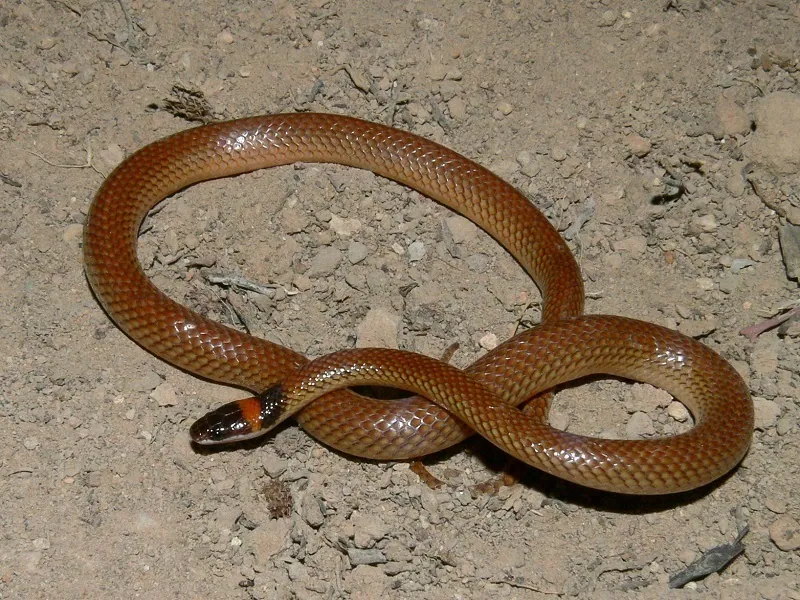
 Sɛdeɛ wobɛhunu no
- Small, slim snake, reaching a maximum length of about 45 cm1
- Shiny black head and neck, with small black eyes and a head that looks partly flattened1
- A white streak on the upper lip1
- A well-defined orange or red patch on the back of the neck, shaped like a diamond, crescent or oval1
- Red-brown body with dark edges to the scales, so the pattern looks like a net; the belly is cream or white1
Wɔtaa fa no sɛ: The red-naped snake looks similar to the juvenile eastern brown snake. The eastern brown snake has a lighter band between its dark head and neck. Behaviour is the easiest difference: the eastern brown snake is active in the day, while the red-naped snake is nocturnal and is rarely seen unless its shelter is disturbed.1
Bɔre ahoɔden
Bɔre fi ne se mu ba bere a ɔka.
Ne asiane ma nnipa te sɛn?
Asiane ma nnipa: Ɛnyɛ denƐte sɛ wowa wɔ anaa ɛnnu saa. Ɛkame ayɛ sɛ ɛnni asiane ma nnipa.The red-naped snake is venomous, but it is considered harmless to humans. It can bite, and will do so if it is provoked enough.1
Ɛyɛ dɛn bere a ehu aka no?
When threatened, it strikes out several times with the front of its body raised off the ground, usually with its mouth closed.1
 Sɛ ɛka a
- Pressure immobilisation: fa elastic bandage a ɛyɛ den kyekyere baabi a ɛkaa no so, na afei kyekyere kɔ soro wɔ nsa anaa nan no nyinaa so, fa splint kyekyere ho, na ma onipa no ntena dinn koraa kosi sɛ mmoa bɛba.
- Nhohoro baabi a ɛkaa no: ayaresabea betumi ahwehwɛ bɔre a aka honam no so no mu de apaw antivenom a ɛfata.
Di kan frɛ wo ahohiahia nɔma (112, 000, 911). Yei yɛ mmoa a ɛdi kan ho akwankyerɛ, ɛnyɛ dɔkota afotuo. Mmoa a ɛdi kan ho nsɛm titiriw
 Hwɛ wo ho so
- Mfa wo nsa nka wiram aboa biara, nkyere no na mfa no nni agorɔ, sɛ ɔyɛ ketewa mpo, na sɛ ɛte sɛ ɔrededa anaa wawu mpo a.
- Ma no kwan. Sɛ wohyia baako a, ma wo bo nnwo, san w'akyi brɛoo na ma ɔnkɔ ne kwan.
- Sɛ baako ka wo a: ma wo bo nnwo, tena dinn, frɛ wo ahohiahia nɔma (112, 000, 911) anaa kɔ ayaresabea ntɛm. Kae sɛdeɛ na ɛte, mfonini bɛboa.
Ɛnhwehwɛ wo sɛ ɛbɛpira wo. Ɛde ne bɔre kyere aduane anaa ɛbɔ ne ho ban, na ɛpɛ sɛ ɛhinta sene biribiara. Nsɛm pii fa ahobammɔ ho
Wiase mu baabi bɛn?
Ne kɛseɛ te sɛn?
Ne tenten te sɛn?
 ne tenten te sɛ kwadu 2,5 a wɔde to ntoatoasoɔ mu
 ne tenten te sɛ agodeɛ blɔk 14 a wɔde to ntoatoasoɔ mu
 ɛbɛtumi atu mita 100 wɔ anibu 61 mu (onipa a ɔwɔ ntɛm sen biara hia 9.6)
Red-naped snake kɛseɛ te sɛn sɛ wode toto WO ho a?
Akontabuo kɛkɛ wɔ wo browser mu. Wɔnkora hwee, na wɔmfa hwee nkɔ baabiara.
Ne ntɛm te sɛn?


Nsɛm
It kills its prey with both venom and constriction, squeezing the prey in its coils.1
Its look is so close to the young eastern brown snake that behaviour is often the only way to tell them apart.1
Its neck patch is one of its clearest markings: an orange or red shape on an otherwise black head and neck.1
It is nocturnal, so it is rarely seen unless its hiding place is disturbed.1
Ma bɔre ho animdefoɔ
- Nyansahu din
- Furina diadema
- Kuo
- Australia awɔ
- Abusua
- Elapidae2
- Nhyehyɛeɛ (Order)
- Squamata
- Asaase akɛseɛ
- Australia ne Oceania
- Mmofra nketewa
- It lays eggs. Recorded clutches range from 1 to 10 eggs, with an average of 3. Young hatch in January, or February in cooler regions, and become adults within a year.1
- Sɛdeɛ ɔte wɔ kwaem
- Threatened (listed in Victoria)1
- Asiane ma nnipa
- 1 / 5: Ɛnyɛ den3
Baabi a nsɛm no fi
- Red-naped snake (Wikipedia (CC BY-SA 4.0))
- Furina diadema (iNaturalist): din ne nkyekyɛmu.
- Venom Wiki: asiane gyinabea, kɛseɛ a ɛtaa yɛ ne ntɛm susuo no yɛ yɛn ankasa deɛ. Hwɛ sɛdeɛ yɛbu no: Sɛdeɛ yɛkyerɛ asiane gyinabea.
Nsɛm biara a ɛwɔ kratafa yi so wɔ nɔma a ɛkyerɛ ne fibea. Sɛ yɛfom biribi a, kafra, yɛyɛ mmoa ho akɔnnɔfoɔ, ɛnyɛ nyansahu nwoma. Ka kyerɛ yɛn wɔ [email protected] na yɛbɛsiesie.
 Ɔkɔm de akekantwerɛ no! Onipa baako na ɔyɛ Venom Wiki: ɛyɛ kwa, dawurubɔ nni so na biribiara nni so a ɛdi w'akyi. Akyɛdeɛ ketewa bi boa ma ɛkɔ so tena internet so.Ma akekantwere no aduane
Pii fi kuo korɔ no mu: Australia awɔ
 Coastal taipan
 Common death adder
 Eastern brown snake
 Taipan a ɔwɔ Australia mfinimfini
 Ɔwɔ a ɔte sɛ ɔsebɔ (Tiger snake)
 Collett's snake
Ɔte nso wɔ: Australia ne Oceania
 Sydney funnel-web spiderTarantula ne funnel-webƐkum
 Redback spiderAnanseƐhia dɔkota
 Brown tree snakeAwɔ a wɔn bɔre se wɔ akyiƐyɛ yaw kɛkɛ
 Hooded pitohuiMmoa afoforɔ a wɔn ho yɛ awuduroƐyɛ yaw kɛkɛMfa wo nsa nka
 PlatypusNufoɔ mmoa a wɔwɔ bɔreƐyɛ yaw kɛkɛ
 Northern tree-dwelling funnel-web spiderTarantula ne funnel-webƐkum