
 Abibirem
 Asia
Asia Yuropu
 Amerika Anaafoɔ
 Australia ne Oceania
 Antarctica
 Pacific Po
 Atlantic Po
 India Po
 Arctic Po
 Mediterranean Po
 Po Kɔkɔɔ
 Caribbean Po
 Coral Po
 China Anaafoɔ Po
 Philippine Po
 Andaman Po
 Atifi Po
 Timor ne Arafura Po
 Bengal Ɛpo Ano
 California Ɛpo Ano
Yellow-bellied sea snake
 Ka
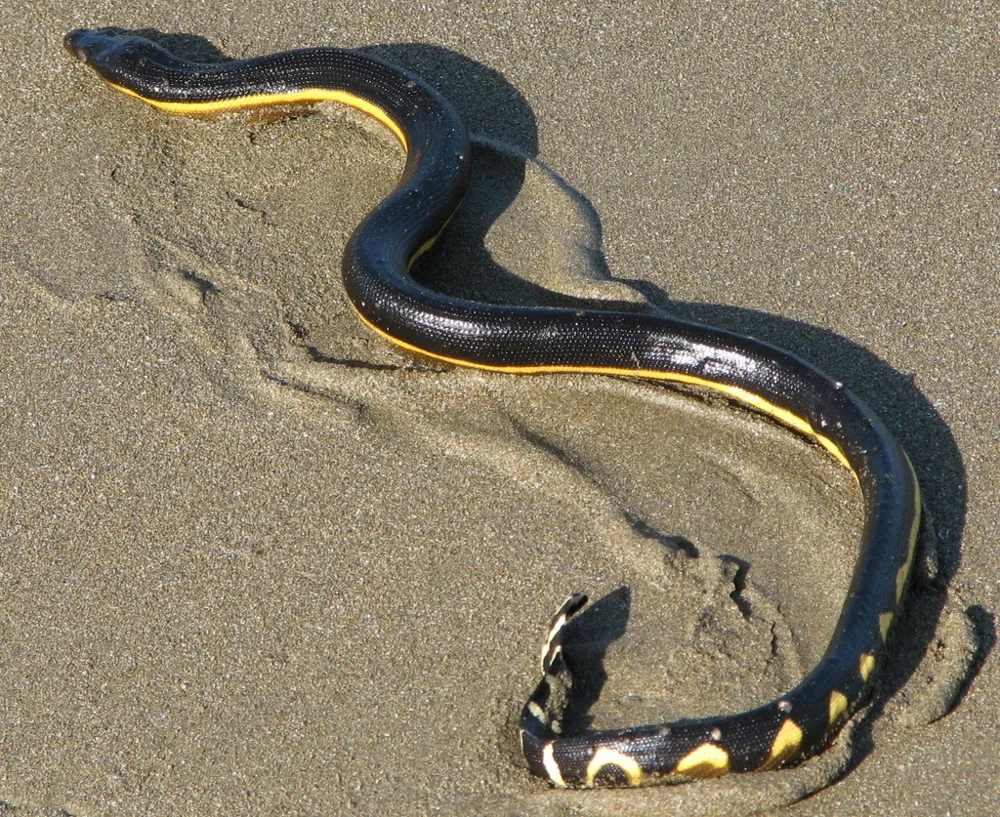
KaThe yellow-bellied sea snake is a sea snake with a strongly venomous bite. It lives in warm tropical oceans and spends its whole life at sea, floating on the surface. Its yellow belly and brown back make it easy to tell apart from most other sea snakes.1

 Sɛdeɛ wobɛhunu no
- Sharply bicoloured: black or dark brown on the back, with a yellow or brown underside.1
- The yellow belly may have black spots, bars or crossbars, or a narrow black stripe along the back.1
- Has a flattened, paddle-shaped tail for swimming.1
- Adults are usually up to about 72 cm (males) or 88 cm (females) long.1
Bɔre ahoɔden
Bɔre fi ne se mu ba bere a ɔka.
Ne bɔre yɛ dɛn?
The venom is highly potent and contains several different neurotoxins, which attack the nerves, along with two other isotoxins. Sea snake venom can damage skeletal muscle, which may release myoglobin into the urine (myoglobinuria), and can cause neuromuscular paralysis or direct kidney damage. Juvenile venom is on average less concentrated than adult venom.1
Ne asiane ma nnipa te sɛn?
Asiane ma nnipa: Ɛyɛ denSɛ ɛka wo a, kɔ dɔkota nkyɛn. Ɛntaa nkum obi koraa.Bites are rare. The most common victims are fishermen who try to remove the snakes from fishing nets. No deaths have been recorded from bites in Australian waters.1
 Asɛmpa: dɔkotafoɔ wɔ aduro (antivenom) anaa ayaresa ma yei.1
Ɛyɛ dɛn bere a ehu aka no?
It is not considered aggressive but will defend itself if threatened.1
 Sɛ ɛka a
- The venom is neutralised with sea snake antivenom (Enhydrina schistosa). If that is not available, tiger snake or polyvalent antivenom should be used.1
- Pressure immobilisation: fa elastic bandage a ɛyɛ den kyekyere baabi a ɛkaa no so, na afei kyekyere kɔ soro wɔ nsa anaa nan no nyinaa so, fa splint kyekyere ho, na ma onipa no ntena dinn koraa kosi sɛ mmoa bɛba.
- Yi onipa no fi nsuo no mu na fa no kɔ ayaresabea ntɛm.
Di kan frɛ wo ahohiahia nɔma (112, 000, 911). Yei yɛ mmoa a ɛdi kan ho akwankyerɛ, ɛnyɛ dɔkota afotuo. Mmoa a ɛdi kan ho nsɛm titiriw
 Hwɛ wo ho so
- Mfa wo nsa nka wiram aboa biara, nkyere no na mfa no nni agorɔ, sɛ ɔyɛ ketewa mpo, na sɛ ɛte sɛ ɔrededa anaa wawu mpo a.
- Ma no kwan. Sɛ wohyia baako a, ma wo bo nnwo, san w'akyi brɛoo na ma ɔnkɔ ne kwan.
- Sɛ baako ka wo a: ma wo bo nnwo, tena dinn, frɛ wo ahohiahia nɔma (112, 000, 911) anaa kɔ ayaresabea ntɛm. Kae sɛdeɛ na ɛte, mfonini bɛboa.
Ɛnhwehwɛ wo sɛ ɛbɛpira wo. Ɛde ne bɔre kyere aduane anaa ɛbɔ ne ho ban, na ɛpɛ sɛ ɛhinta sene biribiara. Nsɛm pii fa ahobammɔ ho
Wiase mu baabi bɛn?
Ne kɛseɛ te sɛn?
Ne tenten te sɛn?
 ne tenten te sɛ fie agyinamoa 2 a wɔde hwene ne dua to ntoatoasoɔ mu
 ne tenten te sɛ kwadu 5 a wɔde to ntoatoasoɔ mu
 ɛbɛtumi aguare aguare tare kɛseɛ tenten (50 m) wɔ anibu 49 mu
Yellow-bellied sea snake kɛseɛ te sɛn sɛ wode toto WO ho a?
Akontabuo kɛkɛ wɔ wo browser mu. Wɔnkora hwee, na wɔmfa hwee nkɔ baabiara.
Ne ntɛm te sɛn?
Nsɛm
It can swim backwards, which is an unusual ability and a distinguishing feature of this species.1
It breathes partly through its skin, taking oxygen from seawater while diving and swimming at the surface.1
It can survive severe dehydration for up to 7 months during seasonal drought.1
Large groups of thousands have been seen floating together on the surface in oceanic drift lines.1
It is the only sea snake known to have reached the Hawaiian Islands.1
Strays wash up so often on New Zealand's coasts that it is considered native to the country and protected under the Wildlife Act 1953.1
Atosɛm sɛefoɔ
Atosɛm: Sea snakes drink seawater and filter out the salt through a special salt gland in the lower jaw.
Nokorɛ: Sea snakes drink only fresh water. The salt gland was once thought to filter salt, but it is not used for that purpose. The yellow-bellied sea snake likely drinks from freshwater lenses that form on the sea surface after heavy rain.1
Ma bɔre ho animdefoɔ
- Nyansahu din
- Hydrophis platurus
- Kuo
- Ɛpo mu awɔ
- Abusua
- Elapidae2
- Nhyehyɛeɛ (Order)
- Squamata
- Asaase akɛseɛ
- Pacific Po, India Po, Coral Po, China Anaafoɔ Po, Philippine Po, Andaman Po, Arabia Po ne Persia Ɛpo Ano, Timor ne Arafura Po, Bengal Ɛpo Ano, California Ɛpo Ano, Po akɛseɛ
- Mmofra nketewa
- It gives birth to live young (ovoviviparous) after a gestation period of around 6 months, and females bear them in tidal pools.1
- Asiane ma nnipa
- 3 / 5: Ɛyɛ den3
Baabi a nsɛm no fi
- Yellow-bellied sea snake (Wikipedia (CC BY-SA 4.0))
- Hydrophis platurus (iNaturalist): din ne nkyekyɛmu.
- Venom Wiki: asiane gyinabea, kɛseɛ a ɛtaa yɛ ne ntɛm susuo no yɛ yɛn ankasa deɛ. Hwɛ sɛdeɛ yɛbu no: Sɛdeɛ yɛkyerɛ asiane gyinabea.
Nsɛm biara a ɛwɔ kratafa yi so wɔ nɔma a ɛkyerɛ ne fibea. Sɛ yɛfom biribi a, kafra, yɛyɛ mmoa ho akɔnnɔfoɔ, ɛnyɛ nyansahu nwoma. Ka kyerɛ yɛn wɔ [email protected] na yɛbɛsiesie.
 Ɔkɔm de akekantwerɛ no! Onipa baako na ɔyɛ Venom Wiki: ɛyɛ kwa, dawurubɔ nni so na biribiara nni so a ɛdi w'akyi. Akyɛdeɛ ketewa bi boa ma ɛkɔ so tena internet so.Ma akekantwere no aduane
Pii fi kuo korɔ no mu: Ɛpo mu awɔ
 Beaked sea snake
 Belcher's sea snake
 Black-banded sea krait
 Blue-lipped sea krait
 Dubois' sea snake
 Olive sea snake
Ɔte nso wɔ: Pacific Po
 Australian box jellyfishJellyfish ne ɛpo mu mmoa a wɔwɔƐkumMfa wo nsa nka
 Geography coneCone snails ne octopusƐkum
 Greater blue-ringed octopusCone snails ne octopusƐkum
 Japanese pufferfishMmoa afoforɔ a wɔn ho yɛ awuduroƐkum
 Southern blue-ringed octopusCone snails ne octopusƐkum
 Hawksbill sea turtleMmoa afoforɔ a wɔn ho yɛ awuduroƐtumi kum