
 Bitten or stung?
 All animals
 Pick a continent
 Africa
 Asia
 Europe
 South America
 Australia & Oceania
 Antarctica
 Pacific Ocean
 Atlantic Ocean
 Indian Ocean
 Arctic Ocean
 Mediterranean Sea
 Red Sea
 Caribbean Sea
 Coral Sea
 South China Sea
 Philippine Sea
 Andaman Sea
 North Sea
 Timor & Arafura Sea
 Bay of Bengal
 Gulf of California
 Games
 Venom battle
 Animal race
 Field notebook
 Venom TOP lists
 Stay safe
 Surprise me

Geography cone
 If it stingsDanger to people: DeadlyOne of the most dangerous animals in the world.
 Stings
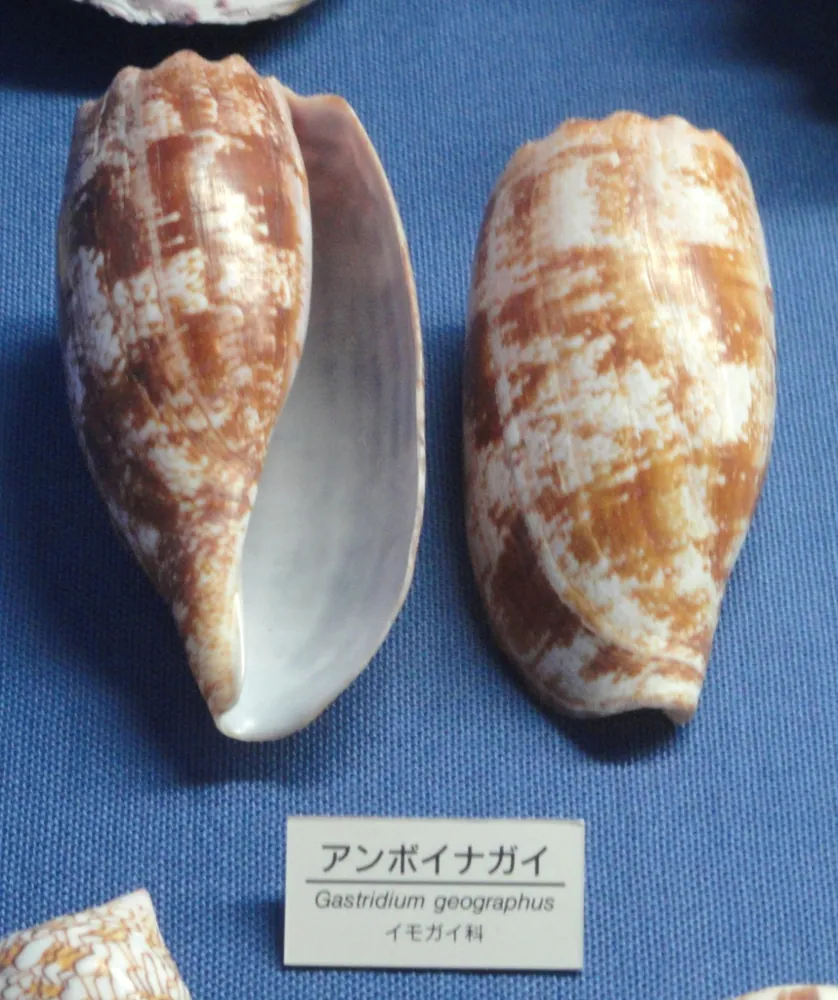
The geography cone is a predatory sea snail that lives on shallow tropical reefs in the Indo-Pacific. It hunts small fish. Its venom is strong enough to kill a person, which makes it one of the most dangerous cone snails.1
 How to recognise it
- Broad, thin shell that is cylindrically inflated, usually 10 to 15 cm long1
- Ground colour is pink or violet-white, sometimes reddish1
- Mottled pattern of chestnut or chocolate brown, usually forming two irregular bands1
- Wide pink or violet-white opening and numerous shoulder ridges or spines1
Often confused with: Compared with other cone shells of a similar size, the geography cone has a noticeably wider, more convex middle and a flattened spire. Its walls are also thinner and lighter.1
Venom power
It fires a tiny harpoon-like tooth full of venom.
What does its venom do?
Its venom is a complex mix of hundreds of different toxins, delivered through the harpoon-like tooth. It has the most toxic sting known among cone snails. Even the most venomous cone snails take about one to five hours to kill a healthy adult, but medical care must still be prompt.1
How dangerous is it to people?
Danger to people: DeadlyOne of the most dangerous animals in the world.There are reports of about 36 human deaths over the past 300 years. Live specimens should be handled with extreme caution.1
What does it do when it is scared?
Most of the venom's toxic compounds are believed to be used for defence rather than feeding.1
If it stings
Always call your emergency number first (for example 112 in Europe, 911 in North America, 000 in Australia).
- Pressure immobilisation: wrap a firm elastic bandage over the bite and then up the whole limb, splint it, and keep the person completely still until help arrives.
- A blue-ringed octopus or cone snail can stop a person breathing while they are still awake: call for help and be ready to give rescue breaths until the ambulance takes over.
- Call the emergency number at once. Keep the person still and put a firm pressure bandage over the sting and up the limb, then splint it. If breathing slows or stops, give rescue breaths or CPR until help arrives. There is no antivenom, so hospitals support breathing until the venom wears off.1
This is general first aid guidance, not medical advice. Based on the first aid guidelines of the World Health Organization and the Australian Resuscitation Council. Facts come from public sources and may contain mistakes. When in doubt, always get medical help. First aid basics
 Stay safe
- Never touch, catch or tease a wild animal, even a small one, and even if it looks asleep or dead.
- Give it space. If you meet one, stay calm, step back slowly and let it go its own way.
- If one stings you: stay calm, keep still, call your emergency number (for example 112 in Europe, 911 in North America, 000 in Australia) or get to a hospital fast. Remember what it looked like, a photo helps.
It is not out to get you. It uses its venom to catch food or to protect itself, and it would much rather hide. More about staying safe
Where in the world?
How big is it?
How long is it?
 as long as 2 bank cards end to end
 slower than a garden snail
How big is Geography cone compared to you?
Just maths in your browser. Nothing is saved or sent anywhere.
How fast is it?

Facts
Its venom contains a form of insulin, which it uses to stun fish. Once the venom passes through a fish's gills, the fish goes into hypoglycaemic shock (a dangerous drop in blood sugar).1
Apart from the tulip cone snail, no other living thing is known to use its own insulin as a weapon.1
Research shows that some proteins from cone snail venom can be up to 10,000 times more effective than morphine as painkillers, without morphine's addictive properties and side effects.1
Of the venom's 100 to 200 toxic peptides, only 15 to 20 are used for feeding.1
Adult geography cones can fall prey to sea turtles, rays, birds and human shell collectors.1
Myth buster
Myth: The nickname 'cigarette snail' means a sting gives you just enough time to smoke a cigarette before you die.
Truth: This is a gallows humour exaggeration. Even the most venomous cone snails take about one to five hours to kill a healthy human.1
For venom experts
Where the facts come from
- Conus geographus (Wikipedia (CC BY-SA 4.0))
- Conus geographus (iNaturalist): names and classification.
- Venom Wiki: the danger level, the typical size and the speed guess are our own. See how we work them out: How we rate danger.
Every fact on this page has a number that points to its source. If we got something wrong, sorry, we are animal fans, not a science journal. Tell us at [email protected] and we will fix it.
Get the Venom Wiki app
Every creature, every picture and the games in your pocket, even without internet.


 Support Venom Wiki Venom Wiki is a one-man project: free, with no ads and no cookies. A small tip helps keep it online.Feed the scorpion
More from the same group: Cone snails & octopuses
 Greater blue-ringed octopus
 Southern blue-ringed octopus
 Blue sea dragon
 Common octopus
 Giant Pacific octopus
 Blue-lined octopus
Also lives in: Indian Ocean
 Australian box jellyfishJellyfish & sea stingersDeadlyDo not touch
 Hawksbill sea turtleOther poisonous animalsCan kill
 Irukandji jellyfishJellyfish & sea stingersCan killDo not touch
 Reef stonefishVenomous fishCan killDo not touch
 Crown-of-thorns starfishUrchins, stars & wormsNeeds a doctorDo not touch
 Portuguese man o' warJellyfish & sea stingersNeeds a doctorDo not touch