
 Bitten or stung?
 All animals
 Pick a continent
 Africa
 Asia
 Europe
 South America
 Australia & Oceania
 Antarctica
 Pacific Ocean
 Atlantic Ocean
 Indian Ocean
 Arctic Ocean
 Mediterranean Sea
 Red Sea
 Caribbean Sea
 Coral Sea
 South China Sea
 Philippine Sea
 Andaman Sea
 North Sea
 Timor & Arafura Sea
 Bay of Bengal
 Gulf of California
 Games
 Venom battle
 Animal race
 Field notebook
 Venom TOP lists
 Stay safe
 Surprise me

Crown-of-thorns starfish
 Venomous spines
The crown-of-thorns starfish is a large starfish with long, sharp spines that look like a crown of thorns. It lives on coral reefs across the Indo-Pacific, from the Red Sea to the west coast of Central America, and it is most common around Australia. It feeds on hard coral, so it can change the reefs it lives on.1
 How to recognise it
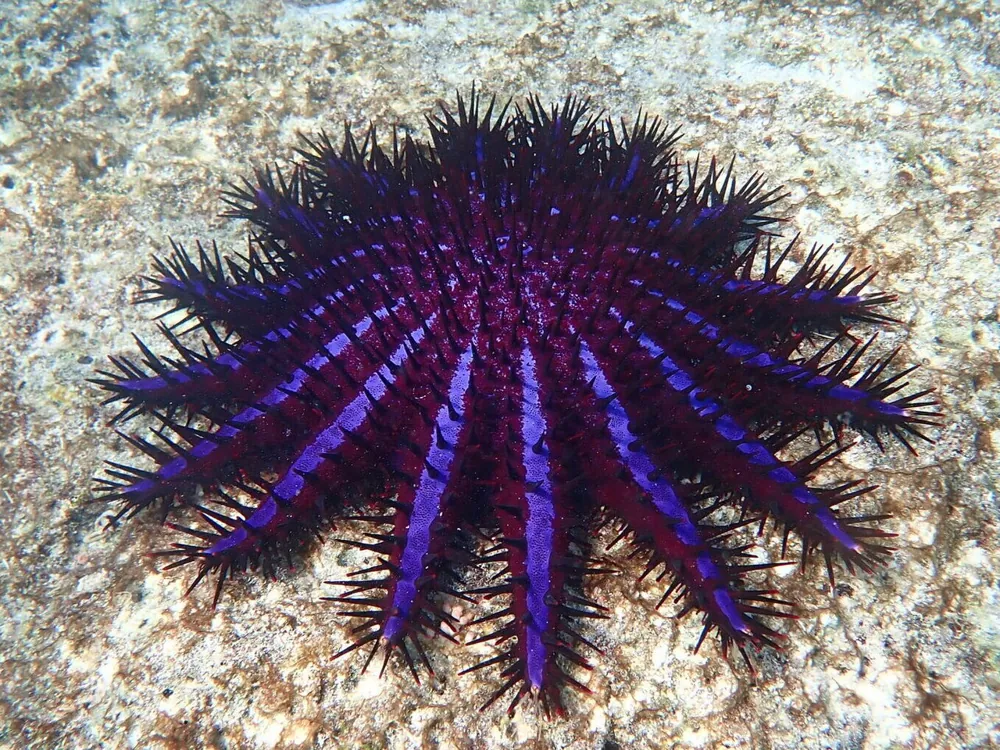
- Adults are normally 25 to 35 cm across.1
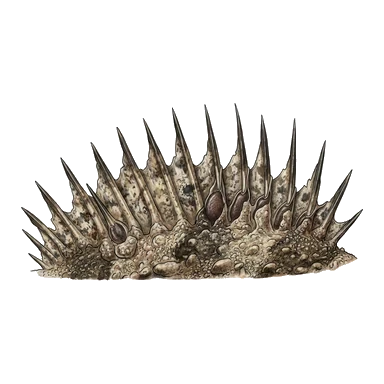
- Up to 21 arms, with long, stiff, very sharp spines that are 4 to 5 cm long on the top and sides of the arms.1
- Colour varies with diet or region: purple, purple-blue, reddish grey or brown with red spine tips, or green with yellow spine tips.1
- The body is flexible and can bend and twist around coral surfaces.1
Often confused with: A close relative, Acanthaster brevispinus, lives on soft sea floors at moderate depths rather than on coral reefs. The two are considered sibling species.1
Venom power
Sharp spines carry the venom. Stepping on it or grabbing it hurts.
What does its venom do?
The spines do not inject venom. When they pierce skin, tissue containing saponins (detergent-like chemicals) is left in the wound. In humans this causes a sharp, stinging pain that can last several hours, persistent bleeding, and nausea and swelling that may last a week or more.1
How dangerous is it to people?
Danger to people: SeriousIf its spines stab you, see a doctor. Deaths are very rare.The spines can cause sharp pain, long-lasting bleeding, nausea and swelling. Brittle spines can break off and stay in the tissue.1
 If its spines stab you
Always call your emergency number first (for example 112 in Europe, 911 in North America, 000 in Australia).
- Carefully remove spine pieces you can see, then soak the wound in hot water, as hot as the person can stand without scalding, to ease the pain. See a doctor, because broken spines left in the skin may need to be removed and the wound can get infected.1
- Put the wound in hot water, as hot as the person can stand without burning, and get medical help to remove spines. Do not dig for them yourself.
This is general first aid guidance, not medical advice. Based on the first aid guidelines of the World Health Organization and the Australian Resuscitation Council. Facts come from public sources and may contain mistakes. When in doubt, always get medical help. First aid basics
 Stay safe
- Never touch, catch or tease a wild animal, even a small one, and even if it looks asleep or dead.
- Give it space. If you meet one, stay calm, step back slowly and let it go its own way.
- If its spines stab you: stay calm, keep still, call your emergency number (for example 112 in Europe, 911 in North America, 000 in Australia) or get to a hospital fast. Remember what it looked like, a photo helps.
It is not out to get you. It uses its venom to catch food or to protect itself, and it would much rather hide. More about staying safe
Where in the world?
How big is it?
How long is it?
 as long as 4 bank cards end to end
 slower than a garden snail
How big is Crown-of-thorns starfish compared to you?
Just maths in your browser. Nothing is saved or sent anywhere.
How fast is it?


Facts
An individual starfish can consume up to 6 square metres of living coral reef per year.1
When taken out of water, its soft body ruptures and collapses, but its spines can recover their shape if it is put back in the water while still alive.1
Its body contains detergent-like saponins, so keeping starfish in small volumes of water with aeration produces large amounts of foam.1
It is one of the largest starfish in the world.1
It has lost the usual five-fold symmetry of starfish as it grew more arms, although it begins life with five-fold symmetry.1
Myth buster
Myth: Its spines inject venom like a snake or stinging animal.
Truth: It has no mechanism for injecting toxin. Its spines pierce skin and leave saponin-containing tissue in the wound.1
For venom experts
- Scientific name
- Acanthaster planci
- Group
- Urchins, stars & worms
- Also called
- Long-spined Crown-of-Thorns, Long-spined Crown-of-Thorns Sea Star, Purple crown-of-thorns1
- Family
- Acanthasteridae2
- Order
- Valvatida
- Continents
- Indian Ocean, Pacific Ocean, Red Sea, Coral Sea, Philippine Sea, South China Sea, Andaman Sea, Arabian Sea & Persian Gulf, Timor & Arafura Sea, Bay of Bengal, The oceans
- Babies
- It releases vast amounts of eggs and sperm (gametes) during mass spawning events in summer, and the eggs contain saponins similar to those in adults.1
- Danger to people
- 3 / 5: Serious3
Where the facts come from
- Crown-of-thorns starfish (Wikipedia (CC BY-SA 4.0))
- Acanthaster planci (iNaturalist): names and classification.
- Venom Wiki: the danger level, the typical size and the speed guess are our own. See how we work them out: How we rate danger.
Every fact on this page has a number that points to its source. If we got something wrong, sorry, we are animal fans, not a science journal. Tell us at [email protected] and we will fix it.
Get the Venom Wiki app
Every creature, every picture and the games in your pocket, even without internet.


 Support Venom Wiki Venom Wiki is a one-man project: free, with no ads and no cookies. A small tip helps keep it online.Feed the scorpion
More from the same group: Urchins, stars & worms
 Flower urchinUrchins, stars & wormsNeeds a doctor
 Bearded firewormUrchins, stars & wormsPainfulDo not touch
 Black long-spined urchinUrchins, stars & wormsPainfulDo not touch
 Bobbit wormUrchins, stars & wormsPainful
 Fire urchinUrchins, stars & wormsPainfulDo not touch
 Long-spined sea urchinUrchins, stars & wormsPainfulDo not touch
Also lives in: Indian Ocean
 Australian box jellyfishJellyfish & sea stingersDeadlyDo not touch
 Geography coneCone snails & octopusesDeadly
 Greater blue-ringed octopusCone snails & octopusesDeadly
 Southern blue-ringed octopusCone snails & octopusesDeadly
 Hawksbill sea turtleOther poisonous animalsCan kill
 Irukandji jellyfishJellyfish & sea stingersCan killDo not touch