
 Bitten or stung?
 All animals
 Pick a continent
 Africa
 Asia
 Europe
 South America
 Australia & Oceania
 Antarctica
 Pacific Ocean
 Atlantic Ocean
 Indian Ocean
 Arctic Ocean
 Mediterranean Sea
 Red Sea
 Caribbean Sea
 Coral Sea
 South China Sea
 Philippine Sea
 Andaman Sea
 North Sea
 Timor & Arafura Sea
 Bay of Bengal
 Gulf of California
 Games
 Venom battle
 Animal race
 Field notebook
 Venom TOP lists
 Stay safe
 Surprise me

Giant freshwater stingray
 StingsEats: MeatTOP 50 · No. 4: LongestTOP 50 · No. 3: HeaviestTOP 50 · No. 3: Fastest
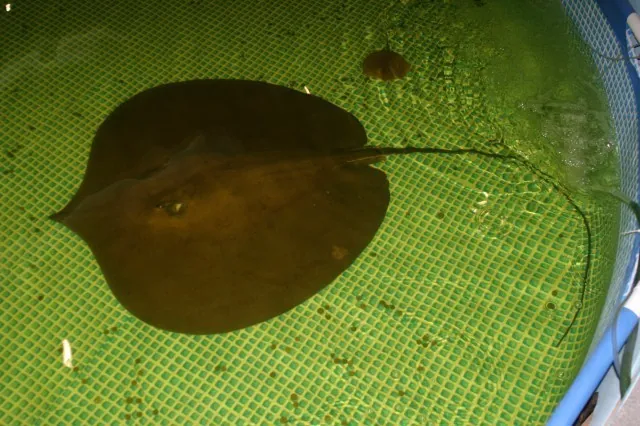
The giant freshwater stingray is a large ray that lives in big rivers and estuaries in Southeast Asia and Borneo. It is the widest freshwater fish in the world, and it is now endangered because of fishing and habitat loss. It has a long, whip-like tail with a sharp spine near the base.1
 How to recognise it
- Plain grayish brown on top, often with a yellowish or pinkish tint towards the fin edges1
- White underside with broad dark bands on the rear edges of the pectoral and pelvic fins1
- Thin, whip-like tail that is black behind the spine and has no fin folds1
- Sharply pointed snout that projects beyond the disc1
- A single serrated stinging spine on the upper tail near its base, up to 38 cm long1
Often confused with: Similar freshwater stingrays in South Asia, Southeast Asia and Australasia were once tentatively grouped with this species. Some of them, such as the Australian Urogymnus dalyensis, are now described as separate species.1
Venom power
Venom comes out through a stinger.
What does its venom do?
Its sting is sheathed in toxic mucus. The sting is capable of piercing bone.1
How dangerous is it to people?
Danger to people: SeriousA sting needs a doctor. Deaths are very rare.The giant freshwater stingray is not aggressive. Its sting is strong enough to pierce bone and is coated in toxic mucus, so it should be treated with care.1
 If it stings
Always call your emergency number first (for example 112 in Europe, 911 in North America, 000 in Australia).
- Get out of the water and soak the wound in hot water, as hot as the person can stand without scalding (about 45 °C), for 30 to 90 minutes. Do not pull out a spine stuck deep in the body. See a doctor, as wounds often need cleaning, X-rays and a tetanus shot. Call the emergency number for a chest or belly wound or heavy bleeding.1
- Put the wound in hot water, about 45 °C: as hot as the helper can comfortably hold their own hand in, never hotter, for 30 to 90 minutes. Get medical help, especially for stonefish and stingrays.
This is general first aid guidance, not medical advice. Based on the first aid guidelines of the World Health Organization and the Australian Resuscitation Council. Facts come from public sources and may contain mistakes. When in doubt, always get medical help. First aid basics
 Stay safe
- Never touch, catch or tease a wild animal, even a small one, and even if it looks asleep or dead.
- Give it space. If you meet one, stay calm, step back slowly and let it go its own way.
- If one stings you: stay calm, keep still, call your emergency number (for example 112 in Europe, 911 in North America, 000 in Australia) or get to a hospital fast. Remember what it looked like, a photo helps.
It is not out to get you. It uses its venom to catch food or to protect itself, and it would much rather hide. More about staying safe
Where in the world?
How big is it?
How long is it?
How heavy is it?
 as long as 5 dogs nose to tail
 as long as 28 bananas end to end
 could swim the length of a big swimming pool (50 m) in 6 seconds
How big is Giant freshwater stingray compared to you?
Just maths in your browser. Nothing is saved or sent anywhere.
How fast is it?

Facts
In June 2022, a specimen caught in the Mekong River was reported as the largest strict freshwater fish ever documented, at about 300 kg.1
It is the widest freshwater fish in the world, growing up to 2.2 m across.1
Its tail spine is up to 38 cm long, the largest of any stingray species.1
Pups are nourished in the womb by a milk-like substance called histotroph, or 'uterine milk', made by the mother.1
In Cambodia, the average weight of a landed ray fell from 23.2 kg in 1980 to 6.9 kg in 2006.1
For venom experts
- Scientific name
- Urogymnus polylepis
- Group
- Venomous fish
- Also called
- Giant Freshwater Whipray, River Stingray, Giant Stingray1
- Family
- Dasyatidae2
- Order
- Myliobatiformes
- Continents
- Asia
- Babies
- It gives birth to live young. Females have litters of one to four pups, each about 30 cm across at birth.1
- How it is doing in the wild
- Endangered (IUCN overall); Critically Endangered in Thailand1
- Danger to people
- 3 / 5: Serious3
Where the facts come from
- Giant freshwater stingray (Wikipedia (CC BY-SA 4.0))
- Urogymnus polylepis (iNaturalist): names and classification.
- Venom Wiki: the danger level, the typical size and the speed guess are our own. See how we work them out: How we rate danger.
Every fact on this page has a number that points to its source. If we got something wrong, sorry, we are animal fans, not a science journal. Tell us at [email protected] and we will fix it.
Get the Venom Wiki app
Every creature, every picture and the games in your pocket, even without internet.


 Support Venom Wiki Venom Wiki is a one-man project: free, with no ads and no cookies. A small tip helps keep it online.Feed the scorpion
 Walking catfish
 Asian stinging catfish
 Reef stonefish
 Red lionfish
 Estuarine stonefish
 Short-tail stingray
 Indian cobra
 Indian saw-scaled viper
 King cobra
 Puff adder
 Russell's viper
 Asian giant hornet