
 Bitten or stung?
 All animals
 Pick a continent
 Africa
 Asia
 Europe
 South America
 Australia & Oceania
 Antarctica
 Pacific Ocean
 Atlantic Ocean
 Indian Ocean
 Arctic Ocean
 Mediterranean Sea
 Red Sea
 Caribbean Sea
 Coral Sea
 South China Sea
 Philippine Sea
 Andaman Sea
 North Sea
 Timor & Arafura Sea
 Bay of Bengal
 Gulf of California
 Games
 Venom battle
 Animal race
 Field notebook
 Venom TOP lists
 Stay safe
 Surprise me

Giant golden orb-weaver
 Bites
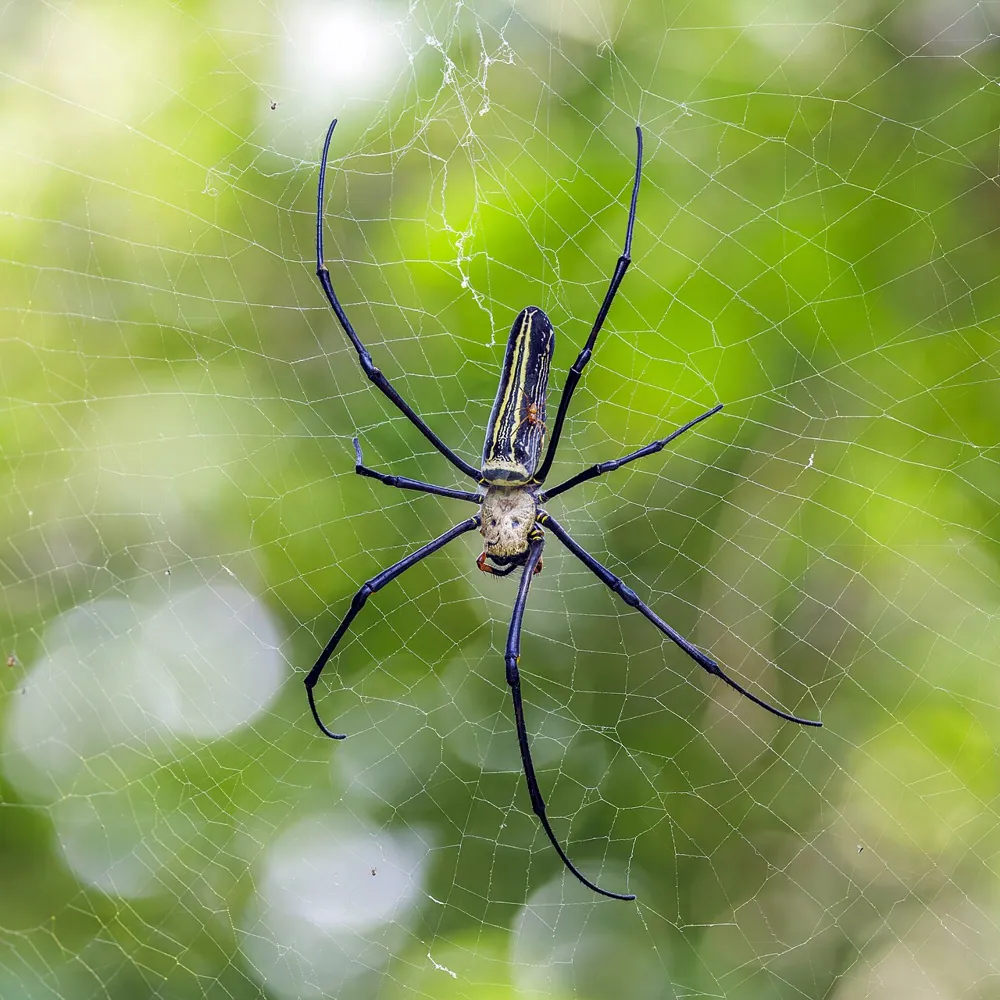
The giant golden orb-weaver is a large spider found across East and Southeast Asia and in Oceania. Adult females have bodies up to 50 mm long, while the males are tiny by comparison. Its big, yellowish webs are often seen in forests and against buildings.1
 How to recognise it
- Adult females are very large, with a body length of 25 to 50 mm.1
- The abdomen is mostly dark yellow-brown with yellow stripes.1
- The legs are long and black and yellow.1
- Females have a horn-like bulge on the back of the body (tergum).1
- Males are tiny, measuring about 4 to 6 mm, with light brown legs.1
Often confused with: Trichonephila clavata has no horn-like bulge on its back, which the giant golden orb-weaver does have. Nephila laurinae lacks the pair of yellow stripes at the back of the abdomen that this species has.1
Venom power
Venom comes out through its fangs or teeth when it bites.
How dangerous is it to people?
Danger to people: MildLike a bee sting or less. Basically harmless to people, unless the person is allergic. If it bites
Call your emergency number at once if the person has trouble breathing, swelling of the face or throat, or feels faint.
- Wash the bite and put an ice pack on it for the pain. Get medical help if the pain is strong, spreads or the person feels unwell.
This is general first aid guidance, not medical advice. Based on the first aid guidelines of the World Health Organization and the Australian Resuscitation Council. Facts come from public sources and may contain mistakes. When in doubt, always get medical help. First aid basics
 Stay safe
- Never touch, catch or tease a wild animal, even a small one, and even if it looks asleep or dead.
- Give it space. If you meet one, stay calm, step back slowly and let it go its own way.
- If it hurts you: wash the spot, stay calm and get medical help if the pain is strong or spreads, or the person feels unwell.
It is not out to get you. It uses its venom to catch food or to protect itself, and it would much rather hide. More about staying safe
Where in the world?
How big is it?
How long is it?
 shorter than your little finger
 could cover 100 metres in 130 seconds (the fastest human needs 9.6)
How big is Giant golden orb-weaver compared to you?
Just maths in your browser. Nothing is saved or sent anywhere.
How fast is it?


Facts
Its silk is more robust than most human-made materials, which has drawn attention from materials scientists.1
Males can be 4 to 10 times smaller than the females, one of the biggest size differences among land animals.1
Adult females keep growing by moulting after they mature, which most spiders do not do.1
Females do not shed their genitals when they moult, so they can keep collecting sperm.1
When temperatures rise above 40 °C, it will abandon its web.1
For venom experts
- Scientific name
- Nephila pilipes
- Group
- Spiders
- Also called
- Northern golden orb weaver, Giant golden orbweaver, Large woodland spider1
- Family
- Nephilidae2
- Order
- Araneae
- Continents
- Asia, Australia & Oceania
- Babies
- Females do not hang egg sacs in the web. Instead they dig a pit, lay eggs in it and cover it with plant debris or soil. Adult females lay eggs continuously.1
- Danger to people
- 1 / 5: Mild3
Where the facts come from
- Nephila pilipes (Wikipedia (CC BY-SA 4.0))
- Nephila pilipes (iNaturalist): names and classification.
- Venom Wiki: the danger level, the typical size and the speed guess are our own. See how we work them out: How we rate danger.
Every fact on this page has a number that points to its source. If we got something wrong, sorry, we are animal fans, not a science journal. Tell us at [email protected] and we will fix it.
Get the Venom Wiki app
Every creature, every picture and the games in your pocket, even without internet.


 Support Venom Wiki Venom Wiki is a one-man project: free, with no ads and no cookies. A small tip helps keep it online.Feed the scorpion
 Redback spider
 Katipo
 Mediterranean black widow
 Diving bell spider
 European yellow sac spider
 Noble false widow
 Indian cobra
 Indian saw-scaled viper
 King cobra
 Puff adder
 Russell's viper
 Asian giant hornet
