
 Bitten or stung?
 All animals
 Pick a continent
 Africa
 Asia
 Europe
 South America
 Australia & Oceania
 Antarctica
 Pacific Ocean
 Atlantic Ocean
 Indian Ocean
 Arctic Ocean
 Mediterranean Sea
 Red Sea
 Caribbean Sea
 Coral Sea
 South China Sea
 Philippine Sea
 Andaman Sea
 North Sea
 Timor & Arafura Sea
 Bay of Bengal
 Gulf of California
 Games
 Venom battle
 Animal race
 Field notebook
 Venom TOP lists
 Stay safe
 Surprise me

Painted mantella
 Poison in its skin
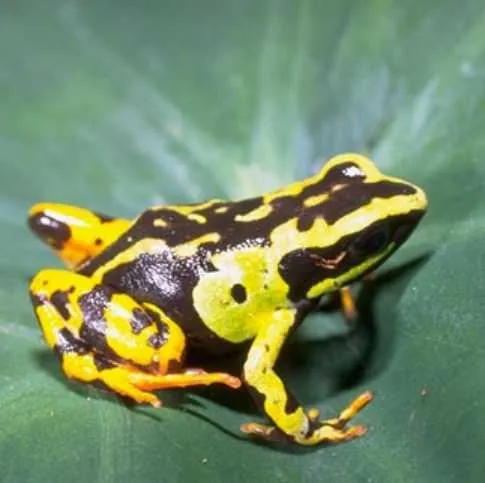
The painted mantella is a tiny, stout frog with bright yellow, green and reddish-orange markings. It lives only on Madagascar, in forests and along streams. Its skin contains toxic chemicals, so it is best left alone.1
 How to recognise it
- Body is usually blackish, with the back commonly black.1
- A green or yellowish stripe runs along the head.1
- Thighs and upper arms are usually yellow to green, while the lower legs and feet are reddish-orange with blackish patches.1
- Yellow-green blotches extend to the sides of the body close to the front legs.1
- Markings are irregular and vary a lot, with black and yellow streaks.1
Often confused with: It is closely related to Mantella pulchra and very similar to Mantella baroni. Some authors think Mantella madagascariensis is actually a group of hidden species that look alike.1
Poison power
Its skin is poisonous. It is dangerous to touch, lick or eat.
What does its poison do?
It is poisonous rather than venomous, so it does not inject venom. Its skin contains several toxic alkaloids, which are harmful chemicals that can affect the body.1
How dangerous is it to people?
Danger to people: MildLike a bee sting or less. Basically harmless to people, unless the person is allergic. If someone touched or ate it
Call your emergency number at once if the person has trouble breathing, swelling of the face or throat, or feels faint.
- If someone touched one: wash the hands well and do not touch the eyes or mouth. If a child or pet licked or ate one: call your poison centre or emergency number.
This is general first aid guidance, not medical advice. Based on the first aid guidelines of the World Health Organization and the Australian Resuscitation Council. Facts come from public sources and may contain mistakes. When in doubt, always get medical help. First aid basics
 Stay safe
- Never touch, catch or tease a wild animal, even a small one, and even if it looks asleep or dead.
- Give it space. If you meet one, stay calm, step back slowly and let it go its own way.
- If you touched or ate it: do not rub your eyes or mouth, wash your hands and get medical help.
It is not out to get you. Its poison is only there so that nothing eats it. More about staying safe
Where in the world?
How big is it?
How long is it?
 about as long as a paper clip
 could cover 100 metres in 100 seconds (the fastest human needs 9.6)
How big is Painted mantella compared to you?
Just maths in your browser. Nothing is saved or sent anywhere.
How fast is it?


Facts
Its skin contains several toxic alkaloids, and all Mantella species share this feature.1
Breeding takes place in streams, but the females lay their eggs on land.1
The frogs are active on the ground during the day.1
Some scientists think this frog may be a complex of cryptic species, meaning several separate species that look almost identical.1
For venom experts
- Scientific name
- Mantella madagascariensis
- Group
- Poison frogs, toads & newts
- Also called
- Malagasy painted mantella, Madagascan mantella, Madagascar golden frog1
- Family
- Mantellidae2
- Order
- Anura
- Continents
- Africa
- Babies
- Females lay eggs on land, and the young (larvae) develop in water in streams.1
- Danger to people
- 1 / 5: Mild3
Where the facts come from
- Madagascan mantella (Wikipedia (CC BY-SA 4.0))
- Mantella madagascariensis (iNaturalist): names and classification.
- Venom Wiki: the danger level, the typical size and the speed guess are our own. See how we work them out: How we rate danger.
Every fact on this page has a number that points to its source. If we got something wrong, sorry, we are animal fans, not a science journal. Tell us at [email protected] and we will fix it.
Get the Venom Wiki app
Every creature, every picture and the games in your pocket, even without internet.


 Support Venom Wiki Venom Wiki is a one-man project: free, with no ads and no cookies. A small tip helps keep it online.Feed the scorpion
 Golden mantella
 Iberian ribbed newt
 Tomato frog
 African common toad
 Baron's mantella
 Blue-legged mantella
 Black mamba
 Deathstalker
 Egyptian cobra
 Puff adder
 Boomslang
 Fat-tailed scorpion
