
 Bitten or stung?
 All animals
 Pick a continent
 Africa
 Asia
 Europe
 South America
 Australia & Oceania
 Antarctica
 Pacific Ocean
 Atlantic Ocean
 Indian Ocean
 Arctic Ocean
 Mediterranean Sea
 Red Sea
 Caribbean Sea
 Coral Sea
 South China Sea
 Philippine Sea
 Andaman Sea
 North Sea
 Timor & Arafura Sea
 Bay of Bengal
 Gulf of California
 Games
 Venom battle
 Animal race
 Field notebook
 Venom TOP lists
 Stay safe
 Surprise me

Southern stingray
 Stings
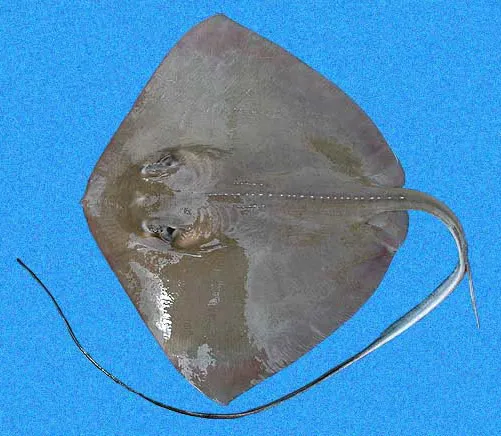
The southern stingray is a flat, diamond-shaped fish that lives on the sea bed in warm waters of the western Atlantic Ocean. It hides under sand and mud and is famous for the venomous spine on its tail. Divers and snorkellers often meet it in the Caribbean.1
 How to recognise it
- A flat, diamond-shaped body that is more angular than other rays1
- Top of the body is olive brown or green in adults and dark grey in juveniles1
- Underside is white1
- A slender tail with a long, serrated, venomous spine at the base1
- Eyes sit on top of the head, with small breathing openings called spiracles behind them1
Venom power
Venom comes out through a stinger.
What does its venom do?
The barb on the tail is covered in venomous mucus. Stepping on one causes intense pain. Deaths are very rare and happen only when the spine goes deep into the chest or belly.1
How dangerous is it to people?
Danger to people: SeriousA sting needs a doctor. Deaths are very rare.The spines are very rarely deadly to humans, but they are incredibly painful if stepped on. They are used to defend the stingray against predators, including humans.1
What does it do when it is scared?
It buries itself in the sea bed to avoid predators and uses its venomous tail spines to drive them off.1
 If it stings
Always call your emergency number first (for example 112 in Europe, 911 in North America, 000 in Australia).
- Call the emergency number at once. Put the stung foot or hand in hot water, as hot as the person can stand without burning (test it with your own hand first), for 30 to 90 minutes. Every stingray wound needs a doctor, because pieces of the spine can stay inside and the wound can get infected.1
- Put the wound in hot water, about 45 °C: as hot as the helper can comfortably hold their own hand in, never hotter, for 30 to 90 minutes. Get medical help, especially for stonefish and stingrays.
This is general first aid guidance, not medical advice. Based on the first aid guidelines of the World Health Organization and the Australian Resuscitation Council. Facts come from public sources and may contain mistakes. When in doubt, always get medical help. First aid basics
 Stay safe
- Never touch, catch or tease a wild animal, even a small one, and even if it looks asleep or dead.
- Give it space. If you meet one, stay calm, step back slowly and let it go its own way.
- If one stings you: stay calm, keep still, call your emergency number (for example 112 in Europe, 911 in North America, 000 in Australia) or get to a hospital fast. Remember what it looked like, a photo helps.
It is not out to get you. It uses its venom to catch food or to protect itself, and it would much rather hide. More about staying safe
Where in the world?
How big is it?
How long is it?
 as long as 3 house cats nose to tail
 as long as 8 bananas end to end
 could swim the length of a big swimming pool (50 m) in 8.2 seconds
How big is Southern stingray compared to you?
Just maths in your browser. Nothing is saved or sent anywhere.
How fast is it?

Facts
In shallow waters, birds follow the stingrays as they dig, eating the fish that the stingrays uncover.1
Its eyes and breathing openings sit on top of its head, so it can take in water while lying on the sea bed or buried in sand.1
It senses hidden prey through Ampullae of Lorenzini, which pick up the electric fields that prey give off.1
It is nocturnal, so most of its hunting happens at night.1
Female southern stingrays grow much larger than males.1
For venom experts
- Scientific name
- Hypanus americanus
- Group
- Venomous fish
- Family
- Dasyatidae2
- Order
- Myliobatiformes
- Continents
- Atlantic Ocean, Gulf of Mexico, Caribbean Sea, The oceans
- Babies
- It gives live birth after a pregnancy lasting about seven to eight months. In captivity, a litter of two to ten young has been recorded.1
- Danger to people
- 3 / 5: Serious3
Where the facts come from
- Southern stingray (Wikipedia (CC BY-SA 4.0))
- Hypanus americanus (iNaturalist): names and classification.
- Venom Wiki: the danger level, the typical size and the speed guess are our own. See how we work them out: How we rate danger.
Every fact on this page has a number that points to its source. If we got something wrong, sorry, we are animal fans, not a science journal. Tell us at [email protected] and we will fix it.
Get the Venom Wiki app
Every creature, every picture and the games in your pocket, even without internet.


 Support Venom Wiki Venom Wiki is a one-man project: free, with no ads and no cookies. A small tip helps keep it online.Feed the scorpion
More from the same group: Venomous fish
 Reef stonefish
 Red lionfish
 Estuarine stonefish
 Short-tail stingray
 Bluespotted ribbontail ray
 Common stingray

Also lives in: Atlantic Ocean
 Hawksbill sea turtleOther poisonous animalsCan kill
 Portuguese man o' warJellyfish & sea stingersNeeds a doctorDo not touch
 Blue sea dragonCone snails & octopusesPainful
 Greenland sharkOther poisonous animalsPainful
 Lion's mane jellyfishJellyfish & sea stingersPainfulDo not touch
 Common octopusCone snails & octopusesMild