
 África
 Asia
Asia Europa
 Sudamérica
 Australia y Oceanía
 Antártida
 Océano Pacífico
 Océano Atlántico
 Océano Índico
 Océano Ártico
 Mar Mediterráneo
 Mar Rojo
 Mar Caribe
 Mar del Coral
 Mar de China Meridional
 Mar de Filipinas
 Mar de Andamán
 Mar del Norte
 Mar de Timor y de Arafura
 Golfo de Bengala
 Golfo de California
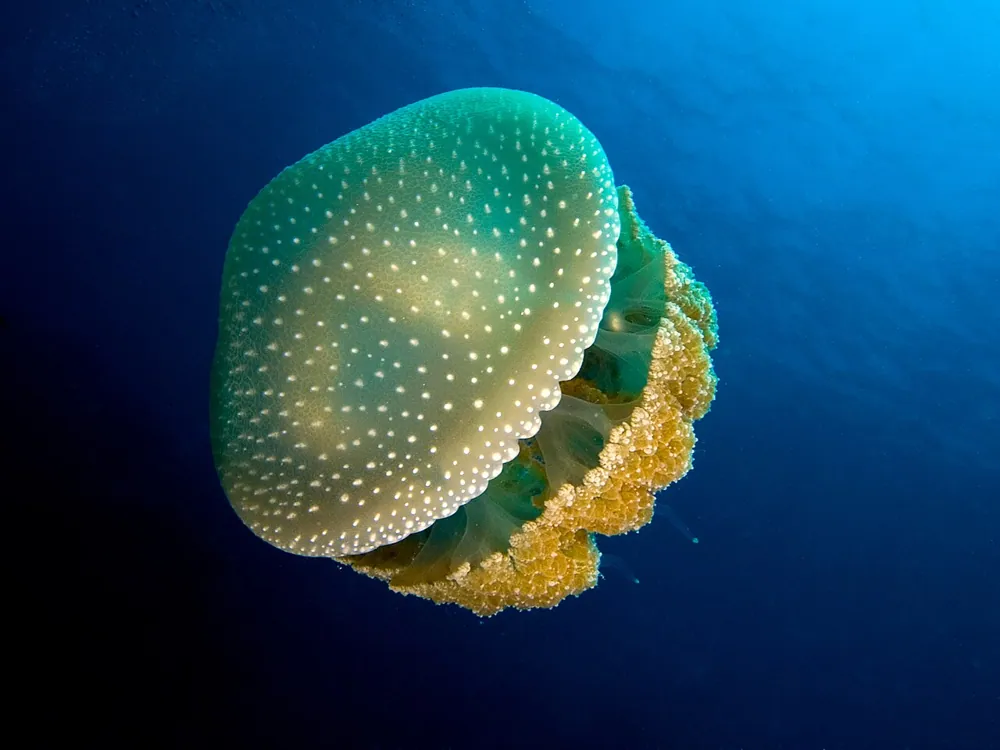
Australian spotted jellyfish
 Tentáculos urticantes
The Australian spotted jellyfish is a jellyfish with a bell up to 50 cm wide. It is native to the western Pacific, from Australia to Japan, but has spread to many other seas. Its sting is mild and it is not considered a threat to people, but large groups can cause problems for fishing and local sea life.1

 Cómo reconocerlo
Poder del veneno
Miles de células urticantes diminutas se disparan cuando algo las toca.
¿Qué hace su veneno?
It has only a mild venom. The venom is not strong enough to kill its prey, which is why it catches food by filtering rather than by stunning it.1
¿Qué peligro tiene para las personas?
Peligro para las personas: LeveComo una picadura de abeja o menos. Prácticamente inofensivo para las personas.It is not considered a threat to humans, and its sting is mild or hard to notice. It does cause harm to fishing industries, where it eats fish, crab and shrimp eggs and larvae and clogs nets.1
 Si pica
- The sting can be treated with a dilute acid, usually white or cider vinegar.1
- Sal del agua y quita los tentáculos que queden (con guantes o un trapo).
- Para las cubomedusas tropicales: echa vinagre sobre las picaduras al menos 30 segundos, pide ayuda y prepárate para hacer RCP. Para fragatas portuguesas y la mayoría de las demás: aclara con agua de mar y luego agua caliente para el dolor.
Llama siempre primero a tu número de emergencias (112, 000, 911). Esto son pautas generales de primeros auxilios, no consejo médico. Primeros auxilios básicos
 Mantente a salvo
- Nunca toques, atrapes ni molestes a un animal salvaje, aunque sea pequeño y aunque parezca dormido o muerto.
- Déjale espacio. Si te encuentras uno, mantén la calma, retrocede despacio y deja que siga su camino.
- Si te pica: mantén la calma, no te muevas, llama a tu número de emergencias (112, 000, 911) o ve rápido a un hospital. Recuerda cómo era, una foto ayuda.
No va a por ti. Usa su veneno para cazar o defenderse, y prefiere mil veces esconderse. Más sobre cómo protegerte
¿En qué parte del mundo?
¿Qué tamaño tiene?
¿Cuánto mide?
 mide como 3 plátanos puestos en fila
 mide como 16 piezas de construcción de juguete en fila
 podría nadar el largo de una piscina grande (50 m) en 150 segundos
¿Qué tamaño tiene Australian spotted jellyfish comparado contigo?
Solo cálculos en tu navegador. No se guarda ni se envía nada a ningún sitio.
¿Qué velocidad alcanza?

_edit.jpg)
Datos
Each jellyfish can filter as much as 50,000 litres of seawater per day.1
One individual found on Sunset Beach, North Carolina, in October 2007 measured 74 cm wide, perhaps the largest ever recorded.1
Large swarms can clog fishing nets, damage boat intakes and sometimes force fishing areas to close.1
Its polyps can multiply by dividing into other polyps, which makes a larger group than the one the mother started with.1
Its polyp stage can last up to five years, and its adult stage up to two years.1
In the Gulf of Mexico, medusae grow unusually large, reaching more than 60 cm across.1
Cazamitos
Mito: It is a dangerous jellyfish that is a serious threat to people.
Verdad: It has only a mild venom and is not considered a threat to humans. Its main harm is to fishing and the local ecosystem, where it eats large amounts of zooplankton.1
Para expertos en veneno
- Nombre científico
- Phyllorhiza punctata
- Grupo
- Medusas y picadores marinos
- Familia
- Mastigiidae2
- Orden
- Rhizostomeae
- Continentes
- Océano Pacífico, Océano Índico, Mar del Coral, Océano Atlántico, Mar Caribe, Golfo de México, Mar de Timor y de Arafura, Los océanos
- Crías
- Males release sperm into the water, and the female gathers it into her mouth, where she holds the fertilised eggs. The larvae settle on the seabed and grow into polyps, which reproduce by cloning themselves.1
- Peligro para las personas
- 1 / 5: Leve3
De dónde salen los datos
- Phyllorhiza punctata (Wikipedia (CC BY-SA 4.0))
- Phyllorhiza punctata (iNaturalist): nombres y clasificación.
- Venom Wiki: el nivel de peligro, el tamaño típico y la velocidad estimada son nuestros. Mira cómo los calculamos: Cómo valoramos el peligro.
Cada dato de esta página tiene un número que lleva a su fuente. Si nos hemos equivocado en algo, perdón, somos fans de los animales, no una revista científica. Escríbenos a [email protected] y lo arreglamos.
 ¡El escorpión tiene hambre! Venom Wiki es un proyecto de una sola persona: gratis, sin anuncios y sin rastreadores. Una pequeña propina ayuda a mantenerlo en línea.Alimenta al escorpión
Más del mismo grupo: Medusas y picadores marinos
 Avispa de marMedusas y picadores marinosMortalNo tocar
 Irukandji jellyfishMedusas y picadores marinosPuede matarNo tocar
 Portuguese man o' warMedusas y picadores marinosNecesita médicoNo tocar
 Lion's mane jellyfishMedusas y picadores marinosSolo dueleNo tocar
 Moon jellyfishMedusas y picadores marinosInofensivo
 Common kingslayerMedusas y picadores marinosPuede matarNo tocar
También vive en: Océano Pacífico
 Cono geógrafoCaracoles cono y pulposMortal
 Pulpo de anillos azules mayorCaracoles cono y pulposMortal
 Pez globo tigreOtros animales tóxicosMortal
 Pulpo de anillos azules del surCaracoles cono y pulposMortal
 Hawksbill sea turtleOtros animales tóxicosPuede matar
 Reef stonefishPeces venenososPuede matarNo tocar