
 África
 Asia
Asia Europa
 Sudamérica
 Australia y Oceanía
 Antártida
 Océano Pacífico
 Océano Atlántico
 Océano Índico
 Océano Ártico
 Mar Mediterráneo
 Mar Rojo
 Mar Caribe
 Mar del Coral
 Mar de China Meridional
 Mar de Filipinas
 Mar de Andamán
 Mar del Norte
 Mar de Timor y de Arafura
 Golfo de Bengala
 Golfo de California
Striped pyjama squid
 Veneno en la piel
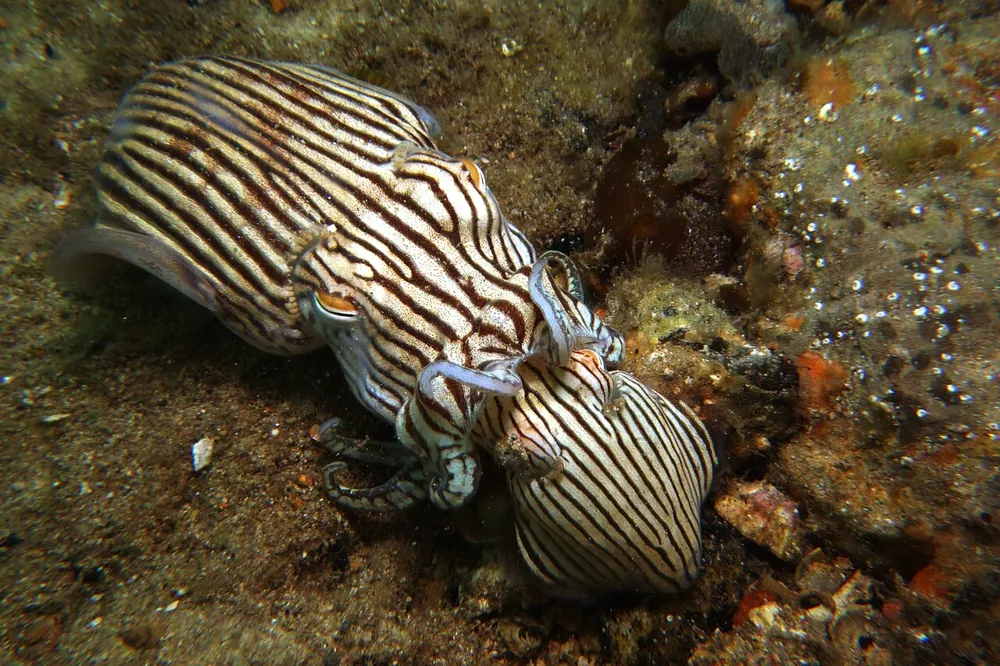
The striped pyjama squid is a small squid that lives on the seafloor in the Indo-Pacific waters of Australia. It hides by burying itself in the sand, with only the top of its head and its yellow eye showing. Its saliva contains a toxin, which makes it a squid to leave alone.1



 Cómo reconocerlo
- White and brown stripes run across its whole body.1
- It can change to dark brown or purple, to match its surroundings or when attacked.1
- It has a yellow eye, and only the top of its head shows above the sand.1
- It has two feeding tentacles and eight arms, with finger-like tendrils around the mantle opening.1
- Adults are about 7 to 8 cm long. It has no shell.1
Poder tóxico
Su piel es venenosa. Es peligroso tocarlo, lamerlo o comerlo.
¿Qué hace su toxina?
Its saliva contains tetrodotoxin, a neurotoxin, which is a poison that attacks the nerves. The squid also has glands under its body that release a toxic slime when it is attacked.1
¿Qué peligro tiene para las personas?
Peligro para las personas: LeveComo una picadura de abeja o menos. Prácticamente inofensivo para las personas.¿Qué hace cuando se asusta?
When attacked, it can release toxic slime to scare off predators or give it time to escape, and it can release ink that can mimic its shape to distract a predator.1
 Si alguien lo tocó o se lo comió
- Inmovilización con presión: envuelve con una venda elástica firme la mordedura y luego toda la extremidad, ponle una férula y mantén a la persona totalmente quieta hasta que llegue la ayuda.
- Un pulpo de anillos azules o un caracol cono pueden dejar a una persona sin respirar estando todavía despierta: pide ayuda y prepárate para dar respiraciones de rescate hasta que llegue la ambulancia.
Llama siempre primero a tu número de emergencias (112, 000, 911). Esto son pautas generales de primeros auxilios, no consejo médico. Primeros auxilios básicos
 Mantente a salvo
- Nunca toques, atrapes ni molestes a un animal salvaje, aunque sea pequeño y aunque parezca dormido o muerto.
- Déjale espacio. Si te encuentras uno, mantén la calma, retrocede despacio y deja que siga su camino.
- Si lo tocaste o te lo comiste: no te frotes los ojos ni la boca, lávate las manos y busca ayuda médica.
No va a por ti. Su veneno solo está ahí para que nadie se lo coma. Más sobre cómo protegerte
¿En qué parte del mundo?
¿Qué tamaño tiene?
¿Cuánto mide?
 mide como 2,5 piezas de construcción de juguete en fila
 podría nadar el largo de una piscina grande (50 m) en 12 segundos
¿Qué tamaño tiene Striped pyjama squid comparado contigo?
Solo cálculos en tu navegador. No se guarda ni se envía nada a ningún sitio.
¿Qué velocidad alcanza?


Datos
The male uses a spoon-shaped arm to remove sperm from another male if he finds it in the female.1
It can change its colour to dark brown or purple when attacked or to blend in with its surroundings.1
Its white stripes reflect white light, while its dark stripes are tiny pigment sacs called chromatophores that it can flash.1
It buries itself in the sand during the day and keeps flicking sand over its body to stay hidden.1
Worm-like parasites called dicyemids live inside it and feed on its urine.1
Like many members of its order, the male usually dies after mating.1
Para expertos en veneno
- Nombre científico
- Sepioloidea lineolata
- Grupo
- Caracoles cono y pulpos
- Familia
- Sepiadariidae2
- Orden
- Sepiolida
- Continentes
- Océano Índico, Océano Pacífico, Mar del Coral, Los océanos
- Crías
- Females lay their eggs in batches or clumps under coral on the seafloor, soon after mating.1
- Peligro para las personas
- 1 / 5: Leve3
De dónde salen los datos
- Sepioloidea lineolata (Wikipedia (CC BY-SA 4.0))
- Sepioloidea lineolata (iNaturalist): nombres y clasificación.
- Venom Wiki: el nivel de peligro, el tamaño típico y la velocidad estimada son nuestros. Mira cómo los calculamos: Cómo valoramos el peligro.
Cada dato de esta página tiene un número que lleva a su fuente. Si nos hemos equivocado en algo, perdón, somos fans de los animales, no una revista científica. Escríbenos a [email protected] y lo arreglamos.
 ¡El escorpión tiene hambre! Venom Wiki es un proyecto de una sola persona: gratis, sin anuncios y sin rastreadores. Una pequeña propina ayuda a mantenerlo en línea.Alimenta al escorpión
Más del mismo grupo: Caracoles cono y pulpos
 Cono geógrafoCaracoles cono y pulposMortal
 Pulpo de anillos azules mayorCaracoles cono y pulposMortal
 Pulpo de anillos azules del surCaracoles cono y pulposMortal
 Blue sea dragonCaracoles cono y pulposSolo duele
 Common octopusCaracoles cono y pulposInofensivo
 Giant Pacific octopusCaracoles cono y pulposInofensivo
También vive en: Océano Índico
 Avispa de marMedusas y picadores marinosMortalNo tocar
 Hawksbill sea turtleOtros animales tóxicosPuede matar
 Irukandji jellyfishMedusas y picadores marinosPuede matarNo tocar
 Reef stonefishPeces venenososPuede matarNo tocar
 Crown-of-thorns starfishErizos, estrellas y gusanosNecesita médicoNo tocar
 Portuguese man o' warMedusas y picadores marinosNecesita médicoNo tocar