
 Afrika
 Asia
Asia Europa
 Hego Amerika
 Australia eta Ozeania
 Antartika
 Ozeano Barea
 Ozeano Atlantikoa
 Ozeano Indikoa
 Ozeano Artikoa
 Mediterraneo itsasoa
 Itsaso Gorria
 Karibe itsasoa
 Koralen itsasoa
 Hego Txinako itsasoa
 Filipinetako itsasoa
 Andaman itsasoa
 Ipar itsasoa
 Timor eta Arafura itsasoak
 Bengalako golkoa
 Kaliforniako golkoa
Common desert centipede
 Koska
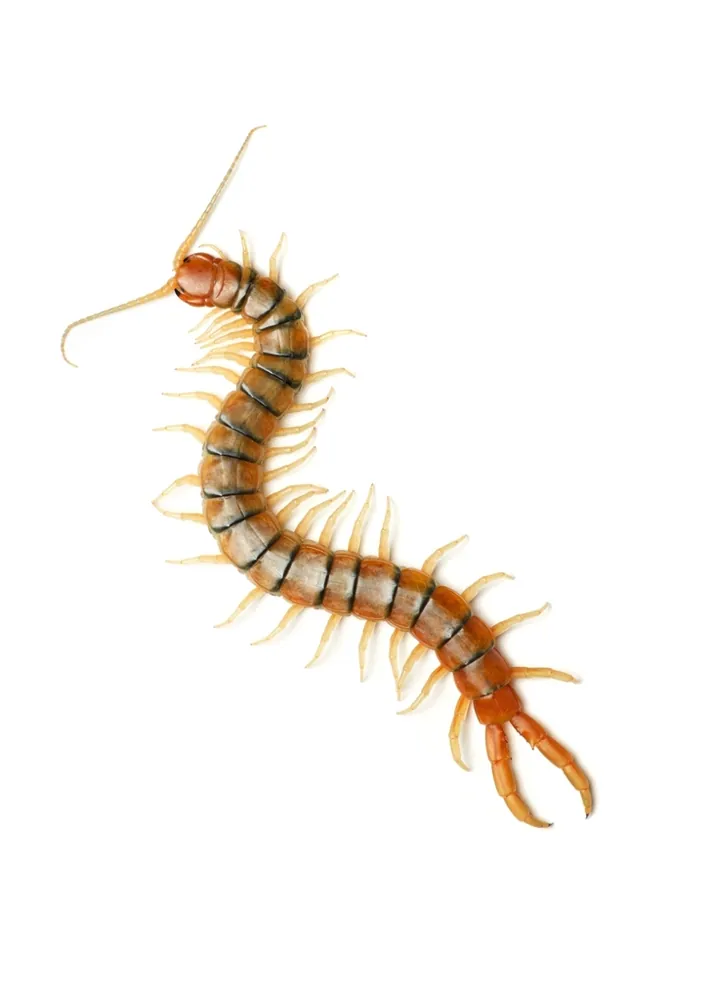
KoskaThe common desert centipede is a large centipede that lives in the deserts and dry grasslands of western North America. It is known for its striped body and for its venom, which scientists are studying for possible medical uses.1
 Nola ezagutu
- Adults usually measure 10 to 18 cm long.1
- Each body segment has one dark stripe along its side, which gives it the name tiger centipede.1
- Most have a darker brown, red or orange head, lighter brown, tan or orange body segments and yellow legs.1
- Some populations, such as those in Southern California, are entirely light blue with indigo stripes and turquoise legs.1
- Its antennae have seven or more smooth segments.1
Pozoi-ahalmena
Pozoia letaginetatik edo hortzetatik ateratzen da kosk egiten duenean.
Zer egiten du bere pozoiak?
Its venom contains a peptide called SPC13 that kills or slows some bacteria, including Staphylococcus aureus and Pseudomonas aeruginosa. In studies on mice, the venom damaged muscle, causing tissue death and abnormal mitochondria (the parts of cells that make energy). It may also affect the respiratory complexes, the chemical systems cells use to make energy, of the animals it hunts.1
Zein arriskutsua da pertsonentzat?
Arriskua pertsonentzat: MingarriaBenetan min handia eman dezake, baina ia inoiz ez da larria.Zer egiten du beldurtzen denean?
Its venom is used to defend itself, but it cannot fully rebuild its venom within 48 hours, which limits how well it can defend itself.1
 Kosk egiten badu
- Garbitu koska, hoztu edo sartu ur epelean minerako, eta lortu mediku-laguntza okerrera egiten badu.
Deitu beti lehenik zure larrialdi-zenbakira (112, 000, 911). Lehen sorospenei buruzko orientabide orokorra da hau, ez mediku-aholkua. Lehen sorospenen oinarriak
 Egon seguru
- Ez ukitu, ez harrapatu eta ez zirikatu inoiz animalia basati bat, txikia izan arren, eta lo edo hilda dagoela badirudi ere.
- Utzi tartea. Bat aurkitzen baduzu, egon lasai, egin atzera poliki eta utzi bere bidetik joaten.
- Batek kosk egiten badizu: egon lasai, egon geldi, deitu zure larrialdi-zenbakira (112, 000, 911) edo joan ospitalera azkar. Gogoratu nolakoa zen, argazki batek laguntzen du.
Ez dabil zure atzetik. Pozoia janaria harrapatzeko edo bere burua babesteko erabiltzen du, eta askoz nahiago du ezkutatu. Seguru egoteari buruz gehiago
Munduko zein tokitan?
Zein handia da?
Zein luzea da?
 6 eraikuntza-bloke ilaran jarrita bezain luzea
 100 metro 220 segundotan egin litzake (gizakirik azkarrenak 9,6 behar ditu)
Zein handia da Common desert centipede ZUREKIN alderatuta?
Matematika hutsa zure nabigatzailean. Ez da ezer gordetzen, ezta inora bidaltzen ere.
Zein azkarra da?


Datuak
Its venom contains a peptide that has shown antimicrobial activity against bacteria that cause hospital infections.1
Within two days it regenerates 65 to 86% of its venom volume, but its venom levels do not return to their original amounts even after 7 months.1
The bigger the centipede, the slower its venom regenerates, so body size limits how quickly it can recover its venom.1
Its colours are so varied that its species name, polymorpha, means "many forms".1
It is most active at night during the cool winter months, or during the summer New Mexico Monsoon, when it is cooler and wetter.1
Datuak nondik datozen
- Scolopendra polymorpha (Wikipedia (CC BY-SA 4.0))
- Scolopendra polymorpha (iNaturalist): izenak eta sailkapena.
- Venom Wiki: arrisku-maila, ohiko tamaina eta abiadura-kalkulua geureak dira. Ikusi nola kalkulatzen ditugun: Nola baloratzen dugun arriskua.
Orrialde honetako datu bakoitzak zenbaki bat du, bere iturrira eramaten zaituena. Zerbait gaizki badugu, barkatu, animalien zaleak gara, ez zientzia-aldizkari bat. Esaiguzu [email protected] helbidean eta konponduko dugu.
 Eskorpioia gose da! Venom Wiki pertsona bakar baten proiektua da: doakoa, iragarkirik eta jarraitzailerik gabe. Eskupeko txiki batek sarean mantentzen laguntzen du.Elikatu eskorpioia
Talde bereko gehiago: Ehunzangoak
 Giant desert centipedeEhunzangoakMin ematen du, besterik ez
 Green centipedeEhunzangoakMin ematen du, besterik ez
 Haitian giant centipedeEhunzangoakMin ematen du, besterik ez
 Eastern red centipedeEhunzangoakKaltegabea
 Florida blue centipedeEhunzangoakKaltegabea
 Peruvian giant centipedeEhunzangoakMedikua behar du
 Terciopelo
 Eastern coral snake
 Eastern diamondback rattlesnake
 Eyelash viper
 Timber rattlesnake
 Western diamondback rattlesnake